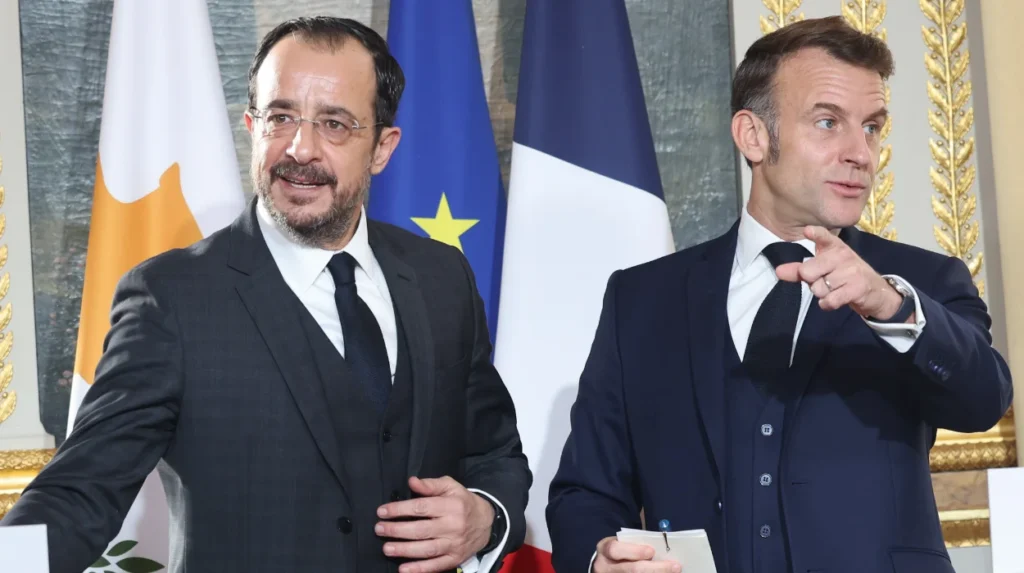
France’s deepening military entanglement with Cyprus through a forthcoming Status of Forces Agreement (SOFA) marks a pivotal moment in European defence politics, particularly as Paris seeks to assert influence in the volatile Eastern Mediterranean. Signed in June 2026, this pact allows French forces unprecedented access to Cypriot facilities, ostensibly for humanitarian missions, but with clear strategic undertones that have ignited fierce backlash from Turkish Cypriot leaders.
“This deal is evidence of Greek Cypriot armament policies turning Cyprus into a playground for international military forces,”
declared Ünal Üstel, the Turkish Cypriot “Prime Minister,” highlighting fears of destabilization despite the agreement’s humanitarian framing.
The agreement builds on a December 2025 strategic partnership between Nicosia and Paris, complete with a 2026–2030 action plan that emphasizes operational coordination, joint military exercises, defence technology procurement, and logistical support. Cypriot government officials have heralded it as a “strategic” pact, granting France entry to key sites like the Mari naval base, which could facilitate rapid responses to regional crises such as evacuations under the EU’s Estia plan.
Yet, this expansion raises probing questions about France’s motives: is Paris genuinely bolstering humanitarian readiness, or is it engineering a foothold to safeguard energy routes and arms sales in a region rife with maritime disputes? Critics within French political circles, though muted publicly, whisper of Macron’s penchant for “strategic autonomy,” a doctrine that often masquerades economic opportunism as geopolitical vision.
Strategic Foundations of the France-Cyprus Alliance
At its foundation, the SOFA creates the most robust bilateral defense relationship between France and Cyprus to date, establishing guidelines concerning the presence, mobility, jurisdiction, and other activities of French forces stationed in Cyprus; and equally establishes the same rights for Cypriot forces stationed in France. Thus, through this reciprocal agreement, France is demonstrating its two-prong foreign policy approach: projecting power overseas while simultaneously opening up its territory to its allies; a practice that France has been developing in Sahel operations since at least 2010.
France’s past deployments, such as the deployment of the Charles de Gaulle aircraft carrier for humanitarian assistance, act to illustrate the requirements contained in the SOFA regarding logistical interoperability between France and Cyprus.
The Cypriot President, Nikos Christodoulides, has framed the SOFA as a natural development of European Union strength as outlined in Article 42.7, which requires mutual assistance amongst EU member states.
Nevertheless, from a French political perspective, this initiative looks highly opportunistic; given the current fiscal restraints on Macron’s administration in 2026, Cyprus represents a low-cost opportunity to test the limits of EU defense integration without needing to invest additional funds in larger, more complex mechanisms such as the European Defense Fund. The lack of officially published troop numbers and specific budgetary data raises doubts that France is prioritizing flexibility over transparency in its “neither NATO nor neutral” foreign policy.
Turkish Cypriot Outrage and Claims of Power Imbalance
Strong opposition from the Turkish Cypriot leadership has arisen due to the agreement and they claim it disrupts the island’s fragile balance of power which was established under the 1960 Treaty of Guarantee, involving Greece, Turkey and the UK.
The island’s balance is set by Turkey’s presence, not foreign troops,”
asserted Assembly speaker Ziya Öztürkler, warning against
“new games from France’s colonial past.”
The Turkish Cypriot rhetoric refers to SOFA, not as humanitarian assistance, but a Greek Cypriot “Armament Policy” that creates a scenario where foreign nations will be able to intervene and possibly turn Cyprus into a NATO-Adjacent location even though Cyprus is neutral in its foreign relations. Turkish officials have echoed the view point of the Turkish Cypriots and are critical of the Greek Cypriots on their exclusion from the discussions. Furthermore, they state that the 1960 Agreements require that the Turkish Cypriots are included in discussions that are to take place.
When Öztürkler referenced France’s “Colonial Past”, he was referencing its ambitions for conquest and colonization in the Levant during the 19th century. He was referring back to a time before France attempted to represent itself as a main power broker after its colonial period. Importantly in terms of French politics, the response to the above actions will display how the actions of President Macron respect to his Mediterranean strategy can have consequences for him.
By aligning with Cyprus, France creates an atmosphere of anti-Turkey sentiment and thereby risks losing Turkey as NATO ally, whose distance from France (only a few miles across the water) makes military deployments by France from Cyprus mean that such deployments are less symbolic in nature than they are marginal in terms of providing military assistance.
Ankara’s Broader Rejections and Regional Ramifications
Turkey’s official response tempers outright fury with pragmatic dismissal, with analysts like Prof. Hasan Ünal arguing the pact constitutes mere “political posturing for arms sales” rather than a game-changer.
“It requires Turkish Cypriot consultation under 1960 guarantees and heightens tensions without altering strategic realities,”
Ünal noted, emphasizing Turkey’s unchallenged dominance due to geographic and demographic advantages.
Nevertheless, the Republic of Cyprus asserts that Turkey has been offered a place in what can only be described as a partnership; therefore, Turkey’s indignation seems to stem from an astonishment at the rapid development of friendship between Cyprus and other countries.
The ongoing friction between Cyprus and Turkey reverberates through France. Macron must continue to juggle maintaining relations with Turkey while dealing with the existing Eastern Mediterranean gas disputes; thus, his overtures to Cyprus are indicative of his support for Greece concerning problems in the Aegean and establishing Paris as Athens’ and Nicosia’s protector against Turkey’s neo-Ottomanism.
The timing of this latest SOFA, following Lebanon’s 2025 maritime deal, highlights a response by France to counter Turkey’s claims to maritime territory, possibly increasing hybrid threats such as Oruç Reis’ incursion into Cyprus’ territorial waters.
EU Dimensions and France’s Leadership Ambitions
The Cyprus Pact with France supports Cyprus’ direction of aligning itself with a collective defensive strategy under Article 42.7 amidst a Turkish encirclement narrative. Nicosia sees itself as aiding regional stability through bases for the EU to operate in a theatre stretching from Libya through to Syria.
French diplomats have always seen themselves as architects of European strategic autonomy and promote this agreement with Cyprus as a model for bilateralism within multilateralism by providing access to the Mari base for Estia evacuations in keeping with France’s Operation Irini mandate for counter-smuggling operations.
Turkish Cypriots characterize this as the EU abandoning its position of impartiality and many believe this perception of an EU pro-Greece bias among Turkish Cypriots continues to be reinforced by the EU’s history of conflicting positions on the basis of a two-state solution to the Cyprus problem.
Implications for French Political Strategy
When viewed broadly, Macron’s foreign policy strategy is clearly represented by the France-Cyprus Defense Pact (FCDP), as being bold, maximally using alliances for advantage, and being intricately linked to economic interests. Through attaching “humanitarian” labels to forces deployed to Cyprus, France avoids full NATO responsibilities while eyeing significant energy supplies from Cyprus (gas from TotalEnergies), thus positioning itself to be able to have a foothold in the Eastern Mediterranean.
Critics from French think tanks (including this report) have cautioned against making such a large commitment based upon the ambiguity of Turkish rejectionism and the Blue Homeland Doctrine, which could potentially lead to no real gains for France.
Cypriot officials have dismissed this alarmist approach to the situation noting that the numbers of French troops deployed in Cyprus are not that significant compared to both the British Sovereign Base Area and Turkey’s presence in Northern Cyprus. Still, the lack of specificity with troop numbers or estimated costs surrounding this defense pact raises serious issues regarding French accountability to its citizens. If reunification discussions between Greek and Turkish Cypriots stall, the outcome of this agreement will likely solidify division and make France appear as an instigator of further discord.