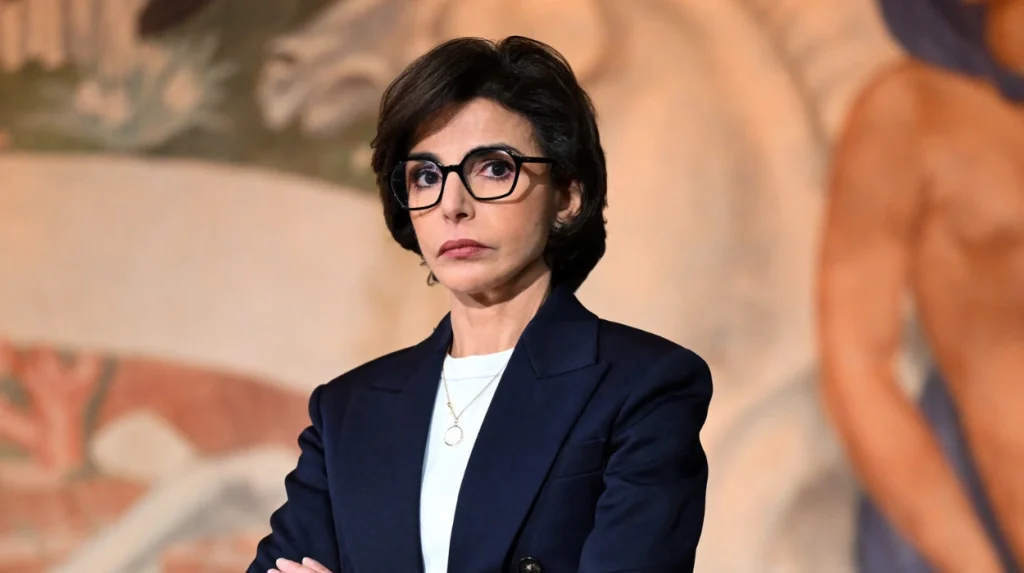
Rachida Dati, the culture minister of France and one of the most recognizable faces of politics in the country, is attempting to take over Paris after a quarter of a century of left-wing politics. Loved by her supporters for her fighting spirit and her ability to rise to the top of politics, and loathed by her critics for her hard-right politics, Dati’s candidacy for mayor has made the Paris election one of the most divisive in recent history.
As the election draws near, the winner is still far from certain.
Why Has Rachida Dati Become Such a Divisive Figure?
Dati broke historical records as the first female of North African and Muslim descent to occupy a high-ranking position in the French government. Her personal story of growing up on a housing estate in a low-income neighborhood and eventually becoming the justice minister of Nicolas Sarkozy’s government has long been a part of her political brand.
However, her hardline rhetoric has made her extremely divisive. With promises to “bring back authority,” Dati has called for the arming of municipal police, increased CCTV cameras, and a tougher approach to public disorder. Her policies have been criticized for potentially turning Paris into what they call a “Trumpist laboratory.”
What Is at Stake in Paris’s Mayoral Election?
The Paris mayoral election has turned into a referendum on what kind of approach the most-visited city in Europe should take in the face of growing challenges. Paris is facing a serious shortage of housing, rising living costs, and record-breaking summer heatwaves caused by climate change.
Dati, who is running on the conservative party Les Républicains’ ticket, has promised to boost police presence, overhaul the rules for social housing to give priority to Parisians, reduce the city’s debt, and complete the privatization of waste management, a plan she dramatically announced by appearing as a garbage collector in a TikTok video.
While she has promised not to reverse the pedestrianisation of the Seine riverbanks, a flagship policy of the left, she insists those spaces need renovation rather than ideological symbolism. Dati rejects accusations that she would dismantle environmental progress, saying she supports green spaces and climate adaptation—but scepticism remains strong on the left.
How Are Supporters and Opponents Responding on the Ground?
For her supporters, the personal story of Dati is very compelling.
“She is an example that you can move up in life, even in France,”
said a volunteer distributing campaign flyers near Les Halles.
“She proves you don’t have to be born with a silver spoon in your mouth to be successful.”
Critics, on the other hand, worry about a reversal of social and environmental policies. With incumbent mayor Anne Hidalgo not running for a third term, the Socialist Party, Greens, and Communists have formed a joint ticket with Emmanuel Grégoire, a deputy mayor who vows to increase social housing and continue Paris’s strong record on air quality and bike paths.
The city is also in the headlines due to revelations of child sexual abuse allegations against school monitors, which have become caught up in the larger politics of the city.
Can Dati Survive Her Legal Troubles?
Dati’s campaign has been overshadowed by a trial that is scheduled to take place in September, in which she is accused of corruption and abuse of power in her lobbying activities on behalf of the Renault-Nissan group while she was a member of the European parliament. She has denied all charges.
It has raised questions about whether Parisians are ready to put a candidate in charge of city hall who is currently under criminal indictment or whether this trial will simply support her story of resilience in the face of political attacks.
Does Dati’s Personal Story Still Work as Political Capital?
Dati frequently invokes her upbringing as the second of eleven children in a working-class estate in Burgundy, arguing it gives her a deeper understanding of social housing and inequality than her rivals. She recalls working from the age of 14, navigating family bureaucracy for illiterate parents, and escaping an arranged marriage.
Her rise to justice minister in 2007 was widely seen as breaking not just a glass ceiling, but a “cast-iron” one. She returned to work four days after giving birth while in office—a detail she cites as evidence of her toughness and independence.
To admirers, this biography embodies meritocracy. To critics, it no longer offsets concerns about her political alliances and governing style.
Could Fragmentation on the Right Cost Dati the Election?
Dati faces competition not only from the left but from both flanks of the right. Sarah Knafo, an MEP for the far-right Reconquête party, hopes to siphon votes in affluent western districts. Although Knafo has expressed openness to working with Dati, the idea has sparked outrage on the left.
Dati has publicly rejected any alliance with a party founded by Éric Zemmour, who has been convicted of inciting racial hatred and once questioned Dati’s right to give her daughter a Muslim name.
Meanwhile, centrist candidate Pierre-Yves Bournazel, a former ally of Dati, is polling in third place. His recently published book portrays Dati as consumed by narcissism—an accusation she dismissed with characteristic venom.
What Do the Polls Suggest About Dati’s Chances?
According to opinion analysts, Dati’s name recognition is both her greatest asset and her biggest liability. While she is far better known than her rivals, she also polarises voters more sharply. Surveys show a majority of Parisians view her unfavourably, even as she retains a loyal base.
A recent reform to the voting system, allowing a more direct mayoral vote, could nonetheless work in her favour—particularly if the opposition vote fragments.
Is Paris Ready for Political Change After 25 Years of the Left?
For some voters, fatigue with long-term leftwing governance is decisive. Concerns about overtourism, Airbnb-driven housing shortages, and the transformation of neighbourhoods into “Disneylands for tourists” have created space for a change narrative.
National politics also loom large. Grégoire’s united left faces competition from La France Insoumise, raising the possibility that ideological splits could shape the final outcome.
As one voter put it bluntly:
“Twenty-five years is too long for any party to run the show.”