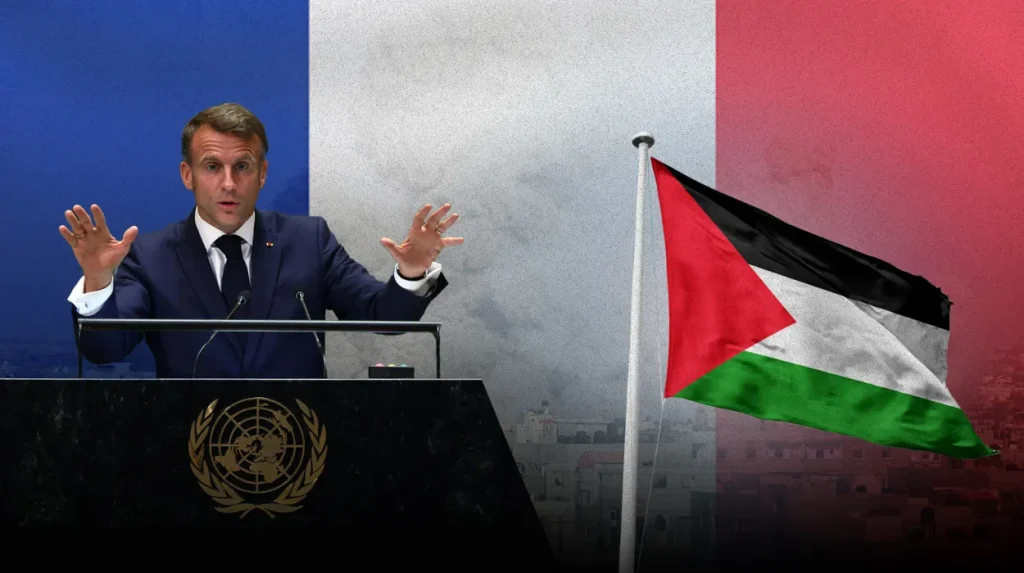
The Middle East policy of the French president Emmanuel Macron can be seen as a balanced act in terms of French traditional alliances and the new humanitarian obligations. His historic move to officially acknowledge the State of Palestine in the year 2025 at the United Nations General Assembly was a landmark move in the foreign policy history of France. The action, backed by a number of European and Arab countries, placed France among the only Western powers that were ready to break the cycle of things with respect to Palestinian statehood.
This recognition was in the context of a larger program done in co-arrangement with Saudi Arabia to renew the stagnating peace process and to solve the humanitarian crisis in Gaza. Macron insisted that the only way to achieve lasting peace is by being politically bold and he urged all the parties to revert to talks that would be supervised by international bodies. However, the course of France is walked down and it is not imposing any sanctions or any punitive measures to Israel despite the intense criticism of its current military action. These two-pronged diplomacy highlights the intentions of Macron to maintain the role of a mediator of France in the region without losing the partners in the West and the Middle East.
The fact that Macron demanded the cessation of civilian bombings and forced displacements in Gaza also indicated the increasing dissatisfaction of the people in France. Nevertheless, his demand to have a dialogue with Israel brings out a realistic interpretation of the many geopolitics that characterized the Middle East in the contemporary world.
US-France Divergence and Diplomatic Pressures
One of the major aspects of the Middle East policy of Macron is that it is increasingly moving away from the US policy. The active military and diplomatic support of Israel, which Washington has had since the time of the Biden administration, remains steady and the support of Israel reaches up to more than 14 billion dollars in aid to coordinate its defense and reconstruction efforts. The decision by Macron to recognize Palestine has, however, put France on the wrong side of the US foreign policy rejuvenating the debate on transatlantic unity and European strategic independence.
In the United Nations, Macron defended his move by contextualizing it as a necessary balance operation that Palestine recognition does not amount to hostility with Israel. However there have been some diplomatic tensions particularly in the Security Council deliberations where the efforts of France espoused on ceasefire monitoring by the council was treated with deafening silence by Washington.
Managing transatlantic ties amid divergence
Macron has not confronted the United States openly even though there are differences in policies. France is also a very important NATO ally, and it is involved with the common defense modernization and counterterrorism operations. Regional security, counter-proliferation, and maritime safety Diplomatic co-ordination between Paris and Washington proceeds on all three to indicate how Macron wants to keep cooperation despite disagreement.
The influence of lobbying and domestic pressure
Domestically, the lobbying of the pro-Israel lobby and political organizations, which fear losing some of its main European allies, complicates even further the position of France. The inner opposition of the administration of Macron is the conservative lawmakers, who claim that the recognition of Palestine by France would be a blowback on its credibility as a mediator. In the meantime, sections of the French community, especially those in the Muslim community, have rejoiced at the move as a moral and diplomatic achievement.
This balancing act highlights the greater burden of ensuring that moral imperatives are balanced with strategic alliances is becoming more and more a dilemma that is characterizing Western diplomacy in the Middle East.
Regional Initiatives and France’s Leadership Role
Macron is not just a symbolic recognition of the Middle East, which is aggressive diplomacy. The fact that he co-chairs multilateral peace efforts with Saudi Arabia indicates that France has a desire to once again become the global leader in the field of diplomacy. The October 2025 conference in Paris that saw the ministers of the European and Arab League come together made clear the approach of Macron to market France as a point of contact between the Western and the Arab views.
Reviving multilateralism through peace frameworks
Ceasefire monitoring, financing of reconstruction, and humanitarian corridors of Gaza are some of the important steps that were discussed in the Paris conference. Macron referred to the talks as a new stage of pragmatic diplomacy, and that only with the aid of inclusive dialogue and long-term aid engagements can peace be sustained.
France’s engagement with regional powers
Macron is also interested in the Gulf states and, especially, Saudi Arabia and Qatar, which is also an indication of his interest in increasing influence in the reconstruction efforts in the post-conflict period. Through following the Arab-led initiatives but at the same time continuing to dialogue with Israel, France will be trying to position itself as a stabilizing force in a world where US dominance is no longer taken as a matter of fact. Critics however believe that France has not been using its leverage to enforce accountability because of its reluctance to sanction Israel.
The idea of structural barriers to any settlement to two states, as it is presented by the statement of Macron condemning the activities of Israeli settlement in the West Bank as an existential threat to peace, points to his understanding of the existence of the structural barriers to the solution to the problem. His strategy represents the centuries-old diplomatic philosophy of France: a realist coupled with an idealist in a volatile region.
Domestic Challenges Shaping Macron’s Policy
The foreign policy towards the Middle East is determined by the internal politics of France. An increase in antisemitic and Islamophobic events in 2025 has put Macron in a delicate position between the need to champion the Palestinian rights and the necessity to keep the country together socially.
Managing public sentiment and political polarization
The acknowledgment of Palestine has increased the division within French society. Right-wing parties have also criticized Macron saying that he has compromised national security interests, and the progressive parties rejoiced over this move by saying that France has asserted its moral autonomy in international affairs. This conflict between the two ideologies has been escalated by the media houses which have been in a debate whether France is contributing to world peace.
Political sustainability and legacy considerations
Macron is struggling with accumulating internal problems in his second term, such as inflationary pressures and lowered approval ratings. Analysts observe that his foreign policy success especially in the Middle East is an effort to leave a legacy in his diplomatic history. Re-establishing France as a neutral mediator on the international scale, Macron aims to make the Fifth Republic one of the pivotal actors in the international conflict resolution at a moment when multipolarity redefines global politics.
Delicate Diplomacy Amid Enduring Conflict
The Middle East policy of 2025 of Macron is a manifestation of the overall desire of France to pursue independent diplomacy in a disunited global system. His demand in Palestinian recognition, humanitarian aid and multilateral involvement in peace is consistent with international demands of justice but is limited in the realities of alliance politics and domestic frailty.
Months to come will say whether the strategy of Macron will be able to make the moral leadership work into the actual outcomes in the area of diplomacy. The more intense the Gaza crisis and the faster the settlement activity, the more France will be able to influence the peace through its endurance in dialogue, accountability, and long-term humanitarian coordination. Such a balancing act by Macron is therefore not one that is unique to the crossroad of the France foreign policy, but that of the timeless clash between ideals and practicality in contemporary diplomacy.