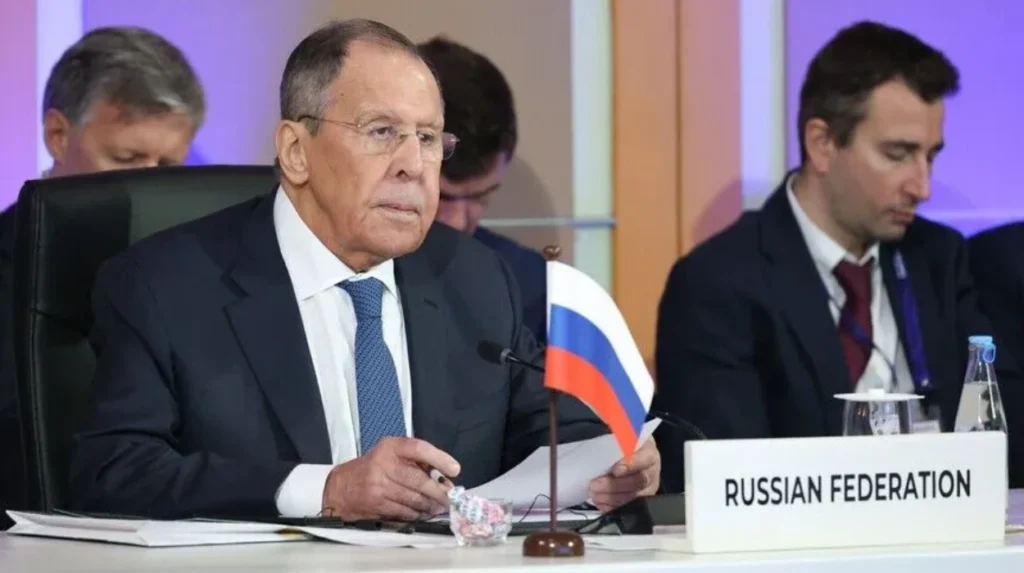
Russia’s decision to close German Goethe-Institut cultural centres has transformed a failed drone operation at a German airport into a wider diplomatic and cultural confrontation between Moscow and Berlin.
The Russian Foreign Minister Sergei Lavrov declared on 3 September that Goethe Institut’s offices in Moscow, St Petersburg, and Yekaterinburg would be closed down. The statement came in the wake of Germany accusing Russia of conducting a drone attack on Leipzig/Halle Airport loaded with explosives and announcing reprisals against Russian diplomatic establishments and cultural centers. The immediate conflict centers around the issue of the Russian House in Berlin, which is the center for Russian culture and diplomacy. Berlin has decided to end the arrangement regarding the management of the center and closed down the Russian Consulate General in Bonn by 18 September.
Lavrov framed the decision as a matter of national dignity.
“Of course, they will be closed after our cultural centre was kicked out of Berlin. Otherwise, we won’t respect ourselves,”
Lavrov said at the Eastern Economic Forum in Vladivostok. He also argued that Germany had knowingly chosen to end the remaining framework for cultural cooperation.
“They deliberately took this step – they could not have failed to understand this – which means the end of their cultural presence in Russia,”
he said, according to Russian state media.
The language underlines the political character of Moscow’s response. The Goethe-Institut is formally a cultural and educational organisation, but in the current security environment Berlin and Moscow increasingly view such institutions through the prism of influence, access and state power.
How the Leipzig airport crisis began
The series of events started on 4 August, when German authorities found an explosive-laden drone in the secure zone of Leipzig/Halle Airport in Saxony. It was said that the drone had landed near a Ukrainian Antonov cargo aircraft, which carries military supplies. The investigators suggested that the aircraft, not the civilian airport, might be the main target. Besides, a second drone might have collided or flown close to a DHL cargo aircraft following closure of the airport. The drone failed to explode. At first, it was thought that the detonator had malfunctioned in such a way that prevented a possible attack on the aircraft and/or the airport infrastructure. The presence of explosives near the fuel tank and the Ukrainian military supply aircraft still rendered the incident one of the most serious attempts of sabotage in Germany since the full-scale Russian invasion of Ukraine. However, the investigation continued. On 14 August, authorities found a third drone in the field west of the airport in Kabelsketal municipality.
The following day, forensic technicians from Germany’s Federal Criminal Police Office reportedly recovered approximately 50 grams of a substance suspected to be hexogen, also known as RDX, a military-grade explosive.
The discovery changed the apparent scale of the operation. What initially appeared to be a single drone incident began to look like a coordinated, multi-stage attempt involving several aircraft, explosives and possible support equipment.
Security sources cited in German media suspected Russian intelligence involvement, although Moscow rejected the allegation. The German government did not immediately publish its attribution and spent several weeks examining the technical evidence, the devices’ components, the explosives and intelligence associated with the people suspected of preparing or carrying out the operation.
Berlin’s attribution of responsibility
Germany publicly assigned responsibility on 1 September. Interior Minister Alexander Dobrindt said the government’s conclusion was based on the combined findings of police, intelligence agencies and the wider pattern of alleged Russian operations in Europe.
“Taken together, police investigations, patterns of the offences, and intelligence findings establish Russian responsibility for the attempted attack at Leipzig airport,”
Dobrindt said.
The formulation was significant because it did not rely on one publicly disclosed piece of evidence. Instead, Berlin pointed to an intelligence assessment supported by investigative findings and what officials described as the operational signature of Russian hybrid activity.
Dobrindt said Germany did not view Leipzig as an isolated event.
“We do not view the Leipzig incident in isolation, but rather see it in the context of other hybrid actions,”
he said, adding,
“We assume that Germany is the target of further hybrid attacks by Russia.”
Foreign Minister Johann Wadephul described the alleged operation as part of a broader campaign designed to damage European infrastructure, intimidate governments and weaken public support for Ukraine.
“It fits into a broader pattern of Russian hybrid operations in Europe,”
Wadephul said.
It is alleged that Russian government personnel provided the necessary information or guidance, while the lower-tier individuals were responsible for carrying out actions on the ground. Such an approach would enable the Russian government to have a certain level of deniability when using criminal networks or even freelancers for sabotage. But many crucial facts are still not revealed. First of all, Germany has not published the full intelligence dossier; second, it has not named the individuals it suspects, nor has it presented the full command structure of the latter and its link to the Russian state organization.
Germany’s countermeasures
Berlin’s response extended beyond the airport investigation.
The German government declared the closure of the Consulate General of Russia in Bonn, and also announced that it will cancel the deal allowing for the functioning of the Russian House in Berlin. The Russian ambassador was invited to the Ministry of Foreign Affairs, as the German government prepared further diplomatic, security and economic steps. Wadephul announced that Germany will take further steps in the form of additional sanctions in the European Union against Russian individuals connected with hybrid operations. Additionally, Germany plans to tighten regulations related to entry into the country of Russians and put pressure on the so-called shadow fleet of Russia, which according to the West supports the work of Russia in the field of sanctions violation and evasion of restrictions on oil export from Russia.
The objective of Germany was to send a message that the covert attack on infrastructure will have consequences even if there are no victims and damage. This is also a change in the policy of Germany towards Russia. At the beginning of the war, Germany was trying to balance its support for Ukraine with maintaining some channels of communication with Russia.
The German government has simultaneously insisted that it will continue supporting Ukraine. The suspected proximity of the drone to a Ukrainian cargo aircraft gave the case a direct connection to the war and to Germany’s role as one of Kyiv’s principal European supporters.
Moscow rejects Germany’s case
Russia has denied involvement in the Leipzig operation. The Russian Embassy in Berlin called Germany’s allegations unsubstantiated and absurd, while Moscow accused Berlin of using the incident to dismantle the remaining foundations of bilateral relations.
Russian officials have demanded evidence and argued that Germany’s public attribution was politically motivated. The Kremlin has not accepted that the drones were directed by Russian intelligence services and has rejected the broader Western narrative that Moscow is conducting a continent-wide campaign of sabotage.
The dispute exposes a recurring problem in state-attribution cases. Governments may possess sensitive intelligence that cannot be made public without compromising sources, surveillance methods or ongoing investigations. That can leave the accused country able to argue that the allegations are merely assertions, while the accusing government maintains that it cannot safely release the evidence.
In practical terms, the disagreement is unlikely to be resolved through a public exchange of documents. Germany has already acted on its conclusion, and Russia has already retaliated.
Why cultural institutions became targets
The Goethe-Institut and the Russian House are not equivalent to embassies, but both operate within formal bilateral frameworks and serve as prominent symbols of national presence abroad.
The Goethe-Institut supports German-language education, cultural programmes, public lectures, exhibitions, academic contact and examinations. Its Russian branches have continued operating despite the collapse of political relations and the reduction of other forms of cooperation after 2022.
As Lavrov stressed, the Goethe-Institut centers have been functioning regardless of what he referred to as difficulties arising from the war in Ukraine and confrontation of the West with Russia. Hence, the closing of these institutions goes beyond a purely administrative issue since it deprives Germany of one of the last opportunities for reaching out to Russia through an institutional mechanism. Similarly, the Russian House in Berlin has organized exhibitions, presentations, courses and other cultural events related to Russia.
There have been growing doubts in Germany regarding the possibility of separation of Russian state-sponsored cultural institutions from public diplomacy, propaganda and intelligence activities. From a legal perspective, there is an interconnection between the two cases. The Russian House works under some special bilateral agreements, namely, a 2011 intergovernmental agreement on the organization of German and Russian cultural and information centers and another one from 2013 regarding the rental of a building in Berlin.
That linkage made retaliation predictable. German officials reportedly understood that closing the Russian House could expose Goethe-Institut branches to reciprocal Russian measures. Berlin nevertheless proceeded, indicating that it considered the security implications more important than preserving the cultural arrangement.
From war in Ukraine to hybrid confrontation
The confrontation must be understood against the broader history of Germany–Russia relations.
Before 2022, the two countries maintained significant economic, political and cultural ties. Germany was one of Russia’s most important European partners, while Russia was a major energy supplier to Germany. That relationship began deteriorating after Russia’s annexation of Crimea in 2014 and the conflict in eastern Ukraine.
After the poisoning of Russian opposition activist Aleksey Navalny, charges of Russian cyber spying against German institutions and the murder of a Chechen-Georgian former fighter in Berlin, relations have deteriorated further due to the fact that German courts connected the assassination in Berlin to the Russian state structure. The full-scale invasion of Ukraine by Russia in February 2022 marked the end of the model of relations between Germany and Russia.
As a response to this, Germany has imposed sanctions against Russia, sent weapons to Ukraine, decreased its dependency on energy supplies from Russia, and expelled Russian diplomats. In return, Russia has imposed sanctions, negative rhetoric and limitations on Western institutions. After this point, there were threats from European governments for the implementation of the so-called “hybrid” campaign consisting of cyber attacks, sabotage, disinformation, espionage, arson attacks and attacks on critical infrastructure. Under these circumstances, a drone loaded with explosives near an airport dealing with cargo of Ukraine can be seen as an attempt by Russia to operate below the level of open military confrontation. Such attempts, according to German and European officials, do not necessarily aim at causing mass casualties.
European consequences
The situation has already developed into a European problem. According to Ursula von der Leyen, the head of the European Commission, the Leipzig case illustrates the increasing recklessness on the part of Moscow, for which she promises additional pressure, including sanctions. She was supposed to raise this topic in a conversation with the head of NATO, Mark Rutte. A number of European nations expressed their support towards Germany. Poland, Sweden, the Czech Republic and other states have been warning that alleged hybrid actions of the Russians are not limited by the territory of any particular state.
The political problem is that the European nations can be subjected to repeated attacks at a relatively low level of intensity without any clear threshold for collective actions. One drone attack near the German airport, one cyberattack at a Baltic organization, some destruction of the underwater infrastructure or arson against a defense-related facility can seem insignificant if taken separately. Taken together, European politicians believe, they constitute a pattern that needs to be responded collectively.
Germany’s domestic political challenge
The governmental reaction to the issue also has certain political implications inside the country. First of all, it is necessary for Germany to show that it is able to secure its critical infrastructure without any exaggeration of the intelligence reports or stifling the discussion of the information. The AfD, which advocated a less aggressive policy toward Moscow, attacked the government’s decision to close the airport.
The leader of AfD, Tino Chrupalla, said that Berlin is making the double standard and mentioned the ongoing disputes concerning the explosions of Nord Stream gas pipeline. Politically, the situation is very delicate since an election in Saxony-Anhalt is coming soon and according to the Reuters, the opinion polls show that AfD has about 40% popularity there while Christian Democrats under the leadership of Chancellor Friedrich Merz have about 23%. For Chancellor Merz’s government, this issue provides an opportunity to present itself tough on national security and Europe. However, it also brings the burden of proving.