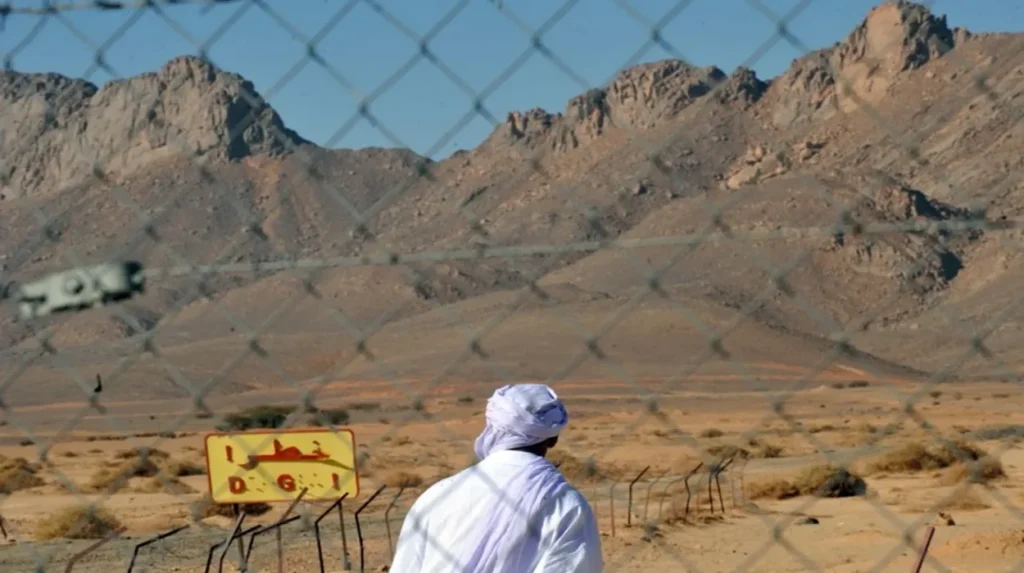
More than six decades after France detonated its first atomic bomb in the Algerian Sahara, the radioactive legacy of those tests continues to shape health, land use, and diplomatic relations between Algiers and Paris. Between 1960 and 1966, France carried out 17 nuclear explosions on Algerian soil—four atmospheric blasts near Reggane and 13 underground tests in the Hoggar mountains—leaving behind contaminated sites, unacknowledged victims, and a bitter dispute over maps, waste, and responsibility.
A programme born in empire, extended after independence
France’s nuclear weapon programme was initiated during the last days of French colonial administration. On 13 February 1960, the plutonium device nicknamed Gerboise Bleue (Blue Jerboa) was exploded at Reggane with a power of 60-70 kilotons, about four or five times more powerful than the bomb dropped on Hiroshima. This day saw the birth of nuclear era in Algeria – not as a sovereign country, but as a colony where the metropolitan country tested its programme of nuclear deterrence and prestige. Four first nuclear tests were done atmospherically from February 1960 to April 1961.
After the public pressure grew because of the radioactive fallout reaching countries of Senegal, Ivory Coast, Burkina Faso and Sudan, France moved to underground tests of its programme. Between November 1961 and February 1966, thirteen shaft tests were performed at In Ekker site in Hoggar mountains along with other sub-critical and plutonium tests. Notably, 11 out of 17 explosions were done after Algeria gained independence in July 1962. According to the Evian Accords, France could continue using the Saharan sites for five years, but these accords did not require France to restore the territories afterwards. Thus, the newly independent state got an area contaminated with radioactive waste.
The human cost: workers, soldiers, and Saharan communities
It is not clear how many people fell victims. According to historical sources, French tests involved about 6,500 military personnel, researchers and engineers and around 3,500 Algerian manual workers directly engaged at the test sites. Apart from this, whole nomadic communities, oasis residents and regional populations were affected by fallout, contamination, and radioactive dust without any consent or protective measures.
It is estimated that there are 27,000 to 60,000 Algerians residing in the zones where the tests took place and who have been affected by radiation-related diseases such as cancer, genetic defects, infertility and other radio-caused illnesses. The effects have been passed on from generation to generation. As per historical sources, the local population in the Reggane region and its environs reduced to half of the original number from 40,000 to 20,000 due to deaths, migration and long-term negative effects of exposure. Workers at the testing sites were subjected to radiation doses of 42-100 mSv or 20-50 times the annual dose of natural background radiation.
Contamination that refuses to fade
The physical footprint of France’s tests is vast and enduring. At Reggane, atmospheric bursts spread radioactive sand and debris across large desert areas; at In Ekker, underground detonations created shafts, tunnels and contaminated rock formations. The Béryl test in May 1962, intended to be contained, leaked radioactive gas and molten material, heavily contaminating the site and observers.
French parliamentary work has acknowledged that four of the 13 underground tests were never fully contained, meaning isotopes such as cesium‑137 and plutonium continue to pose risks. Waste includes equipment, vehicles and construction materials scattered across wide areas, much of it likely still radioactive. Algeria has repeatedly demanded that France hand over precise maps of buried waste and contaminated zones; Paris has not complied.
In the absence of French data, Algerian authorities began their own decontamination operations in February 2026, starting at Taourirt Tan Afella in the In Ekker area, collecting waste into concrete containers. But without comprehensive maps and radiological surveys, cleanup remains partial and hazardous, constrained by the very secrecy that has surrounded the programme since its inception.
Compensation, law, and the politics of recognition
For victims, the legal landscape has been defined by exclusion. France’s 2010 Morin Law created a compensation regime for victims of nuclear tests in Algeria and French Polynesia, but its criteria are narrow: claimants must prove residence during specific test periods and suffer from a limited list of recognised illnesses. By 2021, only one Algerian had been compensated among roughly 545–1,000 beneficiaries, most of them French veterans or Polynesian residents.
Algeria has sought to deal with the issue through legislation on its own terms. In December 2025, the national legislature enacted a statute making illegal elements of the French colonial legacy, including nuclear testing. The document notes that the victims—now including present-day individuals—are entitled automatically to reparation, requires France to remedy contamination and calls for the creation of detailed maps of locations where toxic waste was buried. An updated version of the law enacted in 2026 included nuclear victim compensation but softened some of the language regarding other forms of reparations. Regardless of these developments, the message from Algerian politicians has been clear that monetary compensation was not all that matters. Speaking in 2024, Algeria’s president Abdelmadjid Tebboune stated that Algerians “do not want money” and that compensation without cleanup and disclosure will be “humiliating”.
Diplomatic friction and competing memories
Nuclear testing sits at the heart of wider Franco‑Algerian tensions over colonial memory. Algeria’s 2025–2026 law, which frames French colonisation as a crime and enumerates atrocities including nuclear experiments, has been read in Paris as confrontational. For Algiers, it is a tool to force recognition of harms that have long been minimised or hidden.
France, for its part, has not issued a formal apology for the Algerian tests nor launched an Algeria‑specific cleanup and compensation programme comparable to steps taken for French Polynesia. In 2021, President Emmanuel Macron acknowledged France’s “debt” to French Polynesia for 193 tests conducted there between 1966 and 1996, and set up archive and cleanup monitoring mechanisms. No equivalent political gesture has been extended to Algeria, reinforcing perceptions of a hierarchy of victims shaped by colonial and racial logics.
French law compounds the problem. A 2008 heritage law and a 2021 anti‑terrorism and intelligence statute keep nuclear‑weapons archives under “secret defence”, giving military authorities a veto over releasing data on fallout, waste and exposure. In 2026, French deputies questioned the government on declassifying maps and data on colonial nuclear explosions, but no substantive handover has occurred.
Regional and international dimensions
The consequences of the tests performed by France have never been limited to Algeria only. The radioactive clouds generated during atmospheric testing have been recorded in West Africa, which gives credence to the regional nature of the nuclear damage. The regional aspect reinforces the Algerian claims in terms of their broader character: environmental justice and post-colonial accountability. On the international stage, Algeria has referred to the 2017 Treaty on the Prohibition of Nuclear Weapons. “France should be accountable for her historic responsibility” and “provide us with maps of nuclear waste,” wrote General Bouzid Boufrioua in August 2026 in the army newspaper El Djeich. The General argued that France should follow a normative move towards victim-centered accountability instead of a paradigm of nuclear deterrence. Meanwhile, France opposed any new international obligations regarding the cleanup of test sites. For instance, in 2017 Paris refused to accept the relevant clauses in the Comprehensive Nuclear-Test-Ban Treaty. Thus, there is a deadlock where the moral and political pressure exerted by Algiers and civil society faces archiving and legal minimalism by Paris.
The colonial logic of radioactive erasure
In the context of historians and activists, however, not mapping and cleaning is not an administrative mistake but an extension of the colonial violence committed by France. As noted by Samia Henni and others, the French strategy was to pursue “a colonialist project,” in which the spatial and temporal dimension of the nuclear damage becomes absent, making the Saharan population invisible in official documents and policies. According to ICAN, the Morin Law’s residency criterion affects nomadic Saharans who cannot provide documentary evidence of their presence on the territory for more than ten thousand years. Thus, in such interpretation, the maps denied to France are not simply technical documents but instruments of power defining who may be treated as victims, what lands can be used, and what history can be taken into consideration. The lack of mapping enables Paris to claim limited and controlled experiments, while Algerians suffer from unmarked cemeteries of radioactive waste and intergenerational health problems.