Israel’s quiet construction of a miles-long earthen barrier inside Gaza is more than an engineering project; it is a political signal with potentially long-term consequences for the future of the enclave. The barrier, built along or near the so-called yellow line under the ceasefire arrangement, appears to be transforming a temporary military boundary into a more durable partition.
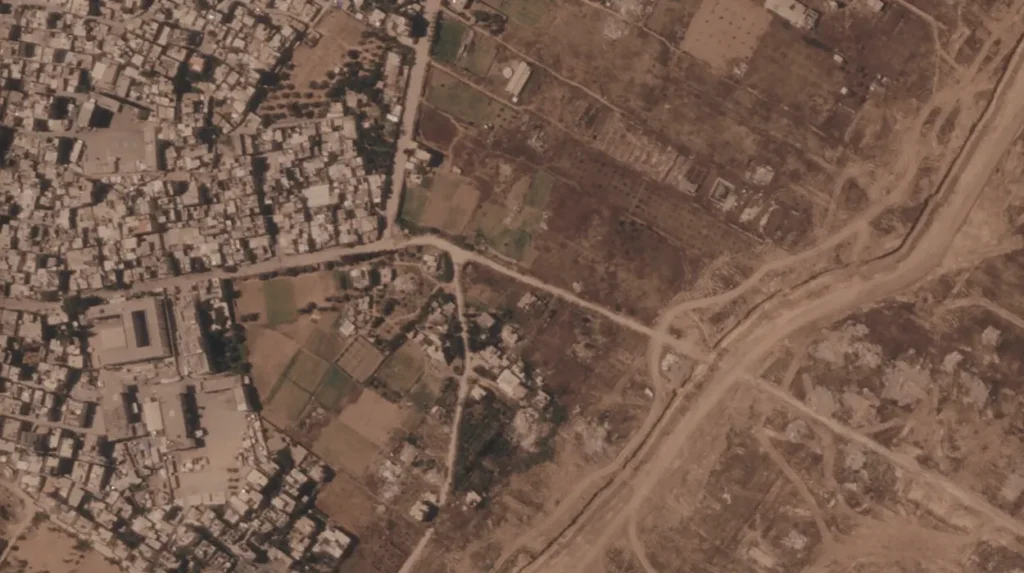
Satellite imagery reported by the Associated Press and other outlets shows that the Israeli military has already completed more than 14 miles of berms in recent months, while other analyses estimate the total at roughly 23 kilometers, or nearly 16 miles. That scale matters because Gaza is small, densely populated, and already fractured by war, displacement, and military control.
What the Barrier Means
The berms that have been talked about are certainly not referred to as walls in the traditional context, rather as a vast earth barrier that was constructed quickly by the use of heavy machinery across portions of the strip. Essentially, this will be a rigid structure which limits movement, reinforces Israeli rule and demarcates territory in ways that cannot be easily undone. The most crucial point here is not just the fact that the wall stands where it does, but also what it signifies. When the line of temporary redeployment is turned into something that resembles a deep trench of division, the ceasefire agreement begins to take shape as a geography of imposition.
Satellite Evidence and Scale
The information provided is mainly based on the satellite images showing excavation and the construction of berms in various places in Gaza. The review of Misbar found that there are three earth berms running parallel to the yellow line with lengths of about 3.62 kilometers, 6.67 kilometers, and 5.4 kilometers respectively, and their total length exceeds 15 kilometers. There is another report stating that the Israelis have constructed 25 kilometers of earth berms in Gaza close to the yellow line and have fortified 38 military bases on the eastern side of the territory controlled by them. The numbers above clearly indicate that there is a bigger picture behind such construction activity.
Israel’s Security Argument
Israel’s military has confirmed to the AP that it is building a physical barrier and says it has created a “security zone” along it, equipped with intelligence assets. That language places the project inside Israel’s familiar security doctrine: control space, reduce risk, and prevent militant movement across a boundary. But the security rationale does not remove the political meaning. A structure that begins as a military safeguard can still become a de facto border if it is maintained, widened, and normalized. In that sense, the barrier is both a tactical asset and a territorial statement.
Palestinian Fears of Partition
For the Palestinians of Gaza, permanence is the primary worry. It is evident from the reports provided by the AP about how the worry that the yellow line – initially drawn in connection with a ceasefire agreement – might become a permanent border which will separate the enclave forever looms over them. This worry gets confirmed when one comes to know that the yellow line has actually changed position, forcing the people to realize overnight that the zone of control is closer to them now. In this manner, the creation of the barrier creates a feeling that Gaza is getting redesigned in physical terms while politics is undecided.
Yellow Line Politics
The yellow line is supposed to represent a boundary set by the U.S.-backed ceasefire arrangement, marking the area to which Israeli forces redeployed. In theory, such a line is a transitional mechanism. In practice, the line is being physically marked, reinforced, and in some accounts shifted westward, making it look increasingly like an enforced territorial divide.
This matters because lines drawn in conflict zones often become political facts before they are ever legally recognized. Gaza’s yellow line is now being translated from map to ground, from a diplomatic marker to earthworks and fortifications. That transformation is exactly what alarms those who believe the war is producing a new geography rather than restoring an old one.
Wider Strategic Pattern
The barrier also fits into a larger pattern of Israeli military entrenchment inside Gaza. Separate reporting has identified expanded military posts and fortified bases inside the Strip, suggesting that the barrier is part of a broader architecture of control rather than a stand-alone project. Earlier satellite analyses also documented the military road and dividing line that split Gaza in two in previous stages of the war.
Taken together, these developments point to a layered territorial strategy: roads, berms, posts, and monitored zones. For Israel, that may appear to be a necessary security framework. For Palestinians, it looks like a creeping system of separation that could outlast the current conflict.
Why This Is Important Now
The timeliness of the situation is extremely important since the conditions of the ceasefire are still weak and the political future of Gaza is yet to be determined. Should the construction proceed without moving forward diplomatically, the line itself might turn out to be more sustainable than any agreement negotiated. In such circumstances, it will lead to a major complication for any future agreement that relies on territorial contiguity, mobility, and unity of Palestinian governmental system. It poses an issue on humanitarian grounds as well. The establishment of any sort of internal border within Gaza is likely to have impact on access to one’s home, land, services, relief corridors and family contacts in a place that has been ruined by war.
The main issue to watch is whether this barrier remains a tactical line or evolves into an accepted permanent feature. Public confirmation by Israel that it is building a “security zone” suggests the work is being normalized rather than treated as temporary emergency engineering. The next phase will likely be shaped by three forces: satellite documentation, diplomatic reaction, and conditions on the ground in Gaza. If the berms expand further, or if the yellow line continues to shift, the argument that this is merely temporary fortification will become harder to sustain.