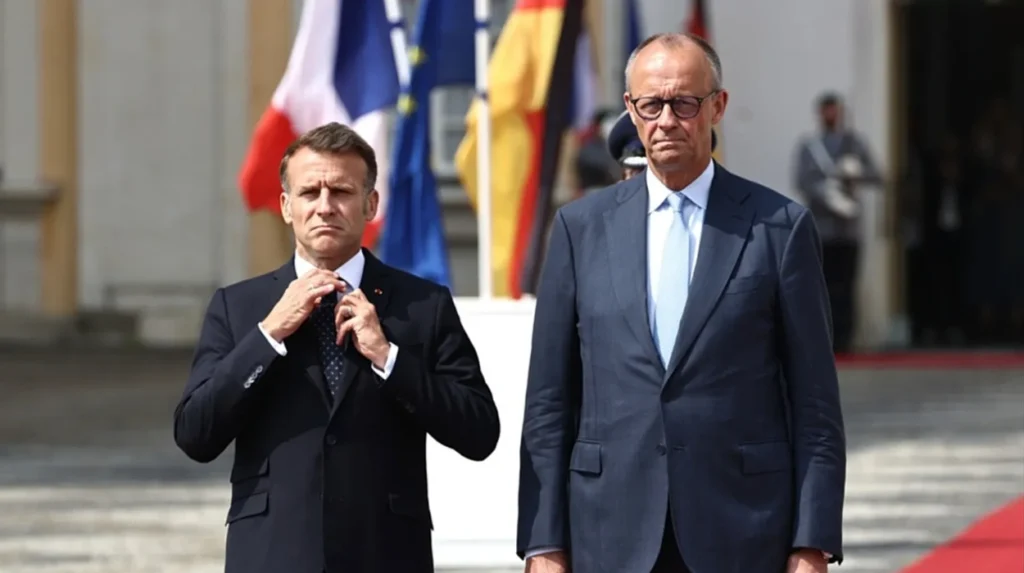
In a charged and carefully choreographed moment for European security politics, Merz hosts Macron in Cologne for key defence talks one month after FCAS initiative collapse. The encounter is more than a routine bilateral; it is a deliberate attempt to demonstrate that the Franco-German axis at the heart of Europe’s defence architecture can survive the failure of its flagship future fighter project and still anchor a coherent strategic vision. Set against the backdrop of deepening geopolitical competition and mounting pressure on Europe to shoulder more of its own defence burden, the talks seek to transform a moment of embarrassment into an opportunity for reset.
The selection of the venue brings out the weight of the occasion. Macron and Merz are conducting the all-important discussions at a place which was used by former President Charles de Gaulle and Chancellor Konrad Adenauer to agree to establish a good relationship between France and Germany. This is more than just a throwback to history; it is meant to send the message that these issues are not new and that this partnership has had to reinvent itself many times before. By going back to this place of conciliation and foresight, both leaders have effectively made it clear that they are willing to defend the political investment made in the Franco-German alliance despite the coming out of economic and strategic differences.
Legacy of de Gaulle and Adenauer: symbolism as strategy
Choosing to hold the meeting in Cologne, in a place steeped in the history of the founding generation of Franco-German reconciliation, places this gathering in a much longer historical context and not just in an isolated case. When Charles de Gaulle and Konrad Adenauer met to lay down the groundwork for friendly relations between France and Germany, they did so amidst the ruins of two devastating wars and attempted to establish a new European order based on trust and not on rivalry.
Eventually, their insight was distilled into the Elysée Treaty and practice of close political cooperation that has characterized European integration up until now. In referencing this history, Macron and Merz appeal to a very compelling story: no matter what difficulties there may be, Paris and Berlin always end up opting for compromise rather than conflict. From a contemporary perspective, such a symbolic choice works on multiple levels. First of all, it reassures other European Union members that any friction between France and Germany regarding FCAS will not affect cooperation in military affairs in general.
The symbolism also carries an implicit warning. If the de Gaulle–Adenauer generation managed to turn post-war hostility into partnership, then today’s leaders have little excuse for allowing industrial disagreements and bureaucratic turf wars to undermine the broader strategic relationship. In that sense, the Cologne setting functions as a benchmark against which Macron and Merz will inevitably be judged.
The FCAS collapse: a flagship project undone
The most immediate context for Merz hosting Macron in Cologne for key defence talks one month after FCAS initiative collapse is the failure of the Future Combat Air System initiative, conceived as a cornerstone of Europe’s next-generation air power. FCAS was envisioned as a comprehensive ecosystem: a sixth-generation fighter jet connected to drones, advanced sensors, and shared combat clouds. It was supposed to showcase Europe’s technological ambition, reduce dependence on external suppliers, and cement Franco-German defence-industrial integration.
On the contrary, it became an illustration of how industrial differences, strategic cultures of countries involved, as well as claims on the part of different companies can slowly ruin common projects. It is believed that conflicts related to the distribution of leadership, questions concerning IP rights and technologies transfer, as well as programme governance led to tensions between main proponents of the project such as Dassault and Airbus. These disagreements have found their reflection in politics with the parties developing mutual mistrust.
Thus, the FCAS collapse is not only a failure from the technical or contractual perspective; it is seen as damage done to the credibility of the French-German defence policy as well as a serious problem in the context of Europe’s ability to implement strategically complex programmes in general. For both Macron and Merz, this situation is unfortunate. France has made a lot of efforts to convince everyone that Europe’s “strategic autonomy” depends on having its own strong capabilities; and FCAS was a cornerstone of this idea. Germany had problems with the modernisation of its army and procurement decisions which should correspond with the interests of both NATO and Europe’s industry.
From setback to reset: the core objectives of the talks
Against this backdrop, Merz hosts Macron in Cologne for key defence talks one month after FCAS initiative collapse with an agenda that explicitly aims to move beyond the failed programme while preserving the underlying logic of cooperation. The central objective is to establish a new framework in which Franco-German defence coordination can continue to evolve, even if the contours of joint projects shift. That involves three interlinked goals: repairing trust, re-prioritising capabilities, and reaffirming political leadership.
Trust building also entails an acceptance that the FCAS programme has shown inherent flaws in the manner that Paris and Berlin have approached large-scale defence-industrial projects in terms of design, negotiation, and implementation. There is a need for both sides to demonstrate that they have learned from the experience and that the future collaboration on any projects would be less prone to the sort of long-term disagreement that brought about the downfall of the FCAS. More transparency and even balance in the roles to be played by both parties in the joint programme and effective mechanisms for dealing with disagreements are needed.
A re-allocation of priorities is also important. Failure in one programme does not mean that there is no need to improve the capabilities of Europe in air defence, long-range strike and intelligence gathering. Thus, the discussions go beyond the failed FCAS to other clusters of cooperation that are more politically and technically feasible such as nuclear deterrence participation, integrated missile defence, long-range conventional strike, and space assets.
Reaffirming political leadership is the third pillar. By staging a highly visible, symbolically loaded meeting and emphasising continuity with the de Gaulle–Adenauer tradition, Macron and Merz are effectively putting their own reputations on the line to salvage Franco-German defence cooperation. The message to allies and adversaries alike is that the political will to work together remains intact, even if individual projects falter.
Nuclear deterrence and missile defence: a deeper integration
One of the most sensitive dimensions of Merz hosting Macron in Cologne for key defence talks one month after FCAS initiative collapse is the reported ambition to deepen cooperation in nuclear deterrence and integrated missile defence. France, as a nuclear-armed state, has long maintained an independent deterrent. Germany, for historical and constitutional reasons, has relied on NATO’s nuclear umbrella and conventional capabilities. Aligning these different traditions in a coherent operational framework is not simple.
However, the dialogues reveal a growing awareness of the need for greater clarity concerning the relationship between France’s nuclear deterrent force and overall European security architecture. Joint drills, common planning arrangements, and interoperable command-and-control structures are some of the ways in which this linkage can be created between the nuclear deterrent and the collective deterrence mechanism. In the case of Germany, involvement in such a framework, without being in possession of its own nuclear weapons, indicates a readiness to confront the facts of European nuclear strategy.
Missile defence is the corollary of deterrence in this new security framework. With the development of cruise missiles, hypersonic weapons, and long-range strike capability in the hands of potential adversaries, Europe’s vulnerability increases. Hence, the Franco-German collaboration in terms of radar technology and interception methods is necessary both technically and politically.
By placing these issues at the heart of the Cologne talks, Macron and Merz are implicitly acknowledging that Europe’s strategic landscape has shifted. The FCAS collapse may have undermined one future-oriented project, but the underlying trend—towards more complex, multi-domain threats—remains. Nuclear deterrence and missile defence, once seen as somewhat abstract policy domains, are now central operational questions for European defence planners.
Long-range strike, space and the digital domain
Beyond deterrence and missile defence, Merz hosting Macron in Cologne for key defence talks one month after FCAS initiative collapse also reflects a broader shift towards multi-domain capabilities—especially long-range conventional strike, space assets, and digital resilience. Long-range strike systems, whether air, land, or sea-based, allow Europe to project force and deter aggression without crossing the nuclear threshold. Coordinated Franco-German investment in such capabilities aligns with NATO priorities and reinforces European autonomy in decision-making.
Space is yet another important area. Secure satellite communication, continuous ISR (intelligence, surveillance, reconnaissance), and early warning from space are essential for contemporary warfare. In speaking about cooperation in space-related capabilities, Macron and Merz acknowledge that competition in technologies and industry inside Europe must be reconciled with the necessity to ensure interoperability. Common projects involving satellites constellations or their payloads, complemented by interoperable ground segments, might become a part of the new approach to security.
The digital world connects the two previous areas. As Europe faces challenges related to cyber threats, information warfare, and weaknesses in critical infrastructure, cooperation of France and Germany in the field of cyber defense, networks security, and digital policy will be a strategically significant tool. Integrating all three mentioned domains into a common vision of France and Germany is one of the more ambitious, yet essential results of the talks in Cologne.
Domestic politics: pressure and opportunity for both leaders
The domestic political context matters significantly to Merz hosting Macron in Cologne for key defence talks one month after FCAS initiative collapse. For Macron, whose presidency has been defined in part by his advocacy of European strategic autonomy, the FCAS setback is politically uncomfortable. It raises questions about the practicality of grand designs and the effectiveness of French diplomacy in navigating complex industrial landscapes. The Cologne meeting offers a chance to reframe the narrative: instead of dwelling on a failure, he can present a broader, more diversified agenda for Franco-German defence cooperation.
For Merz, the stakes are different but equally high. Germany’s security policy has been undergoing a gradual but profound transformation as it moves away from the post-Cold War assumption that its immediate security environment is largely benign. The Zeitenwende discussion has forced Berlin to reconsider defence spending, procurement priorities, and alliance commitments. Being seen as a reliable partner for France and a responsible actor within NATO is central to that repositioning. Hosting Macron in a venue heavy with historical symbolism allows Merz to position himself as a steward of continuity who can simultaneously drive adaptation.
For both leaders, the meeting is an opportunity to signal seriousness to their domestic constituencies: to militaries that demand clarity and resources, to industries that seek predictable frameworks, and to publics that expect coherence and accountability when billions are spent on defence projects. The FCAS collapse is thus converted into a stress test of political leadership—one that Cologne is meant to help them pass.
Implications for Europe’s defence architecture
In the European context, the Merz invitation to Macron to come to Cologne for strategic defence discussions only a month after the failure of the FCAS project has an ambivalent meaning. Firstly, in view of the failure of FCAS, there is an increase in skepticism concerning the capacity of the EU to successfully conduct joint defence projects without help from outside. Secondly, the willingness to regroup and move forward shows that the axis of European defence policy remains in Paris and Berlin. All other European states and allies of NATO will be observing not only the decisions made but also how rapidly they will be fulfilled.
Milestones, such as joint exercises, joint roadmap, industry collaboration on radar, missile defence and long-range strike capabilities, are necessary to overcome the stereotype about Europe being strong in words rather than deeds. The success of Macron and Merz efforts in aligning the French and German armed forces, ministries and industry in a common set of priorities will determine if Cologne will be only a small step in the wrong direction or a pivotal point.
Equally important is the signalling towards adversaries and partners beyond Europe. The Cologne talks underscore that, despite setbacks, the Franco-German engine still aims to shape Europe’s strategic trajectory rather than passively adapting to decisions taken elsewhere. In an era where transatlantic dynamics, regional conflicts, and technological competition increasingly intersect, that ambition is not merely symbolic; it is a necessary condition for Europe to remain a relevant security actor.
In essence, Merz hosts Macron in Cologne for key defence talks one month after FCAS initiative collapse is a test of whether the Franco-German partnership can absorb a significant failure and still function as the core organiser of Europe’s defence thinking. The symbolism of the setting, the sensitivity of the agenda, and the precarious domestic and European context combine to make this meeting a defining moment in the current phase of European security politics.