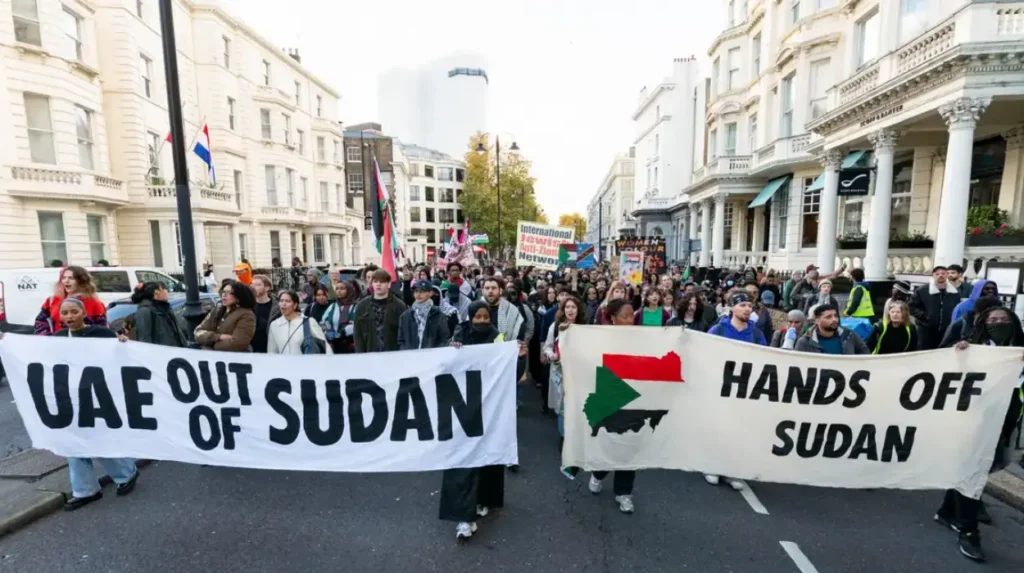
France, the UAE, and Sudan are connected by more than diplomacy: they sit inside a wider struggle over influence, legitimacy, and responsibility in one of Africa’s most devastating wars. France has tried to respond as a humanitarian critic and multilateral broker, while the UAE has faced growing allegations over support for the RSF, and Sudan has borne the human cost. That combination has left Paris in a difficult position, because any serious response to Sudan now has to account for the UAE’s contested role.
France’s Strategic Comfort Zone
France’s instinct in crises like Sudan is usually to stay inside a familiar diplomatic comfort zone. That means supporting humanitarian access, calling for ceasefires, and working through European and international forums rather than naming allies too aggressively. In practice, that approach allows Paris to look engaged without forcing a direct confrontation with Abu Dhabi.
This matters because the UAE is not a peripheral partner for France. It is a major regional actor with defense, commercial, and security importance for Paris. That relationship makes the Sudan issue harder, not easier, because any pressure on the UAE risks widening into a broader bilateral dispute. France therefore chooses language that condemns the war while keeping the relationship intact.
Sudan Exposes The Limits
Sudan has exposed the limits of this style of diplomacy. The war has become a test case for whether Western governments can still defend humanitarian principles when those principles collide with strategic partnerships. France has publicly condemned atrocities, especially in El Fasher, and has called for protection of civilians. But it has not yet matched those words with a direct political challenge to the UAE.
The result is a gap between principle and practice. France says it opposes foreign military support, but it does not publicly isolate the actors most often accused of enabling the conflict. That gap weakens the force of its message. In a war defined by external interference, selective criticism can sound like hesitation.
The UAE Problem For Paris
The UAE’s alleged role changes the diplomatic math. Human Rights Watch report describes a network involving recruitment in Colombia, transit through UAE-linked sites, and deployment of private military contractors into Sudan. If those allegations are accurate, then the UAE is not just another concerned state; it is part of the war’s operational infrastructure. That makes the French response more than a question of wording. It becomes a question of whether Paris is willing to confront a partner when facts become politically uncomfortable.
For France, that is a dangerous threshold. Publicly pressing the UAE could damage a strategic relationship. But avoiding the issue can make France look unwilling to follow its own logic. If the war is being sustained by external backers, then the diplomatic response should name that reality more clearly. Otherwise, France risks appearing selective in its concern for Sudanese civilians.
Why Silence Matters
Silence does not mean indifference, but in this case it can still have political consequences. The longer France avoids direct engagement on the UAE’s alleged role, the more it appears to prioritize alliance management over accountability. That may be understandable from a statecraft perspective, but it is harder to defend morally when Sudan’s civilian population is paying the price.
The deeper problem is that France wants to be both a critic and a partner. It wants to defend international law and also preserve room for cooperation with Abu Dhabi. Those goals are not impossible to reconcile, but they do create limits. France can condemn the war, support diplomacy, and still avoid a public rupture. What it cannot easily do is maintain full credibility while refusing to sharpen its language where the evidence is most politically sensitive.
A More Honest French Approach
A stronger French approach would not require theatrical confrontation. It would require more honesty about the political structure of the war. That means acknowledging that Sudan’s conflict is not only the result of local rivalries but also of outside support networks that empower armed actors. It also means being consistent: if France says foreign military assistance is unacceptable, then that principle must apply even when the source is a valued partner.
Such an approach would be more difficult, but also more credible. France could still work through European channels, the UN, and humanitarian diplomacy. But it would no longer hide behind generic language that treats all outside actors as morally equivalent. Sudan’s war has already shown that they are not.
What This Means Now
France, the UAE, and Sudan are now linked in a diplomatic triangle that reflects the wider failure to contain the war. France wants to avoid a public clash with the UAE. The UAE wants to preserve its regional influence and deny wrongdoing. Sudan continues to suffer the consequences of a war shaped by power, denial, and competing narratives.
That is why this story matters beyond Sudan. It is about whether major governments can still speak clearly when humanitarian disaster intersects with strategic partnership. In this case, France has chosen caution. Whether that caution remains defensible will depend on how much more evidence emerges, and how long Paris is willing to stay in the middle.