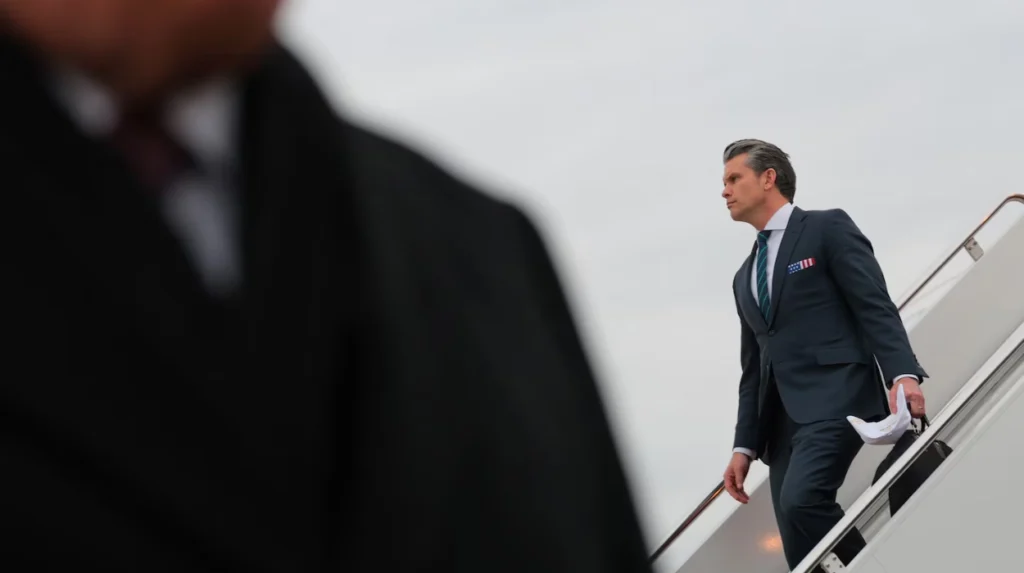
The objective behind the visit was quite evident; it was to commemorate the 82nd anniversary of the landing on D-Day and reiterate the United States’ dedication to transatlantic security. However, an ostensibly ceremonial trip by Defense Secretary Pete Hegseth to France has become a topic of political controversy back home. This is not due to any issues of his schedule but his choice of companionship during his journey. US defense secretary Hegseth brings six of his children along with him to France for an official visit, entering Paris with his wife and six of his children on board a US Air Force plane.
Pictures and video footage of Hegseth landing with his family sparked a frenzy on social media. They were accused of transforming an important state visit, which was taking place amidst warfare and higher risks, into a kind of a family getaway for which the tax dollars have been used. But while some people see this act as a violation, others believe that he is simply following the guidelines, and having a family accompanying you during a ceremony is not uncommon at all.
Your tax dollars at work – Hegseth takes six of his children to France on official trip https://t.co/fKb1EnGTLo
— Jon Maas (@jondmaas) June 6, 2026
The official purpose: D‑Day remembrance and alliance politics
In an official context, the trip is tied to one of the most holy days in the transatlantic world. Hegseth travels to France for participation in ceremonies commemorating the 82nd anniversary of the D-Day landings in Normandy, when troops from Allied nations launched an assault against Nazi Germany in June 1944. As part of his itinerary, he will attend commemorative services in honor of fallen warriors and conduct meetings with top-ranking politicians and defense officials in France. From a Pentagon perspective, the visit is intended to highlight the long-lasting ties between the U.S. and France as well as pay tribute to Allied soldiers who lost their lives in Normandy.
According to prior Pentagon advisories, the department has framed the trip in solemn terms. Officials have emphasized that the secretary’s presence is intended to
“honor the sacrifices of the valiant patriots who fought and died on the Normandy beaches to secure and defend freedom in Europe in the face of tyranny,”
a line that encapsulates both the historical weight of D‑Day and the contemporary message Washington wants to send about its commitment to European security. In this sense, the mission is both remembrance and deterrence, reminding allies and adversaries that the U.S.–France defence relationship is rooted in shared sacrifice.
Apart from attending the ceremonies, Hegseth’s schedule involves consultations regarding European defense strategies and burden sharing as well. During his meetings in the past with the French delegation, he has urged Paris along with other European capitals to play an active role in the conventional defense of Europe. This, in fact, follows the same policy that is being advocated by the United States in asking its allies to take more responsibility for themselves.
The family entourage: optics of a “flying Pentagon” arrival
What made this trip distinctive, however, was not the official itinerary but rather the members of the delegation. Hegseth, aged 45, landed in Paris alongside his wife Jennifer and six of their offspring, making up a total of seven from a blended family, coming out of the so-called “flying Pentagon” or “doomsday plane,” which is nothing less than an air-command center able to function in any possible disastrous situation. The very thought of an upper echelon member of the U.S. Department of Defense traveling in such an elite military airplane accompanied by his family was perceived as an abuse of power.
On social media, many viewers interpreted the footage as evidence that the US defence chief Hegseth takes six of his children to France on official trip not just as an incidental family accompaniment, but as a de facto family holiday embedded within a state mission. Comments flooded in questioning whether American taxpayers were effectively subsidizing what looked like a sightseeing opportunity for his children, with references to possible side trips to popular attractions such as Disneyland Paris. One widely shared sentiment characterized the scene as
“a family holiday by the looks of it,”
suggesting that, whatever the technical legality, the optics were politically tone‑deaf.
Another harsh reaction, echoing the mood among critics, described the visit as “sacred ground being desecrated,” expressing anger at the idea of a solemn battlefield commemoration being merged, visually and symbolically, with a family outing. Online posts mocked the informality of the arrival footage and questioned why a secretary of defense in a period of conflict would choose to surround himself with children in a high‑risk environment overseas, rather than project a strictly professional, security‑focused image.
Ethics, costs and the question of precedent
Besides security concerns, there is another matter that needs careful attention in relation to the trip: how much integration of one’s family can a high-ranking official engage in when traveling officially without violating any codes of conduct. This has been witnessed under both past Republican and Democratic administrations in cases where members of the cabinet, including defense secretaries, have traveled along with their spouse or children on important commemoration ceremonies, state funerals, or summit conferences. According to the laws of the U.S. government, such trips can be conducted legally as long as no violations occur.
Supporters of Hegseth, and some defenders of the practice in general, argue that the presence of family members can humanize officials and underscore the inter‑generational nature of remembrance. For an event like D‑Day, they say, having children witness ceremonies can symbolize the passing of historical memory to a new generation. In this view, the image of the US defence chief Hegseth takes six of his children to France on official trip might be read not as indulgence but as a form of civic education, showing younger Americans the cost of war and the permanence of alliances.
There are, however, two issues that make this defence less compelling. The first is the magnitude of the task: it is one thing to take a spouse and one child on such a trip, but quite another to take six children on such a high security mission by a highly sophisticated piece of military equipment. The second issue relates to the fact that there already exists a track record of controversy concerning how Hegseth separates his professional and personal life.
The Pentagon’s public line and calculated restraint
On the other hand, the Pentagon’s stance remains measured. When questioned on the optics of the trip, Pentagon officials have been consistent in stressing that Hegseth was following protocol, while his trip was fully consistent with the appropriate policies. Messages from the Pentagon have always managed to refocus attention away from any personal considerations and bring the conversation back to the main agenda of commemorating World War II veterans, enhancing cooperation and serving U.S. strategic interests in Europe.
Messages sent out in relation to the D-DAY commemoration have focused not on the personal aspects of the trip, but rather on the symbolic importance of the events as well as the strategic nature of the talks with French officials. In other words, Pentagon officials are basically challenging the public to measure the success of the trip against its official agenda.
Notably, there has been no public indication of an internal review or policy change specifically triggered by this trip. That suggests that, within the Pentagon, the decision to allow family accompaniment is not seen as a clear breach of norms. Instead, the department appears to be relying on established travel and ethics frameworks and betting that the news cycle will eventually move on as other issues take precedence.
Supporters’ case: symbolism, normalcy and humanizing politics
Justifications of Hegseth’s decision include the following. To begin with, it is stressed that in today’s world, spouses and children attend various commemorative events as part of their parents’ delegations. In addition, the presence of family members is sometimes viewed as beneficial since it contributes to improving the general mood by helping people realize that decisions made in Washington have a profound impact on ordinary citizens. It is because of this reason that a military leader’s decision to take his children to Normandy should be interpreted not as an impropriety, but as recognition of sacrifice by younger generations.
Second, supporters argue that optics alone are not proof of wrongdoing. They note that if the secretary or his family are reimbursing appropriate costs or if certain protocol rules allow family travel on specific missions, then the outrage is more about political perception than concrete violations. In their narrative, critics are seizing on the phrase
“US defence chief Hegseth takes six of his children to France on official trip”
to fuel a broader political attack rather than engaging with the underlying policy issues at stake in Europe and the Middle East.
Third, some sympathizers suggest that this episode reflects a broader tension in modern public life: the expectation that high‑ranking officials be both fully human and perfectly controlled. They argue that demanding total separation between family and official duties is unrealistic and that the public often appreciates seeing leaders in more relatable roles, especially at events that are as much about memory and values as they are about hard security.
Critics’ case: judgment, symbolism and public trust
Opponents reply that this is not about banning the participation of the family members completely, but about the degree and proper use of discretion. For them, this was an improper action to take, considering that it was made at the time when there were high levels of risks involved, and the family members included six children, who traveled via special military aircraft.
Symbolism can be positive or negative for those in power. Visiting the beaches of Normandy does not only involve going there on tour; it also involves paying one’s respects and delivering messages concerning the serious matters at stake. The image created by the Secretary of Defense with such a big entourage is bound to send a wrong signal.
Moreover, critics insist that even if rules are technically followed, leaders have a responsibility to avoid the appearance of impropriety. The US defence chief Hegseth takes six of his children to France on official trip, in their eyes, crystallizes anxieties about a governing culture in which boundaries blur too easily, and in which public office risks being treated as a platform for personal comfort and exposure rather than strictly for public service.