The willingness of France to cooperate with Ukraine in terms of developing an anti-ballistic missile shield indicates a major step up in military cooperation between Europe and Ukraine at a time when Russia’s missile and drone attacks continue to represent one of the biggest dangers to Ukrainian cities, energy system, and military installations. The recent coverage of the subject indicates that this move is not simply a politically symbolic act but a move towards helping Ukraine improve its interception capabilities using French air defense technologies such as SAMP/T.
The point coming from Kyiv is that this is not some remote or theoretical alliance. President Volodymyr Zelensky has characterized the French pledge as integral to the immediate battlefield situation, which involves frequent strikes across multiple regions, putting immense strain on Ukraine’s defense systems. In such a scenario, the importance of France comes into focus, owing to the fact that it is among the few European states capable of providing the necessary support in terms of technology and missile defense systems.
Ukrainian defense contractor specializing in missiles/drones, Denys Shtilierman in a post on X said:
“We commend France for its initiative to establish a European ballistic missile defense shield. Emmanuel Macron understands that in today’s world, we can only rely on those who share our common fears and interests. It is also very important that Ukraine plays a key role in the future defense of the entire continent.”
We commend France for its initiative to establish a European ballistic missile defense shield. Emmanuel Macron understands that in today’s world, we can only rely on those who share our common fears and interests. It is also very important that Ukraine plays a key role in the… pic.twitter.com/gkxzpIQL6n
— Denys Shtilierman (@DenShtilierman) May 16, 2026
Zelensky’s framing of the breakthrough
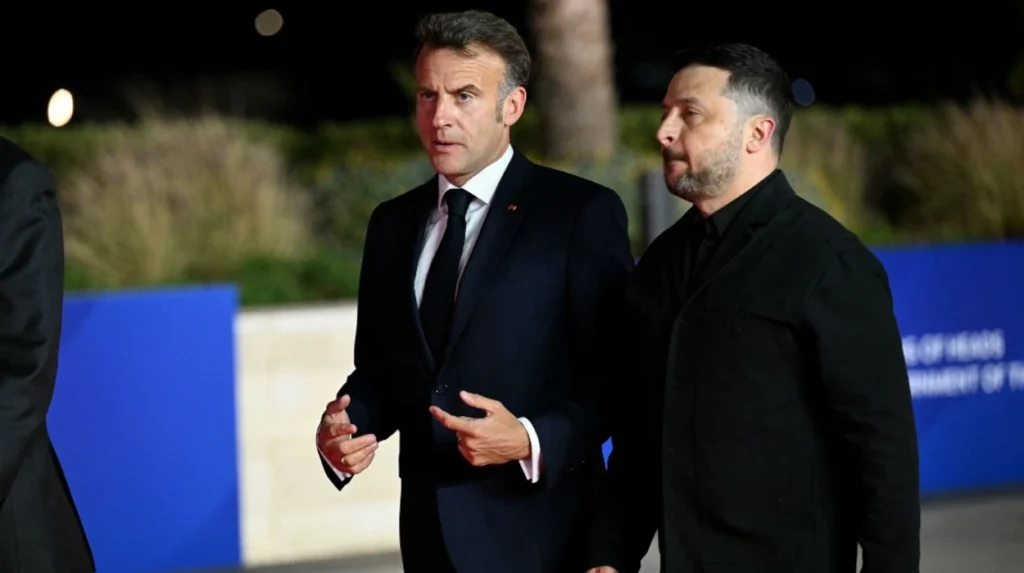
For Zelensky, the deal was nothing short of groundbreaking, highlighting that he and Macron discussed urgent steps to strengthen Ukraine’s air defenses. Urgency matters, since Ukraine lacks the time to indulge in lengthy procurement or diplomacy when at war. Every major wave of missiles sends home the same message: Ukraine must have more interceptors, more launchers, improved radar coverage, and a system capable of tackling both ballistic and cruise missiles.
On this basis, it can be seen that Zelensky’s message has a military and a political element to it. On the one hand, he is sending the message to his domestic population that Ukraine is receiving crucial backing from their allies in the West, and on the other hand, they require the provision of air defense immediately and practically, not just in theory.
Macron’s strategic calculus
This stance also illustrates the overall efforts made by France in order to stay a key player in the military and diplomatic response of Europe to the conflict. By taking steps towards integrating its capabilities into the Ukrainian approach to anti-ballistic missiles defense, France goes beyond mere statements of solidarity, as it links up its own military industries’ capabilities with the requirements of the Ukrainian military operations.
The readiness of France to cooperate has a wider strategic implication, especially beyond Ukraine, since it indicates that Paris is willing to support expensive, complicated, and sensitive defense equipment. This is important because missile defense is the hardest part of air defense. Such cooperation is significant since it demonstrates that the country is capable of dealing with a system that is both technologically and strategically challenging to integrate into the defense system.
Why anti-ballistic defense matters
Ballistic missiles represent one of the most difficult weapons to intercept. In contrast to drones or cruise missiles, ballistic missiles move at high speeds and follow other flight parameters, requiring more from the interception system. This point is important for Ukraine, because the Russian armed forces have used drones, cruise missiles, and ballistic missiles in combination during their attacks to create maximum damage to air defense systems in several territories simultaneously.
This is why the French offer is significant. By testing and integrating a system like SAMP/T NG for intercepting ballistic missiles, Ukraine will enhance its capabilities to protect vital infrastructure. The anti-ballistic element can play a psychological role, as each interception weakens Russia’s coercive policy based on terror attacks.
SAMP/T and the defense architecture
At the heart of the issue lies the SAMP/T air defense missile system, along with its improved NG variant. The former system was built by France and Italy and aims to provide protection against aircraft, cruise missiles, and certain ballistic targets, whereas the latter refers to an improved system meant to enhance capabilities. It becomes clear how Zelensky’s statements regarding France’s readiness to support anti-ballistic defenses relate to the information concerning the tests of an improved system in combat conditions in Ukraine.
This is especially relevant due to the fact that Ukraine is becoming a battlefield where modern weapons systems undergo combat testing. Testing of SAMP/T NG in Ukraine amid combat against the use of ballistic missiles can signify not only hardware delivery from France, but also a strategic collaboration between Ukraine and France, since if the system proves effective in combat conditions, Ukraine will become the first country deploying the said weapon system on the battlefield.
Statements that shaped the story
This discourse revolves largely around the claims made by Zelensky and also the reports on the Ukrainian-French military discussions. According to him, this was a breakthrough and directly connected to the necessity to strengthen Ukraine’s air defense after severe attacks from Russia. What comes out clearly here is that French help will be seen not just as part of a series of steps to address the conflict but also the key step.
One of the most important published statements in the reporting is Zelensky’s declaration that
“France is ready to help Ukraine with anti-ballistic defense”,
a line that captures both the tone and the substance of the developing arrangement. Another essential public claim is that France and Ukraine are moving toward testing the newest SAMP/T NG system in combat conditions, which would be a notable milestone in the evolution of European air defense support for Ukraine.
The tone of Macron’s story in public discourse is much more moderate, although the trajectory is quite obvious. It seems that what France is advocating now is not just about supporting the idea of Ukraine building up its air defense capacity. Rather, it is ready to engage in such cooperation in a number of ways.
The numbers behind the partnership
The larger context of France-Ukraine defense agreement, as covered in prior articles, brings added perspective to the anti-ballistic defense narrative. According to Zelensky, Ukraine could acquire up to 100 Rafale F4 fighter jets by 2035, alongside SAMP/T air defense missiles, radar capabilities, and air-to-air and aerial bomb systems. This certainly speaks volumes about the future of military cooperation between the two nations.
According to some reports, the first delivery dates under the larger agreement would commence in three years, with the more recent SAMP/T NG models arriving by 2026. There have been speculations that Ukraine would receive eight of the more recent NG versions. Although these figures need to be taken with caution because they come from secondary sources rather than from an official published annex document, they still show the gravity of the issue at hand.
These numbers are politically significant because they place France among the most consequential European defense partners for Ukraine. They also point to a model of support that combines near-term battlefield needs with long-term defense modernization. In practical terms, it means Ukraine is not only seeking immediate protection, but also laying groundwork for a more durable air-defense ecosystem.
Russia’s attacks as the backdrop
The background against which this deal takes place is the bombardment of Russia with missiles and drones. This dialogue took place against the backdrop of strikes being conducted in different parts of Ukraine on several occasions, and the significance of this should not be underestimated either. The more severe the attacks, the more important it becomes to have interception systems capable of coping with such attacks.
The fact that the French proposal comes under these conditions is explained by the fact that Ukraine faces threats that require high-performance systems. In addition to ballistic missiles, there are also organized waves of drone strikes and attempts to overcome the protection of anti-aircraft missiles.
What this means strategically
From the perspective of strategy, there are three main implications of the collaboration between France and Ukraine in air defense capabilities. Firstly, the initiative boosts Ukraine’s ability to survive through improved missile protection. Secondly, it cements the connection between industry and military forces of a large European state and Ukraine in the context of growing security cooperation in Europe. Finally, it indicates to Moscow that Europe is ready to develop high-end defense capabilities rather than imposing sanctions or diplomatic pressure.
Moreover, there is an overarching European implication as well. With France taking a lead in developing and providing Ukraine with anti-ballistic systems, it will inevitably affect Europe’s attitude towards its own air defense systems development. Indeed, the war revealed vulnerabilities of the continent regarding missile defense systems.
The road ahead
These are the main open issues regarding timing, quantity, and integration. Despite any political accord, anti-ballistic systems need time for training, maintenance, command coordination, and compatible radar systems. In this respect, the following stage will be no less important than the first announcement itself.
In case of successful trials of SAMP/T NG, France might become one of the major European providers of modern anti-ballistic shields for Ukraine. Further development of the program may lead to a drastic change in Ukraine’s air defense capabilities in the coming years. In this respect, the most important point is that the diplomatic rhetoric already turned into the military one.
France’s readiness to partner with Ukraine on anti-ballistic missile defense is therefore more than a headline. It is a sign that the war’s air-defense contest is entering a new phase, one in which Ukraine is seeking not only survival, but a more resilient shield against some of the most difficult weapons in the Russian arsenal.