The answer lies in a familiar but dangerous European loophole: public agricultural money can be paid to companies whose direct applicants are visible, while the real owners behind those companies remain obscured through shell structures and cross-border holding vehicles. In the case you provided, that opacity allegedly allowed UAE-linked wealth connected to the Al Nahyan family to move through Cyprus and into farms in Romania, Spain, and Italy without the kind of ownership scrutiny that anti-money laundering rules require in other sectors.
What makes this more than a subsidy story?
This is not simply a story about generous farm payments or foreign investment in European land. It is a story about the mismatch between the EU’s transparency ambitions and the way agricultural subsidies are actually administered: the bloc requires beneficial ownership disclosure in many regulated sectors, but farm payment agencies are not required to verify or publish the ultimate beneficial owner behind subsidy recipient companies. That means the system can disclose the front-facing beneficiary while leaving the deeper ownership chain effectively untouched.
Why does the Al Nahyan connection matter?
The significance of the Al Nahyan family is not only its wealth, but its reach. Reporting cited in the public debate describes the UAE’s ruling family as the world’s second-richest family, with acquisitions spanning vast areas of European farmland and access to EU farm subsidies through complex corporate structures. A tweet from Middle East Eye captured the core allegation plainly: Middle East Eye introduced the revelation in an X post,
“UAE’s ruling al-Nayhan family receives tens of millions in EU farming subsidies The world’s second-richest family has acquired vast swathes of European farmland and is taking EU subsidies, DeSmog reveals.”
That framing matters because it shifts the issue from routine subsidy administration to political economy. When a ruling family linked to one of the world’s wealthiest states is alleged to be drawing from EU agricultural funds, the question is no longer whether the paperwork is complete; it is whether European public money is being redirected toward hidden elite capital under a regulatory framework too fragmented to notice.
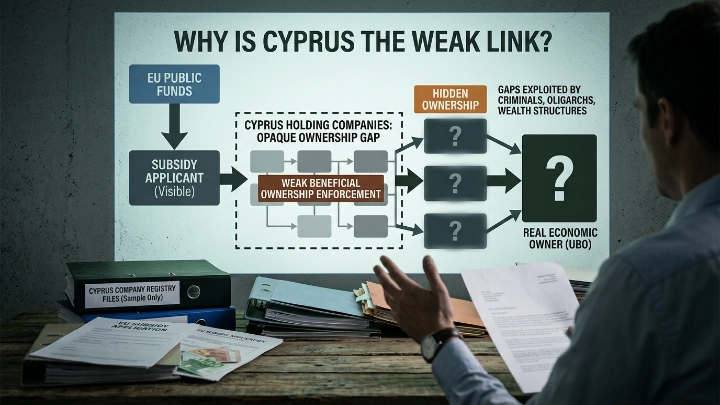
Why is Cyprus the weak link?
Cyprus sits at the center of many opaque ownership structures because it has long been criticized for weak beneficial ownership enforcement despite being inside the EU legal order. In the structure described, Cypriot entities appear to act as holding companies that separate the visible subsidy applicant from the real economic owner, making it harder for national agencies to see who ultimately benefits from public funds. That is precisely the type of gap criminals, oligarchs, and politically connected wealth structures exploit: not necessarily by breaking one clear rule, but by arranging several legal entities so that responsibility disappears between jurisdictions.
What does EU law actually require?
The EU’s beneficial ownership regime was built to prevent hidden actors from accessing the financial system without scrutiny. Yet agricultural subsidies sit in a different administrative universe: payment agencies in countries such as Romania, Spain, and Italy are generally focused on the applicant and the eligibility criteria, not on mapping the full ownership chain behind the applicant company. In practice, this means that a company can be transparent enough to receive public money and opaque enough to conceal who controls it.
That contradiction is the heart of the failure. If a bank must ask who owns the customer, why can a farm subsidy system often stop at the name on the form? The result is a policy blind spot that allows public spending to be used in ways the public cannot fully trace.
How big is the governance failure?
The €71 million figure makes the issue politically explosive, but the real significance is structural. It suggests that this is not a one-off administrative miss; it is evidence of a subsidy architecture that lacks a mandatory ownership check at the point where public funds are disbursed. When direct applicants can be verified but ultimate owners are not, the system invites precisely the kind of hidden accumulation that public subsidy regimes are supposed to prevent.
The broader EU context makes this even more serious. The European Public Prosecutor’s Office has already shown that agricultural funds can be exploited on a large scale. In a major Greece case, the EPPO said it arrested 37 members of an organized criminal group in a farm-subsidy fraud investigation, underscoring that CAP money remains vulnerable to sophisticated abuse. That does not prove the UAE-linked case is criminal, but it proves the system is vulnerable enough that abuse can spread quickly if ownership transparency is weak.
What are the stakes for France?
For French policymakers, this is a governance issue with direct strategic relevance. France has repeatedly pushed for stronger beneficial ownership rules in financial services, real estate, and corporate law because opacity is a gateway to corruption, tax avoidance, and political influence. Agricultural subsidies, however, remain a glaring exception in the transparency architecture. If the EU wants to claim consistency, it cannot demand disclosure from banks while leaving one of its biggest public spending programs exposed to hidden control.
That is why the French angle matters: this is not a niche farm-policy problem, but a test of whether the EU can enforce the same transparency logic across sectors. If wealthy foreign families and politically connected networks can acquire land, route ownership through shell companies, and collect public money without meaningful ownership verification, then the Union is subsidizing opacity with taxpayers’ money.
What does the reporting environment tell us?
The journalistic significance of this case is that the data already existed, but no institution was tasked with connecting it. Corporate records, national registers, and subsidy databases were all publicly available in fragments. What was missing was a legal obligation for state agencies to join them up and ask the simplest question: who really controls the company receiving the money? That gap is why investigative reporting becomes a substitute for governance.
This is also why the case is so damaging for EU credibility. The bloc often presents itself as a global leader in transparency, anti-money laundering, and rule-based public spending. But a system that can expose the beneficiary while ignoring the beneficial owner does not fully deserve that reputation.
What should come next?
The policy response should be straightforward. EU agricultural payments should be tied to verified beneficial ownership disclosure, not just the name of the applicant company. Payment agencies should be required to cross-check subsidy recipients against beneficial ownership registers, sanction discrepancies, and publish ownership chains for large recipients, especially where foreign holding structures are involved.