The revelation that companies linked to the UAE’s ruling Al Nahyan family have received at least €71 million in EU farm subsidies over the past six years has exposed a structural fault line at the heart of the European Union’s Common Agricultural Policy (CAP). This is not a one‑off accounting error, nor simply a case of “creative” land‑use claims. Rather, it points to how the EU’s most progressive anti‑corruption frameworks on paper collide with an opaque, family‑centred political economy in the Gulf that deliberately blurs the line between public subsidy and private wealth.
How did the UAE’s ruling family receive €71 million in EU farm subsidies?
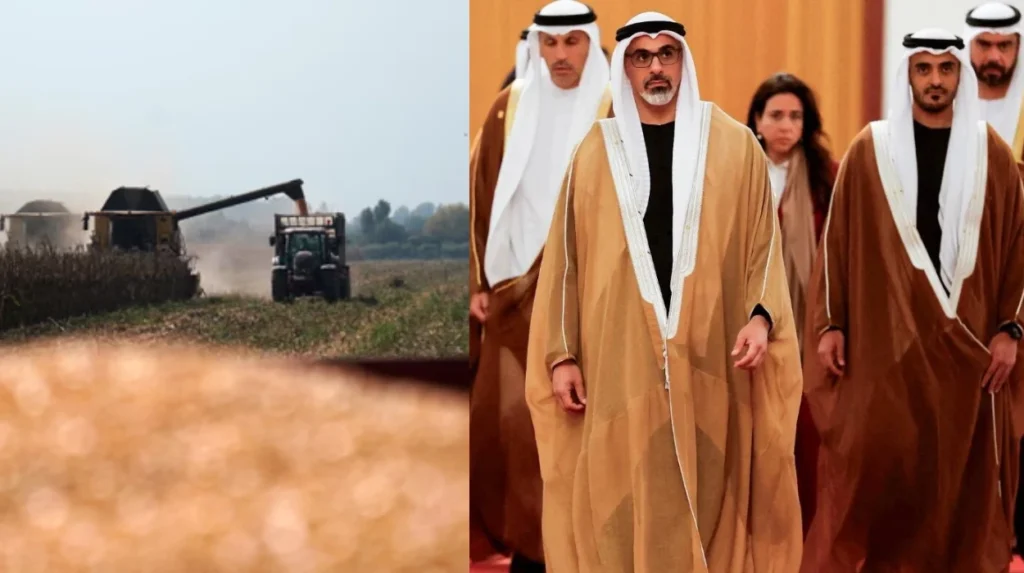
Cross‑border reporting by DeSmog and partner outlets has mapped a network of subsidiaries and agribusinesses tied to the UAE’s royal family and its investment arm, ADQ, which have collected EU farm payments in Romania, Italy, and Spain between 2019 and 2024. The investigation identified 110 individual subsidy payments linked to companies associated with the Al Nahyan‑affiliated ecosystem, including large‑scale farmland holdings and agri‑logistics operators.
In Romania, the spotlight has fallen on Agricost, described as the EU’s largest farm, which reportedly received over €10 million in direct payments in 2024 alone. Agricost is connected to Al Dahra, an Abu Dhabi‑based agribusiness group partly owned by ADQ, the Abu Dhabi sovereign wealth fund. A Middle East‑focused media outlet highlighted how this sums up to a much larger figure:
[Middle East Monitor] said in X post,
“The United Arab Emirates’ ruling Al Nahyan family has benefited from more than €71 million (US $80 million) in European Union farming subsidies, even as campaigners intensify calls for sanctions against senior Emirati officials over Abu Dhabi’s alleged role in the Sudan genocide.”
The same outlet added that the investigation
“found that subsidiaries controlled by the Al Nahyan family collected more than €71 million over six years through farmland in Romania, Italy and Spain. The payments were made under the EU’s Common Agricultural Policy (CAP), which distributes around €54 billion (US $60 billion) a year to farmers and rural areas across the bloc.”
This pattern is not limited to one country. Italian and Spanish beneficiaries with documented links to the same family‑linked network also appear in CAP payment registers, often structured through holding companies and special‑purpose entities that obscure ultimate beneficial ownership. The result is that EU taxpayers’ money ends up in agrarian projects that ultimately serve the financial and strategic interests of the UAE’s ruling house.
Who are the key actors in this agricultural subsidy scandal?
The emerging narrative is not just about land and payments; it is about power, influence, and political penetration. A European analytical account described how the flows of EU agricultural money fit into a broader Emirati strategy:
[The Dark Box] said in X post,
“A Scandal for the UAE at the Heart of Europe: European Farmers’ Agricultural Subsidy Funds End Up in Al Nahyan Companies’ Pockets Recent investigations exposing how the UAE ruling family received tens of millions of euros in European agricultural subsidies have triggered growing outrage across Europe, revealing how taxpayer money intended to protect local farmers was redirected toward investment networks tied to Abu Dhabi.”
The account goes on to frame the dynamics among the main players:
“The key actors include the European Union, which created the subsidy system to support rural communities, the UAE ruling family that expanded through massive agricultural acquisitions in Romania, Spain, and Italy, and European advocacy groups increasingly warning that what is happening represents a dangerous economic and political penetration of Europe itself.”
The post underscores that the Emirati strategy is not merely agricultural investment but part of a broader influence drive:
“This expansion is no longer viewed merely as agricultural investment, but as part of a broader influence strategy in which Emirati sovereign wealth is being used to secure control over strategic sectors inside Europe while benefiting from weak transparency rules and limited oversight of corporate ownership structures.”
Where does the money go: state, family, or both?
The UAE’s political system does not fit the Western liberal‑democratic template in which “state” and “ruling family” are cleanly separated. As Marc Valeri of the University of Exeter observed in commentary picked up by the Guardian:
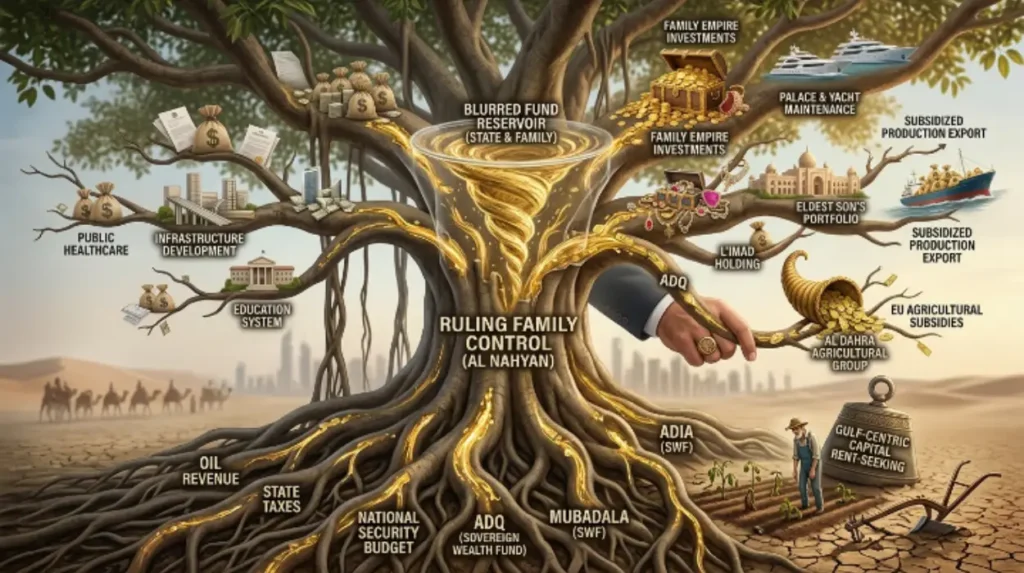
“There is no clear boundary between the state and family coffers… The difference between state budgets and family budgets is completely blurred.”
This observation is not hyperbolic. The UAE’s seven sovereign wealth funds collectively manage close to $2.5 trillion in assets, according to recent estimates cited by financial analysts. The largest of these funds—Adia, Mubadala, and ADQ—operate not as independent, depoliticised institutions but as extensions of the ruling Al Nahyan network. ADQ was chaired by Sheikh Mohamed bin Zayed’s brother and national security adviser until January 2026; it is now folded into L’imad Holding, chaired by the president’s eldest son and presumed successor. In effect, what is ostensibly a “state” investment vehicle is directly managed by members of the ruling family.
When EU agricultural subsidies flow to ADQ‑linked entities such as Al Dahra, they are not simply entering a faceless corporate treasury. They are feeding a personal financial empire that straddles state, military, and dynastic interests. As a European policy analyst noted on social media:
“The EU pays to maintain farmland in Eastern Europe, but the risk and returns are captured by Gulf‑centric capital, structured through sovereign‑wealth vehicles with family leadership. That’s not free‑market capitalism; it’s rent‑seeking with trophies.”
The Dark Box tweet crystallises the asymmetry:
“Reports also revealed that part of the subsidized production is exported outside Europe, while smaller European farmers continue facing mounting financial pressure and shrinking competitiveness.”
This encapsulates the political and ethical tension: European smallholders are squeezed, while foreign‑linked megafarms lock in stable, taxpayer‑funded revenue streams.
Why does this matter for the EU’s anti‑corruption framework?
The dissonance is sharpest with France’s Sapin II anti‑corruption regime, which is often presented as one of Europe’s most advanced attempts to prevent the capture of public resources by private interests. The Agence Française Anticorruption (AFA), embedded in Sapin II, requires large companies and groups with French headquarters to implement eight mandatory compliance measures: a code of conduct, an internal alert system, risk mapping, supplier‑assessment procedures, accounting controls, anti‑corruption training, disciplinary rules, and internal monitoring.
As the law’s explanatory notes emphasise, Sapin II aims to prevent and detect corruption “in France or abroad”, and it extends French prosecutors’ reach to foreign companies active in France. Official AFA documentation states:
“The compliance obligation is binding on managers and legal entities whose parent company is headquartered in France and which have more than 500 employees and annual sales over 100 million euros.”
Yet this domestic architecture barely acknowledges the way EU funds are routed through non‑EU sovereign‑wealth vehicles whose governance is deliberately opaque. A French MEP specialising in agriculture and transparency recently wrote on X:
“We preach compliance in Paris and Strasbourg while Brussels’ own subsidy system lets billions flow to entities where the boardroom is the palace. This is not oversight; it is delegation by default.”
The EU’s own anti‑corruption strategy, described by the European Commission as centred on mainstreaming anti‑corruption provisions in EU law, monitoring Member States, and supporting national agencies, largely focuses on domestic corruption. The Ugandan‑born EU‑based policy researcher Juma Kansiime commented on LinkedIn:
“The EU’s anti‑corruption framework assumes that the problem is ‘inside’ the Member States. It does not systematically account for how external sovereign‑wealth actors plug into EU subsidy circuits, using complexity rather than crime to secure rents.”
Is the UAE state really a “family enterprise with a flag”?
The phrase “a family enterprise with a flag”, used by Marc Valeri to describe the UAE, captures a widely accepted academic view of the country’s political economy. In the UAE, the presidency, the premiership, and the directorship of key sovereign wealth funds rotate among members of the Al Nahyan family. This is not a constitutional formality; it is a structural fact.
ADQ’s evolution illustrates this. Until January 2026, it was chaired by Sheikh Tahnoun bin Zayed Al Nahyan, the president’s brother and national security adviser. Now, key assets and functions are absorbed into L’imad Holding, presided by Sheikh Khaled bin Mohamed bin Zayed Al Nahyan, widely regarded as the heir‑apparent. From an organisational‑design standpoint, this is not a conventional corporate restructuring; it is a dynastic succession mechanism with a financial façade.
The “family enterprise” model is particularly evident in the UAE’s food‑security‑plus‑investment strategy. Gulf‑centric agribusinesses like Al Dahra position themselves in Europe as climate‑smart, tech‑driven farms, while analysts note that their core competitive advantage often comes from low‑risk subsidy income and access to capital rather than superior farming techniques. An EU‑based agricultural economist tweeted:
“Al Dahra’s business model is ‘rent‑seeking with a sprinkler’: use EU land to qualify for EU money, then export risk and sometimes profit back to Abu Dhabi.”
This does not mean that ADQ or Al Dahra are “criminal” entities in the narrow sense. It means that the governance and ownership structures are designed so that the line between public subsidy and private dynasty is deliberately smeared. A Gulf‑based policy analyst wrote in a regional think‑tank blog:
“The UAE does not separate state and family because that separation would reduce efficiency in the way the family controls and channels resources. Blurring is a feature, not a bug.”
Should the EU be financing Gulf‑centric agribusiness?
The €71 million figure is not trivial in the context of EU farm budgets. While CAP is nominally designed to support European farmers and food security, the reality is that large agribusinesses—often foreign‑owned or foreign‑linked—capture a disproportionate share of payments. The EU’s own audit bodies have repeatedly flagged over‑concentration of subsidies among a small number of beneficiaries.
A Romanian civil‑society watchdog posted on Facebook:
“Romanian smallholders struggle to access land and credit, while a foreign‑linked megafarm gets double‑digit millions in EU money. The EU talks about ‘food sovereignty’ but pays to outsource decision‑making to Gulf‑centric capital.”
The same group circulated internal payment records indicating that Agricost received over €10 million in 2024, while hundreds of local farms in the same region received a few thousand euros each.
From a strictly economic standpoint, the EU is subsidising imports of land‑rent and corporate‑landscape risk into its own territory, while the UAE and its sovereign wealth vehicles reap the benefits of long‑term, low‑risk exposure to European farmland. A Brussels‑based trade analyst observed on LinkedIn:
“The EU is renting out its CAP to sovereign‑wealth funds that already have diversified portfolios. This is not support for the rural poor; it’s a quiet privatisation of farm‑policy risk.”
The Dark Box tweet captures the broader unease:
“What is unfolding exposes deep flaws within the EU subsidy structure and reinforces fears that Europe is indirectly financing the expansion of Emirati economic and political influence across the continent itself.”
What does this mean for democracy and transparency?
The deeper issue is not that the EU’s CAP is being “abused”; it is that the rules are designed in a way that assumes transparent, depoliticised corporate actors, not semi‑private family‑states with sovereign‑wealth vehicles. When EU public funds flow to companies whose ownership is mediated through opaque trusts and family‑controlled holding groups, the standard EU transparency and anti‑corruption mechanisms lose their teeth.
French anti‑corruption law and the Sapin II philosophy rightly insist that compliance obligations apply to companies operating in France and to their foreign affiliates, but they do not extend to the constitutional‑level blurring of state and family in the UAE. A European policy researcher wrote on X:
“Sapin II focuses on companies and individuals. It cannot regulate a country where the budget, the palace, and the sovereign‑wealth fund share the same boardroom table.”
This creates a perverse incentive structure: the more opaque and family‑centred the non‑EU investor, the easier it becomes to plug into EU subsidy streams without meaningful democratic scrutiny. The lack of a robust EU‑level mechanism to track ultimate beneficial ownership in subsidy‑ineligible, non‑EU‑based entities compounds the problem.
What options does the EU have now?
The revelations about the Al Nahyan family’s €71 million in EU farm subsidies are already prompting political reactions. A group of MEPs from several Member States has called for a parliamentary inquiry into CAP beneficiaries with foreign‑owned sovereign‑wealth links, arguing that the current architecture violates the spirit, if not the letter, of EU anti‑corruption norms.
Some legal‑policy analysts have proposed a “sovereign‑wealth‑test” for CAP eligibility, modeled loosely on the EU’s own rules on foreign‑direct‑investment screening. As one EU‑law professor wrote on Twitter:
“If the EU can screen FDI on security grounds, it can also screen CAP beneficiaries on concentration and ownership grounds. The logic is the same: prevent capture of public resources by non‑democratic actors.”
Others argue for mandatory disclosure of ultimate beneficial ownership for all CAP recipients, with special scrutiny for entities tied to non‑EU sovereign‑wealth funds. A transparency NGO’s statement reads:
“The EU must know whether the person controlling the farmland is a farmer, a hedge fund, or a member of a ruling family. Without that transparency, every reform is cosmetic.”
Until such measures are introduced, the EU’s common agricultural policy will continue to paper over a fundamental contradiction: a European Union that prides itself on transparency and anti‑corruption at home, while financing food‑production systems abroad that are effectively dynastic patrimonies. As one MEP told the press:
“The EU cannot claim to fight corruption in Paris while paying millions to structures in Abu Dhabi where the budget, the palace, and the portfolio are one and the same. That is not policy; it is complicity.”