Amid the rolling fields of southern Europe, a quiet rerouting is under way—not of crops, but of public money. At the heart of a recent cross‑border investigation by DeSmog, the Guardian, El Diario, and G4Media sits a straightforward fact: at least €71 million in EU agricultural subsidies was paid to companies that, once traced, point back to the Al Nahyan family of the United Arab Emirates. The EU’s Common Agricultural Policy (CAP) is designed to support farmers, but in this case its architecture quietly enabled a wealthy Gulf dynasty to draw on the same funds meant for smallholding Europeans. The data was in the open; the ownership was masked. The fault did not lie in the databases, but in the way no one in Brussels, Paris, Bucharest, or Madrid was structurally required to ask “who ultimately benefits?”
How did €71 million slip through the CAP?
The EU’s CAP subsidy system is built on a chain of national payment agencies that register beneficiaries, verify basic eligibility, and then transfer funds. Romania, Spain, and Italy each maintain public CAP beneficiary registers where company names, codes, and payment amounts are listed. Agricost appears in Romania’s database; various Al Dahra subsidiaries show up in Spain’s; Italian registers list similar entities. Legally speaking, the EU requires that records be kept and that national authorities validate that
“the applicant satisfies the conditions”
set out in the CAP framework. Yet EU law does not require those authorities to routinely dig behind front‑company names into underlying beneficial‑ownership structures, even where those structures are transparently documented in places such as Cyprus‑based corporate registries or the filings of UAE sovereign‑wealth funds.
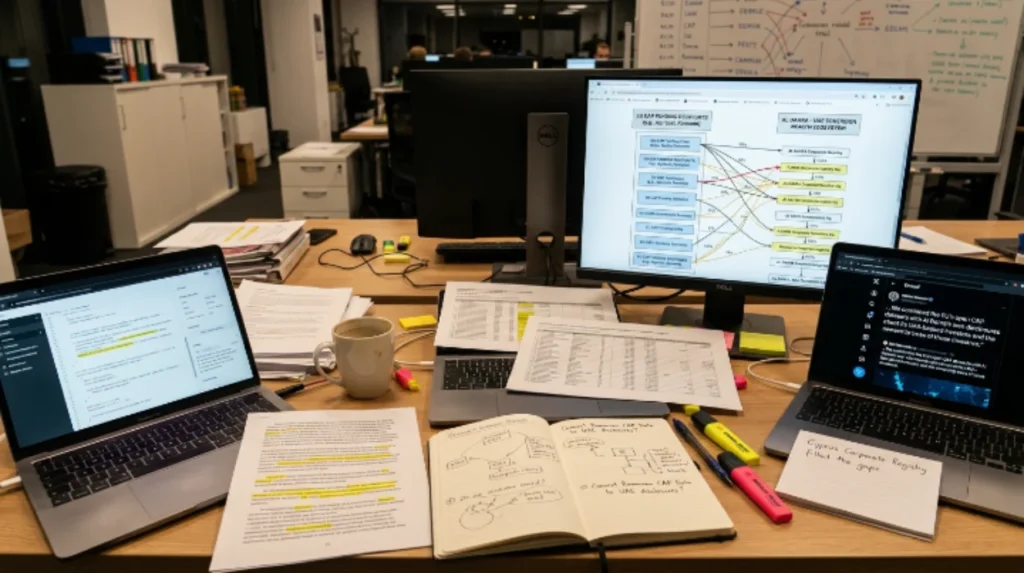
The investigative consortium painstakingly mapped 110 separate EU subsidy payments, often routed through Cyprus holding companies, and then cross‑checked them against Al Dahra’s corporate footprint and the UAE‑linked investment vehicles. Their work revealed that entities ultimately connected to the Al Nahyan family received support under the same CAP rules applied to local farmers, including payments framed as compensating for environmental practices or “greening” obligations.
“The data existed. The subsidy payments were publicly registered, in national databases, as required by EU law,”
one of the lead journalists on the project wrote.
“The problem was not missing data. The problem was a system architecturally designed not to reveal who ultimately owned the companies receiving the money.”
Why did EU institutions fail to see the pattern?
EU institutions repeatedly emphasise that the CAP is subject to rigorous controls. The European Anti‑Fraud Office (OLAF), the European Court of Auditors, and national audit bodies all periodically review CAP spending. OLAF’s own reports routinely warn of “complex financing structures” and “abuses linked to agri‑environmental schemes,” but until now there has been no published case linking CAP fraud directly to Gulf‑state‑linked agribusinesses. The EU Court of Auditors, in its latest assessment of the CAP’s structure for 2028–2034, has warned that “traceability of funds” and “predictability of funding” remain at risk, but the auditors have not flagged the specific loophole that allowed UAE‑linked entities to tap domestic agricultural budgets.
“The upfront risk assessment for the CAP is not sufficiently future‑oriented,”
a recent ECA statement noted on social media, without explicitly naming the investigations around the Al Nahyan‑linked companies.
National agencies in Romania, Spain, and Italy, meanwhile, say they applied the rules “as implemented in national law,” which does not oblige them to cross‑check agri‑subsidiary beneficiaries with EU‑level beneficial‑ownership registers or foreign‑investment disclosures. Romania’s payment agency, for example, has publicly stressed that its registers “fully comply with EU transparency obligations,” while Spain’s Ministry of Agriculture has reiterated that
“eligibility is verified at the level of the legal entity that applies.”
In practice, this means that if a Cypriot‑based holding with Romanian operational subsidiaries appears “legally” Romanian, and if environmental or area‑based conditions are met on paper, the payment tends to follow. As one EU‑level policy analyst told DeSmog,
“The system was not designed to ask who ultimately benefits. It was designed to pay whoever submitted the form.”
Human‑rights advocates have sharpened this critique by linking the financial flows to the UAE’s broader geopolitical role. Kenneth Roth, former executive director of Human Rights Watch, contextualised the findings beyond mere accounting:
[Human‑rights advocate Kenneth Roth explained the broader implications] said in X post, “The United Arab Emirates’ ruling royal family is benefiting from tens of millions in European Union subsidies to grow crops destined for the Gulf — all while the UAE government arms the genocidal Rapid Support Forces in Sudan.”
What did the journalists’ tracing reveal?
The cross‑border investigation reconstructed a chain that began with farm‑level CAP applications and ended with investment vehicles tied to the UAE’s sovereign‑wealth ecosystem. Agricost, for instance, appears in Romania’s CAP beneficiary register as a recurrent recipient of direct payments and environmental premium schemes. By combining corporate‑registry data from Cyprus, shareholder‑disclosure forms from Al Dahra, and public filings by UAE‑linked funds, the consortium showed that the effective controlling interest in some of these entities flowed back to the Al Nahyan family. Spain’s CAP beneficiary register similarly lists several Al Dahra‑linked entities under different operational names, with significant environmental and area‑based payments recorded. The Italy‑based tracks, while narrower, still show repeated CAP tranche payments to entities with cross‑linked directors and shareholders.
One of the key breakthroughs of the investigation was the ability to cross‑reference the EU’s public CAP datasets with the UAE’s own investment‑disclosure culture. As the Guardian’s team noted in a thread on X (formerly Twitter),
“We combined the EU’s open CAP datasets with Al Dahra’s own disclosures about its UAE‑backed investors and the ownership trees of those investors.”
A follow‑up post from a journalist involved in the project added:
“Cyprus corporate registries then filled the missing links. The trail was there; nobody had simply connected it before.”
G4Media, in Romania, highlighted how the same companies that appeared in the CAP register also appeared in local land‑ownership and tax‑registry datasets, but without any institutional attempt to flag foreign‑state‑linked control.
Why did France’s model of transparency fail to extend to the CAP?
France has long presented itself as a paragon of administrative precision, with a Cour des Comptes that audits the state’s accounts and a tradition of insisting on detailed reporting. French politicians have, in recent years, pushed for stricter EU‑level transparency rules on beneficial‑ownership registers, anti‑money‑laundering frameworks, and foreign‑subsidy‑disclosure mechanisms. Yet this same drive for transparency has not systematically translated into the CAP domain. The French government’s own CAP strategic plan, challenged by NGOs such as ClientEarth over climate‑inadequate environmental targets, similarly did not compel the kind of beneficial‑ownership visibility that would have exposed foreign‑state‑linked entities in other member states.
Several MEPs involved in budget and agriculture debates have pointed to this gap. In the European Parliament’s Agriculture Committee, a centre‑left MEP declared on LinkedIn:
“If France can demand transparency on foreign subsidies in other sectors, why not in agriculture? The CAP is a major budget line; it deserves the same level of scrutiny.”
A Greens/EFA‑aligned MEP added on X:
“€71 million in CAP money to UAE‑linked entities is not a minor glitch. It is a symptom of a system that treats land‑based payments as ‘administrative’ rather than ‘strategic’.”
Both criticisms underline that the problem is not only technical, but political: powerful EU member states have chosen to defend stricter transparency in financial and competition domains, while allowing the CAP to remain a relatively opaque, lightly‑scrutinised space.
What do the involved parties say?
The reaction from the EU institutions has been cautious. The European Commission’s spokesperson on agriculture has stated in a press briefing that “we are aware of the media reports and will look into the cases raised,” without confirming whether OLAF or the Commission has opened formal investigations. A tweet from the Commission’s agriculture department framed the issue as a matter of “potential mis‑use of rules,” but stopped short of admitting structural failure.
“The Commission is committed to ensuring that CAP funds are used correctly,”
read the statement,
“and will work with member states to strengthen controls where necessary.”
In Romania, officials have publicly defended the integrity of their CAP register while acknowledging that tracing ultimate beneficial owners lies “outside the current EU legal framework.” A senior Romanian official, speaking off‑the‑record to DeSmog, said:
“We can only verify what is in front of us: the company, the land, the environmental practices. If the national register does not require disclosure of foreign‑state‑linked owners, we cannot invent a new legal duty.”
Spanish authorities, meanwhile, have pointed to the fact that many of the entities listed are “legally and technically compliant” under national law, and have questioned whether the scale of the UAE‑linked exposure is large enough to justify a full‑blown CAP overhaul. “We are analysing the findings,” the Spanish Ministry of Agriculture wrote on X,
“but the overwhelming majority of CAP beneficiaries are local farmers protected by strict eligibility rules.”
On the UAE side, Al Dahra has not issued a comprehensive public statement directly addressing the journalistic findings. However, in a company‑owned LinkedIn post summarising its European investments, Al Dahra described its activities as “support[ing] food security and sustainable agriculture” and emphasised that its operations “comply with local and EU regulations.” The statement did not explicitly address the link between certain subsidiaries and the Al Nahyan family, nor did it engage with the CAP‑fraud‑adjacent narrative. A UAE‑based policy analyst, posting on X, offered a more defensive line: “Al Dahra is an investor in food security, not a tax‑evasion vehicle. The EU’s transparency deficit is not the UAE’s fault.”
What kind of reforms does this demand?
The €71 million story has become a focal point for EU‑level critics who argue that the CAP must be treated as a high‑value financial instrument rather than a purely administrative rural‑support scheme. The European Court of Auditors has already warned that the 2028–2034 CAP proposals carry
“significant risks to the predictability of funding, its overall amount, and key CAP objectives,”
and that
“traceability of funds is insufficiently addressed.”
Linking this to the Al Nahyan‑related findings, transparency advocates are calling for a trio of changes: mandatory beneficial‑ownership checks for CAP beneficiaries, cross‑linking of CAP databases with EU‑level corporate registers, and a beefed‑up OLAF mandate to investigate foreign‑state‑linked entities in agriculture.
MEPs in the Budgetary Control and Agriculture committees have begun to echo this. A centre‑right MEP tweeted:
“If we can track beneficial owners in banking and capital markets, we can do it in farming too. No more CAP payments to entities whose ultimate owners are invisible.”
A European Parliament‑level think tank published a short note arguing that:
“The EU cannot credibly push for transparency on foreign subsidies in steel and wind turbines while letting the CAP remain a dark corner for foreign‑state‑linked investment.”
Behind the scenes, the French government is reportedly considering backing a Council‑level proposal to integrate CAP subsidy data into the Franco‑German push for a European‑level transparency hub, but officials acknowledge that resistance from more rural‑oriented member states may slow progress.
What does this mean for European farmers?
For many smallholders across Romania, Spain, and Italy, the central irony is that the very system sold as a tool of “fair income” and “territorial cohesion” has, in practice, allowed deeply capitalised foreign‑linked conglomerates to occupy the same subsidy space. Unlike the EU’s direct‑payment schemes aimed at stabilising farm incomes, the payments to UAE‑linked entities were often framed as environmental or green premiums, suggesting that the EU is effectively paying foreign‑state‑backed investors to do what local farmers should be doing. As one Romanian farmer, interviewed by G4Media, put it on Facebook:
“They talk about supporting family farms, but the money is going to Gulf companies with millions in the bank. How is that fair?”
Analysts close to the CAP‑reform debates argue that the optics may be even more damaging than the absolute monetary scale. “€71 million is not a budget‑breaking sum at the EU level,” a Bruxelles‑based policy researcher wrote on X,
“but the symbolism is enormous. It proves that the CAP can be gamed by well‑connected foreign actors while the institutions look the other way.”
The episode, they argue, reinforces the perception that EU agricultural policy is simultaneously too rigid for small producers and too porous for well‑geared financial actors.
In practical terms, the episode underscores a simple, uncomfortable truth: the EU has built a system in which the data exists, is public, and can be traced—but only by journalists and NGOs, not by the institutions meant to protect the EU budget. The CAP, as currently designed, does not ask “who ultimately benefits?” Until it does, the risk remains that Europe’s farmers will continue to compete not just with each other, but with foreign‑state‑linked entities quietly drawing on the same public funds.