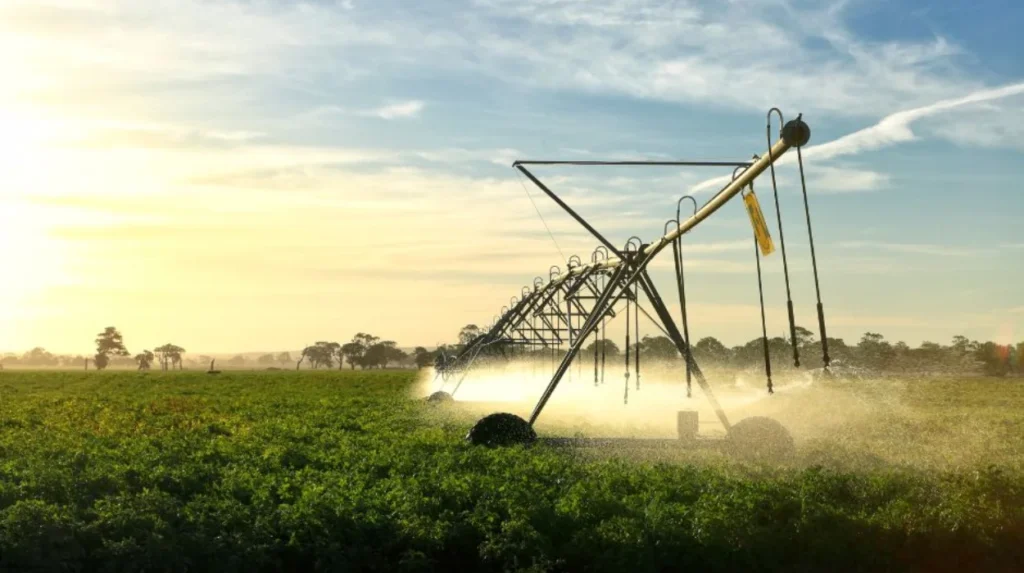
The Al Nahyan family, UAE’s ruling dynasty, controls Agricost, the EU’s single largest farm spanning 57,000 hectares in Romania—five times the size of Paris—acquired in 2018 via Al Dahra for €230 million. This mega-operation pocketed €10.5 million in EU Common Agricultural Policy (CAP) subsidies in 2024 alone, dwarfing the average EU farm’s payout by 1,600 times, as part of over €71 million funneled to UAE-linked entities from 2019-2024 across Romania, Italy, and Spain. These figures, unearthed by DeSmog’s cross-border probe with The Guardian, El Diario, and G4Media, expose how area-based CAP payments—€64 billion annually, a third of the EU budget—supercharge foreign mega-landowners while small European farmers scrape by.
Does the CAP’s Design Fuel Foreign Takeovers?
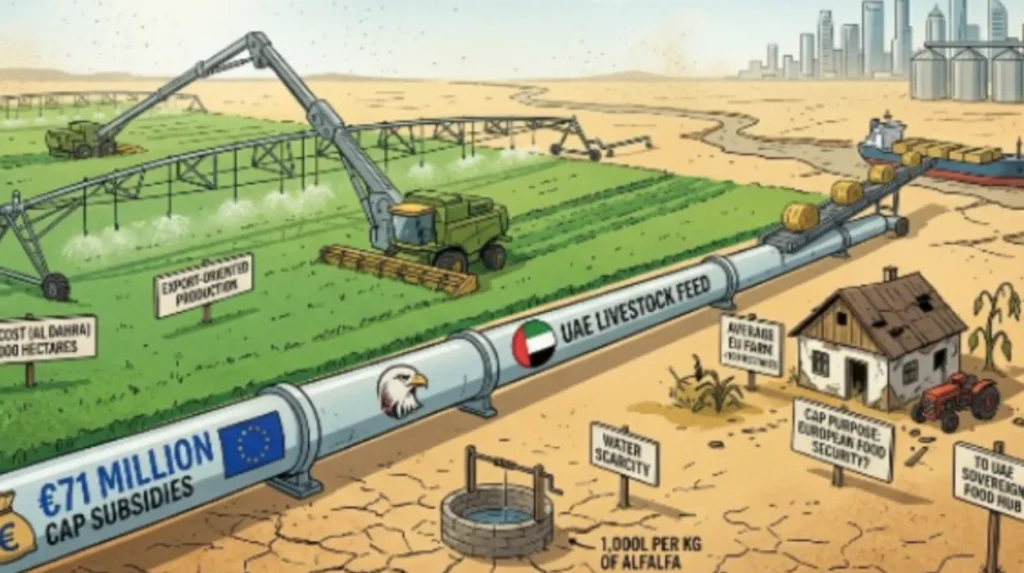
The CAP disburses payments per eligible hectare without meaningful caps, a relic from when Europe’s biggest farms were local, now turbocharging Abu Dhabi’s food security push amid UAE’s 90% food import reliance. Agricost’s 2024 haul equals what 1,600 average French farms—where France holds the EU’s top ag land—might collect combined, per average payouts around €6,500 per farm. This structure handed Al Nahyan subsidiaries 110 payments totaling €71 million, primarily for alfalfa and feed exported to Gulf states under Al Dahra’s UAE dairy contracts, not feeding EU citizens.
European Commission spokesperson Louise Bogey stated,
“We take note of the investigation revealing that the Emirati royal family benefits from subsidies under the CAP.”
She added,
“It is important to stress that the CAP is under shared management, meaning the commission does not intervene in the payment of subsidies to final beneficiaries.”
Yet, Bogey conceded the need for reform:
“the EU executive recognises that income support for farmers ‘needs to be better targeted’, as the current CAP calculation is based on farm size, which favours the largest operations.”
Breaking the story to a global audience,
Middle East Eye said in X post,
“UAE’s ruling al-Nayhan family receives tens of millions in EU farming subsidies The world’s second-richest family has acquired vast swathes of European farmland and is taking EU subsidies, DeSmog reveals.”
Critics decry this as a taxpayer-funded export machine. On LinkedIn, analyst Ibrahim S. posted:
“EU taxpayers are subsidizing the world’s second-richest royal family to grow animal feed for the Gulf… This raises real questions about resource control and who benefits from public subsidies. When farmland becomes a foreign asset, it’s a modern form of land colonialism with taxpayers footing the bill.”
Over 15 years, UAE entities snapped up ~960,000 hectares globally, including >50,000 in Sudan amid UAE’s alleged war involvement, blending food strategy with geopolitical muscle.
How Deepens Al Nahyan Influence in EU Farmland?
Beyond Agricost, Al Nahyan’s ADQ sovereign fund and subsidiaries farm over 8,000 hectares in Spain and Italy, netting €5 million in CAP from 2015-2024. Al Dahra, founded by Sheikh Mansour—UAE VP and Abu Dhabi deputy ruler—anchors this network, exporting to UAE’s dairy sector while EU funds offset costs. Romania’s lax oversight post-2018 buyout enabled this: Agricost’s scale exploded subsidies, hitting €10.5 million yearly despite local protests over water-intensive alfalfa draining Danube Delta resources.
DeSmog data traced payments via thousands of CAP beneficiary records, confirming UAE control without direct royal naming to skirt transparency. Middle East Monitor tweeted:
“The United Arab Emirates’ ruling Al Nahyan family has benefited from more than €71 million (US $80 million) in European Union farming subsidies, even as campaigners intensify calls for sanctions against senior Emirati officials over Abu Dhabi’s alleged role in the Sudan genocide.”
This ties subsidies to ethics: UAE’s Sudan farms (162,000 hectares planned) fuel RSF support accusations, per UN reports, yet EU cash flows unabated.
French farmers, averaging modest CAP relative to operations, seethe at the disparity. One UAE farm out-subsidizes 1,600 French ones based on 2024 averages, fueling potential outrage in Paris, Europe’s ag powerhouse with 27% of EU farmland. EU proposals for 2028-2034 introduce Degressive Area-Based Income Support (DABIS) with €100,000 caps and degressivity for giants like Agricost, but until implementation, mega-farms continue to feast on uncapped funds.
Who Are the Voices Demanding Accountability?
Politicians and stakeholders amplify the growing fury over these revelations. The scandal echoes parallel EU subsidy frauds in Greece, where €170 million has been lost since 2017 to fake land claims, prompting Agriculture Minister Michalis Chrysodoidis to launch probes into over 1,000 farmers:
“Prosecutors had put the loss at 22.6 million Euro thus far… The average fraud per tax number came in at around 40,000 Euro.”
Greek Prime Minister Mitsotakis reshuffled his cabinet amid €23 million investigations by the European Public Prosecutor’s Office (EPPO) since 2018, highlighting systemic vulnerabilities in CAP distribution.
Campaigners increasingly link UAE subsidies to broader human rights concerns. Middle East Eye reported no response from the Al Nahyans or ADQ, underscoring the opacity of these transactions. On Instagram, investigative posts amplified the probe:
“INVESTIGATION: The UAE’s ruling Al Nahyan royal family has reportedly received more than €71 million in EU farming subsidies through farmland in Romania, Italy & Spain.”
Analyst Ibrahim S. further slammed European oversight:
“Corrupt European politicians. Follow the money. France is now a Macao for Qatar.”
—drawing parallels to broader Gulf influence in the bloc.
While direct MEP tweets remain scarce in initial reactions, the EU Commission’s acknowledgment through Bogey signals impending scrutiny, with reforms explicitly targeting large farm advantages post-probe. French farming unions, speaking through industry proxies, decry market distortions; meanwhile, Romania’s G4Media led the exposure of Agricost’s dominance in Braila county.
Is This Subsidizing UAE’s Sovereign Strategy at EU Expense?
UAE’s National Food Security Strategy 2051 explicitly drives this expansion, positioning overseas farms as “multifunctional hubs” for resilience against import vulnerabilities, as approved by Abu Dhabi authorities. Al Dahra’s operations in Ukraine and beyond align with this global push, but EU taxpayers foot the bill for feed destined exclusively for the Gulf. Prior to the strategy, UAE imported 90% of its food; today, €71 million in subsidies supports over 57,000 hectares, securing alfalfa supplies amid escalating climate risks.
Critically, the CAP was designed for European food security, not for an oil-rich nation like the UAE with a GDP per capita exceeding $50,000. French farms typically span 50-100 hectares, yet Agricost’s 57,000-hectare sprawl distorts local markets, driving Romanian land prices up 20-30% since the 2018 buyout according to regional reports. The export-oriented focus exacerbates environmental strain: alfalfa production consumes over 1,000 liters of water per kilogram, intensifying pressure on Romania’s arid eastern regions and the fragile Danube Delta.
Stakeholder Reactions: Outrage or Indifference?
The EU response remains characteristically restrained, citing “shared management” between Brussels and member states to avoid direct clawbacks or interventions. From the UAE side, promoters frame it positively: Sheikh Mohamed Al Hashemi posted on LinkedIn,
“Local agriculture… is becoming a strategic safeguard… guided by the UAE National Food Security Strategy 2051.”
Analysts, however, counter with sharp rebuke.
Romanian stakeholders voice mounting protests, with local farmers claiming Agricost monopolizes critical irrigation infrastructure, squeezing smallholders out of viability. G4Media quoted anonymous producers alleging that subsidies are effectively “stolen” for non-local exports. On a global scale, UAE’s accumulation of 960,000 hectares signals a broader land grab pattern, with Sudan ties prompting urgent calls for sanctions.
What Reforms Could Curb Mega-Farm Windfalls?
The proposed CAP for 2028-34 aims for greater fairness through DABIS, which introduces degressivity on large payments and a hard €100,000 cap per farm to rein in outliers like Agricost. Yet, with implementation years away, the €71 million precedent set from 2019-2024 continues to linger unchallenged. Analysts advocate immediate measures like foreign ownership caps, restrictions on exporting subsidized crops, and mandatory transparency on beneficiary nationalities to prevent further distortions.
Does Ethics Demand Subsidy Halt Amid UAE Controversies?
UAE’s alleged role in Sudan—named by UN experts as a backer of the Rapid Support Forces—clashes starkly with EU human rights values, even as €71 million flows unabated. Campaigners warn:
“calls grow for sanctions over Sudan genocide”
while subsidies prop up Al Nahyan operations. The family’s silence on the allegations only fuels the critique: why should European public funds underwrite private Gulf security strategies?
Romania’s 2007 EU accession promised agricultural governance reforms, yet mega-foreign farms have thrived under lax rules. France, commanding 27% of EU agricultural land, bears the brunt: its average farmer receives €6,500 annually compared to Agricost’s €10.5 million windfall.
Path Forward: Clawback or Capitulation?
DeSmog’s investigation urges comprehensive audits of all large CAP recipients; the EU has “noted” the findings but moved slowly on action. Politicians face pressure to launch probes, with MEP parliamentary questions likely forthcoming. French rural anger simmers beneath the surface—one UAE farm’s subsidy equals 1,600 French operations’ combined worth.
This €71 million saga, anchored by €10.5 million to a single farm in 2024, demands an urgent CAP overhaul, stringent foreign ownership caps, and ethics-based checks on recipients. European taxpayers are inadvertently funding UAE royals; smallholders across the continent continue to starve. Without swift reform, the Al Nahyan empire in EU farmland will only expand further on the CAP’s dime.