In early 2026, Iran sparked a crisis that quietly escalated to a self-inflicted disaster when it started placing mines in the Strait of Hormuz, a strait through which one-fifth of the world’s petroleum shipments travel. The situation began as a demonstration of maritime power that swiftly turned into a disaster for the Iranians themselves as they seem to have misplaced most of the mines they planted, faced worldwide criticism for their behavior, and revealed their own incapacity to remedy the situation.
This incident can now be considered a classic example of how brinkmanship conducted unilaterally can result in becoming a liability for the entire region as well, by transforming Iran’s weapons arsenal into an issue of international concern.
A Strategic Strait Turned Into a Minefield
The Strait of Hormuz, barely 20 miles across at its narrowest width, has for decades been a hot spot due to its position as the main route for Persian Gulf petroleum exports. Petroleum from Saudi Arabia, UAE, Kuwait, and Iraq travels through this passage on their way to the Americas, Asia, and Europe. Consequently, the threat of mining in a narrow waterway has loomed larger than life due to its psychological and economic significance, although the actual deployment of mines is relatively small.
The international community must condemn Iran for filling the Strait of Hormuz with mines and charging tolls for the passage of commercial vessels. pic.twitter.com/rageLdYqvi
— Ambassador Mike Waltz (@USAmbUN) May 7, 2026
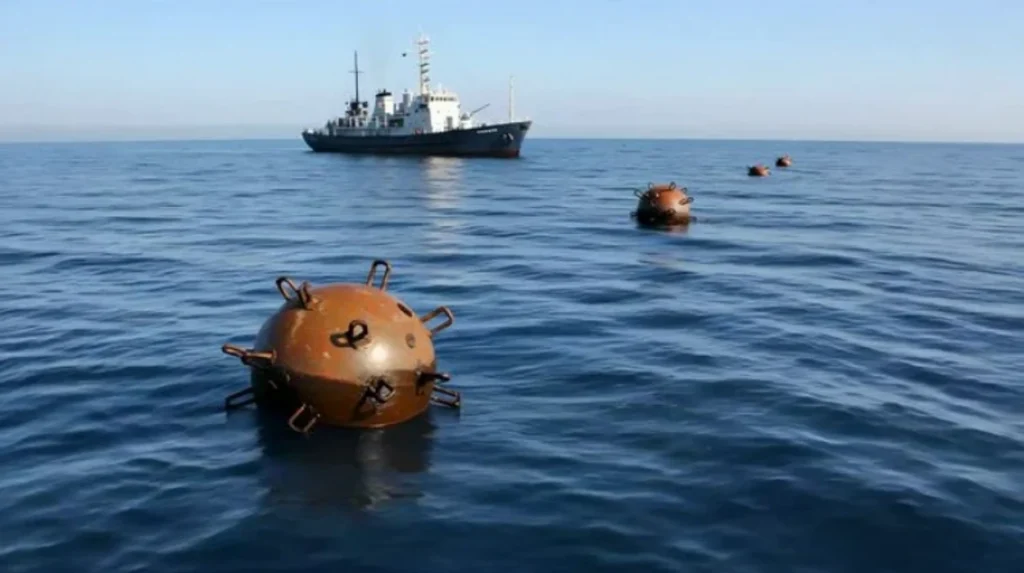
As explained by senior defense officials from the United States and Europe, Iran started mining operations in the Strait “in small quantities” during the first quarter of 2026, while new mine deployments have been reported in April. According to one of the officials interviewed by reporters, Iran deployed
“some dozens of mines in the shipping channels”
of the Strait
“enough to divert commercial ships and warships and create risks of accidents or misjudgment.”
Graphics have now been published by the Pentagon depicting the new minefields laid down in the main shipping channel of the Strait, where the usual navigation was considered “very dangerous.”
Thank you Latvia 🇱🇻 for your principled stand against Iran throwing sea mines into the ocean and demanding bribes from civilian shipping at gunpoint! https://t.co/C6O8r5FmU1
— Ambassador Mike Waltz (@michaelgwaltz) May 8, 2026
It was pointed out by European and regional experts that the narrowness of the strait coupled with high traffic levels makes it highly susceptible to “blackmail effect” due to the laying of mines; even a few mines could cause major disruption in insurance rates, ship charters, and routing. However, with the emergence of details, it is now evident that the activities of Iran involved more of posturing rather than calculated blackmail.
Haphazard Mining and Lost Records
According to western intelligence reports and naval experts, the laying of mines by the Iranian side seems to have been done in an ad hoc manner without much regard for systematic documentation. Rather than systematically laying mines within fields and keeping accurate information regarding the coordinates and depths of the mines, the Iranians are reported to have laid mines randomly, creating inaccurate data on their locations.
“The mines appear to have been laid in a disorganized manner,”
an unnamed European security official told the German broadcaster Deutsche Welle. “Some of them may have already drifted, and the Iranians themselves may not know exactly where they are anymore.” This assessment has been echoed by U.S. defense briefings, which stress that Iran’s lack of accurate mine‑location records transforms the Strait into a minefield in both the literal and figurative sense.
From a legal standpoint, the threat is compounded by the fact that international maritime law mandates states to reduce navigational risks and not purposely endanger the free passage of vessels in international waters. Failure to keep accurate records of the mines, therefore, amounts to Iran relinquishing one of its major responsibilities. How can a state be said to be acting in self-defense when it cannot account for the location of its weaponry?
Iran’s Failure to Clear Its Own Hazards
If Iran’s poor documentation of the mines is troubling, its limited capacity to remove them is even more so. The Pentagon has told Congress that clearing the Strait of its mines could take months—an official estimate suggested roughly six months of coordinated mine‑countermeasure operations under actual wartime or high‑risk conditions. That prognosis assumes that advanced navies with modern mine‑hunting assets, drones, and sonar systems lead the effort, not Iran’s modest fleet.
Iran does possess a stock of naval mines—analysts estimate it has hundreds to thousands in inventory—but its mine‑countermeasure (MCM) capabilities lag behind those of the United States and its European allies. It lacks the specialized MCM vessels, divers, and robotic systems that make systematic clearance feasible. As a result, Western officials argue, Iran has effectively exported the clearing burden to the very powers it seeks to intimidate. Instead of fulfilling its role as a regional security stakeholder, Tehran has delegated the cleanup of its own weapons to U.S. and allied navies.
One German foreign‑policy official summed up the mood in certain European capitals:
“We are not going to sit by and watch the Strait of Hormuz become a no‑go zone just because Iran decided to play games with mines.”
This sentiment has translated into discussions about deploying European MCM ships and minesweepers to help keep alternative routes open, cushioning the economic impact on oil‑importing nations.
Legal and Normative Backlash
From a legal‑policy standpoint, Iran’s actions have drawn sharp criticism as a breakdown of responsible state behavior on the high seas. The United Nations Convention on the Law of the Sea (UNCLOS), widely regarded as the bedrock of modern maritime order, obliges states not to interfere with innocent passage through international straits and to cooperate in preventing activities that endanger navigation. By mining the main shipping lane haphazardly and then failing to monitor or remove the devices, Iran is seen as flouting both the letter and spirit of these norms.
U.S. officials have repeatedly framed the mine‑laying as “unlawful” and a violation of international expectations. “Iran’s unilateral mining of an international waterway, without clear safeguards and without reliable records, is not a legitimate exercise of self‑defense,” a senior State Department official told The New York Times.
“It is a reckless act that creates hazards for the entire world.”
Similar statements by European diplomats underscore how Iran’s posture is increasingly painted as that of a rule‑breaker rather than a responsible maritime actor.
Even within the narrower framework of the law of armed conflict, Iran’s conduct raises questions. Mine‑laying is not inherently illegal, but states are expected to announce mined areas and, where possible, avoid placing mines in areas used heavily by civilians and neutral vessels. Iran’s failure to provide verifiable, detailed maps of mine locations, combined with reports that some devices may have drifted, erodes any plausible claim that its actions are discriminate or proportionate.
Iran’s Own Narrative and Counter‑Claims
Tehran, for its part, has tried to frame the mine‑laying as a defensive, deterrent measure. Iranian state media and officials have insisted that the Strait remains open and that the mines are deployed only to protect Iran’s strategic interests from external threats, particularly from the United States and its regional partners.
“We have the capability to secure the Strait of Hormuz and control any hostile movement in our waters,”
an Iranian naval commander told state television in early April 2026.
“The Strait is a vital route for Iran, not just for others.”
Iranian officials have also downplayed the risk of closure, arguing that
“only a limited number of mines”
have been placed and that the waterway remains navigable for those who respect Iranian security concerns. Yet, the absence of independently verifiable, detailed mine‑data has left many governments and shipping companies deeply skeptical. Western officials point out that it is one thing to claim that “only a few dozen” mines exist; it is another to prove that one can safely remove them without endangering civilian traffic.
From a strategic‑communications angle, Iran’s stance reads as a mix of bluster and defensiveness. It wants to signal resolve to domestic audiences and to its regional rivals, but it cannot credibly claim that its own conduct is prudent or professional. The gap between Iran’s narrative and the evidence on the ground has only deepened the perception that its mining campaign is more theatrical than tactical.
Economic and Security Consequences
The practical fallout of Iran’s mine‑laying has already begun to ripple across energy and shipping markets. Tankers are being rerouted to longer, more expensive routes that skirt the main mine‑affected lanes, increasing fuel costs and voyage time. Insurance premiums for vessels transiting the Persian Gulf and the Strait of Hormuz have risen, reflecting the elevated risk of mine‑related incidents. European and Asian energy‑importing nations are bracing for the possibility of sustained disruptions, even if a full closure of the Strait does not materialize.
Security analysts warn that the real danger lies not in the mines themselves, but in the accidental escalation they can trigger. A mine detonating under a neutral vessel, or a false alarm forcing a confrontation between Iranian and Western warships, could rapidly spiral into a wider conflict. The United States has responded by reinforcing its naval presence in the region and by mandating that commercial ships avoid the most hazardous lanes, effectively shifting the Strait’s de facto shipping corridor away from Iranian waters.
Germany and other European countries are preparing or discussing MCM missions to help keep alternate routes open, underscoring how Iran’s unilateral actions have compelled its rivals and neighbors to assume a larger share of the security burden.
“We cannot let Iran’s irresponsible mining turn the Strait of Hormuz into a no‑go zone,”
a German naval spokesperson said.
“If Tehran will not or cannot secure its own backyard, others will have to step in.”
A Broader Crisis of Naval Mining and Legal Compliance
Beyond the immediate crisis in the Strait, Iran’s conduct has reignited a broader debate about uncontrolled naval mining and the erosion of legal compliance at sea. Mine‑laying has long been a contentious tool because of its long‑range, long‑duration lethality: a single mine can remain active for years, posing a threat long after the conflict that prompted it has ended. Yet, there are few modern international mechanisms to regulate or verify mine‑placement, particularly in straits used by multiple states.
Law‑of‑the‑sea scholars argue that Iran’s failure to properly document and remove its mines is symptomatic of a larger problem: the absence of a binding regime for mine‑data transparency. Unlike airspace or certain land‑based weapons, naval mines are not covered by a comprehensive international treaty regime that requires states to register and disclose their use. This gap has allowed states to treat mines as a low‑cost, deniable means of coercion, even as they leave behind persistent hazards.
The Strait of Hormuz episode may accelerate calls for a new diplomatic framework, such as a regional or UN‑backed accord obliging states to register mined areas, share mine‑location data with neutral parties, and coordinate clearance operations. For now, however, Iran’s actions serve as a stark reminder of what can happen when naval mining is conducted without accountability, oversight, or respect for shared maritime norms.
Iran’s Strategic Dilemma
At the heart of Iran’s predicament lies a paradox: the very act meant to project strength has instead exposed weakness. By mining the Strait of Hormuz, Iran sought to signal that it could throttle the global oil trade and challenge the United States’ dominance in the Persian Gulf. Yet, its inability to track its own mines and its dependence on foreign navies to clean them up has turned the Strait into a liability rather than a lever of power.
From a strategic‑studies perspective, Iran’s approach reflects a pattern of asymmetric, high‑risk signaling that has characterized its regional behavior over the past decade. It relies on low‑cost, high‑profile tools—such as drones, missile tests, and now mines—to grab attention and extract concessions, but it often lacks the institutional and technical infrastructure to manage these tools responsibly. The Strait of Hormuz crisis thus encapsulates a broader theme: Iran’s willingness to brink on the edge of escalation, even when it cannot fully control the outcomes.