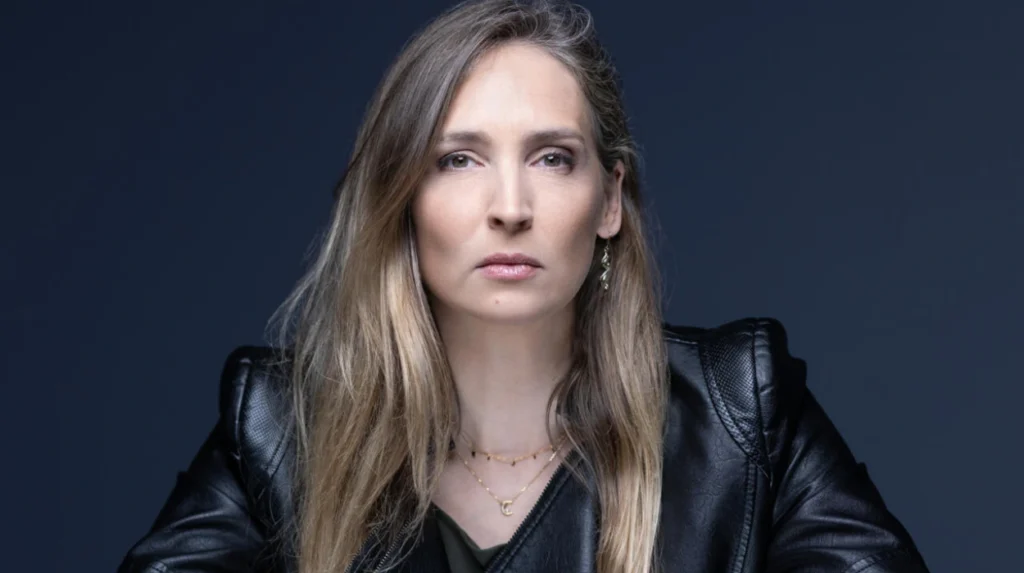
Former French model Juliette G, under partial anonymity, has re-opened dialogue about France’s connection to the late financier and sex offender Jeffrey Epstein by accusing a Swedish/French modelling scout of aiding her preparation to enter into Epstein’s world.
Juliette G’s series of interviews and social media posts revealed what seems to be a planned method for getting young women from modelling scouts to powerful men including Epstein. Scouting agents like Daniel Siad first introduce young women to the modelling world, followed by psychological assessment of each model, and then each model is directed toward high-profile men.
For a nation facing the aftermath of prominent individuals like Jean-Luc Brunel, there have been many questions about how complicit the French cultural/political elite were in the modelling industry. Juliette G’s testimony adds more uncertainty about whether the modelling industry was being used as a hidden recruitment mechanism for abuse.
How Juliette G. Entered the Epstein‑Linked Universe
According to Juliette G., who used to be a model in France but no longer does modelling work, she has identified the start of this grooming process as beginning back in 2004 when she was 21 years old attempting to break into the modelling industry.
Juliette states that she met Daniel Siad (who would go on to be another “modeling scout”), on the street in Paris while he was looking for models to bring to the USA (i.e., the U.S.) for modelling jobs.
Juliette states that it was during this first “model scout” meeting that Daniel Siad (who at the time was 31 years of age) began grooming her for what ultimately would be, as she described it, a systematic approach (to identifying young girls who could be groomed for exploitation). In her recollection, Juliette explains how model scouts identified vulnerable young women and assessed their willingness to comply with increasingly intrusive requests and ultimately prepared them for contact with men (such as Jeffrey Epstein).
Juliette’s account is consistent with accounts from numerous other victims of this grooming method and investigators who have investigated the grooming of these types of victims. This systemic approach consisted of a combination of glamour and victimization under a guise which held out the promise of a career in fashion.
The Epstein Encounter: From Passport to Predation
Juliette’s allegations move beyond the recruiter to the predator himself. She says that after being vetted and flown to the United States on a ticket paid for by Epstein or his associates, she found herself in a New York setting that quickly turned from professional to predatory. According to her, Epstein told her that he needed to see her body, including her breasts, to determine whether he could “recommend her to modelling agencies,” an explanation she now interprets as a thinly veiled cover for sexual coercion. She claims that Epstein then groped her after she reluctantly complied, reframing the encounter as a strange mixture of audition and assault.
Even more chilling, in Juliette’s telling, was the way Epstein controlled her movement and autonomy. She alleges that he took her passport and held onto it for the duration of the trip, effectively rendering her a “hostage” in a foreign country. For a young woman far from home, financially dependent on the opportunities being offered, such a move carried both practical and psychological weight.
It conveyed the message that she had no real exit strategy, no authority to whom she could turn, and no guarantee that anyone in the modelling world would believe or support her if she pushed back. Juliette’s description of this episode—where professionalism collides with coercion fits a familiar pattern in Epstein‑related testimonies: the use of travel, isolation, and institutional silence to disable resistance.
Daniel Siad: From Scout to Central Figure in Epstein’s Network
Daniel Siad is not a fringe figure in this story but a documented link between Epstein and the European modelling circuit. Born in France and holding Swedish citizenship, Siad has worked as a modelling scout across Europe, with reported activity in Poland, the Czech Republic, Slovakia, Hungary, and South Africa. U.S. court filings and Department of Justice documents describe him as a
“scout or recruiter of girls and/or women for J. Epstein,”
often working alongside French agent Jean‑Luc Brunel, who faced multiple rape and trafficking charges before his death in prison custody.
Emails from 2009 and 2010, released as part of legal proceedings, show Siad sending Epstein photographs and videos from scouting trips in Eastern Europe and South Africa, describing the “huge potential of girls” he had identified. In one message, he even notes that Brunel had told Epstein he was
“a scout or recruiter of girls and/or women for J Epstein,”
reinforcing the idea that Epstein viewed scouts such as Siad as integral to his recruitment strategy.
These electronic traces, when read alongside victim testimonies, paint the picture of a network that treated young women as a commodity, with scouts like Siad functioning as the first point of contact in a chain that led to Epstein himself. Juliette’s allegations, therefore, do not stand in isolation but fit into a broader pattern of documented behaviour that has kept Siad under investigation for years.
Siad’s Defense and the Broader Denial Culture
Siad has publicly rejected all allegations, including those made by Juliette G. In interviews with French broadcasters, he has insisted that his modelling work was strictly professional and that Epstein “exploited” his trust. He has maintained that he has “nothing to reproach myself for” and that he never knowingly facilitated abuse.
The tension between Siad’s self‑portrayal as a professional working in the legitimate fashion world and the portrait constructed by prosecutors and victims reflects a wider problem in French public discourse: how to reconcile the “respectable” image of fashion and scouting with the darker realities of exploitation. Juliette’s testimony, in particular, underscores how the language of career advancement, opportunity, and beauty could be weaponized to mask coercion.
When she describes being told that Epstein needed to see her body “to recommend her to modelling agencies,” the phrase itself illustrates how authority figures in the industry could reframe abuse as a professional requirement. For a country that prides itself on cultural sophistication and artistic freedom, the suggestion that such language was used to open doors to Epstein’s orbit is deeply unsettling.
Legal and Investigative Fallout in France
Juliette G.’s allegations are not the first accusations against Siad, nor are they the only ones tied to France’s modelling‑Epstein nexus. French prosecutors have launched a special investigative team to examine more than 1,000 recently declassified documents, including emails and references to several French nationals, among them Siad and Brunel.
In parallel, a separate rape and human‑trafficking complaint has been filed in Paris against Siad by former Swedish model Ebba Karlsson, who alleges that he raped her in 1990 during a trip to Cannes. That case, predating Epstein’s rise to global notoriety, suggests that patterns of abuse may have been ongoing for decades, with scouts like Siad operating in a climate of silence and complicity.
Juliette’s testimony, taken together with Karlsson’s, helps to build a timeline in which the same mechanisms of grooming, travel, and control were employed across different eras and locations. For a French audience already critical of how political elites have handled sex‑crime scandals, these allegations risk reopening old wounds about accountability and the limits of institutional protection.
Juliette G.’s Statement: Testimony as a Weapon of Accountability
Juliette’s decision to speak out, years after the alleged encounters, is framed by her as both a personal reckoning and a political act. She has described the grooming process as one in which young women were tested to see how far they would go, how much they would tolerate, before being introduced to powerful men. In that context, her statement can be read as a rejection of the very logic of silence that has allowed Epstein‑related networks to persist.
Her words about Epstein’s control—the taking of her passport, the feeling of being a “hostage”—are particularly powerful because they collapse the distinction between professional travel and captivity.
Juliette’s account, in which she was told that Epstein needed to see her body “to recommend her to modelling agencies,” underscores how authority figures can normalize abuse by embedding it in the language of career advancement. Juliette’s testimony, therefore, is not merely a personal revelation but a challenge to the broader ecosystem that allowed Epstein and his associates to operate under the guise of legitimate industry practice.
Why This Story Matters for French Political Discourse
For a think tank focused on French political affairs, Juliette G.’s allegations against Daniel Siad are significant not only as a criminal or cultural matter but as a lens through which to examine France’s relationship with power, privilege, and impunity. The fact that a French‑born, Swedish‑citizen scout with documented ties to Epstein has been accused of grooming a French model for the financier underscores how deeply France was woven into Epstein’s global network.
Juliette’s account, in particular, highlights the ways in which elite circles can exploit the aspirations of young women to shield abuse from scrutiny. The narrative of “opportunity” and “international exposure” is one that French elites have long wielded to justify access to powerful networks, but Juliette’s testimony suggests that, in some cases, it may have been a euphemism for exploitation. Her words, and those of other victims, push the discussion beyond individual villains toward a critique of the systems that allow grooming to occur: the normalization of invasive audits of young women’s bodies, the blending of professional and personal boundaries, and the silence that rewards loyalty over truth.
In that sense, the story of Juliette G. and Daniel Siad is not just about one model or one scout. It is about the broader culture that allowed Epstein’s network to exploit France’s modelling industry as a front for recruitment, and it invites a deeper reckoning with how French political and cultural elites have navigated, obscured, or confronted that legacy.