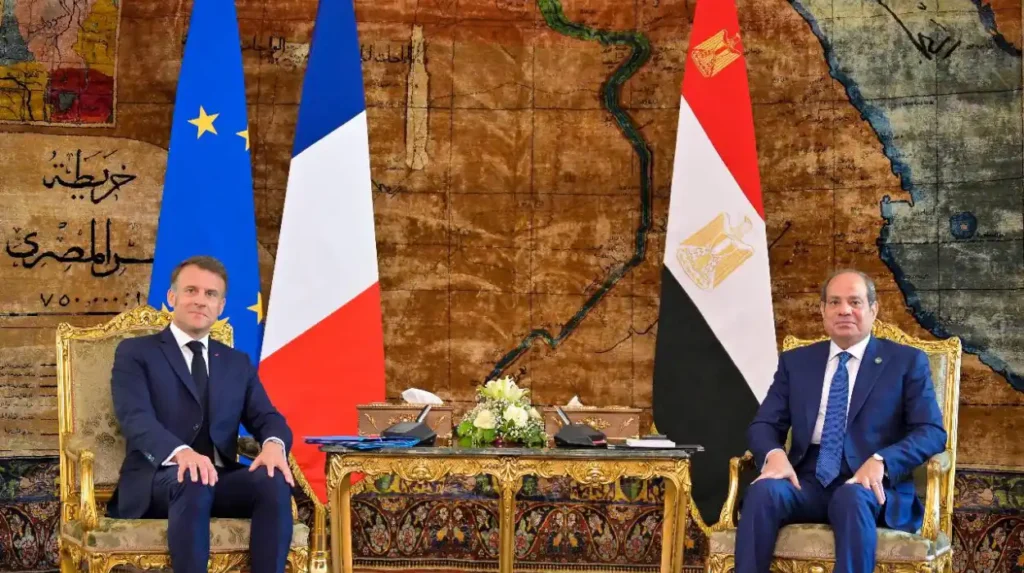
In a significant demonstration of the strengthening strategic alliance between Egypt and France, the Egyptian Ambassador to France, Alaa Youssef, has come to play an important supporting role for French political discourse by providing Cairo’s full vision on how to achieve stability in the Middle East. This news, as relayed in a State Information Service (SIS) report dated April 30, 2026, occurs during a critical time for France, as it seeks to establish itself under the leadership of President Emmanuel Macron as the leading European mediator in the region’s numerous conflicting situations.
Youssef’s remarks indicate that Egypt is committed to the principles of
“respect for the sovereignty of all states, as well as the need to protect and maintain all countries’ and societies’ national institutions”
as the basis for peace that can last; thus, positioning Cairo as more than just a regional player, but as a vital partner for Paris in fighting the instability between Gaza and southern Lebanon.
The above described developments raise serious questions regarding the balance of French foreign policy as Macon’s administration attempts to engage its Mediterranean ambitions while dealing with the more aggressive diplomacy of Egypt; this highlights the possible friction that may exist within Europe when attempting to exert influence over North Africa.
France’s Strategic Embrace of Egypt’s Regional Blueprint
The recent high-level meetings, as well as the ongoing discussion regarding France’s appreciation for Egypt’s “essential position” regarding its involvement and place in the Middle East, as seen in other SIS reports, support Youssef’s presentation.
French diplomats have confirmed that they see Egypt as an important mediator in helping to decrease tensions in Gaza and stabilize Lebanon.
These joint strategic dialogues, which have taken place in Cairo, are the first formal round of a bilateral framework that also includes an economic corridor from India to Europe, an economic corridor called the India-Middle East-Europe Economic Corridor (or IMEC). France has publicly stated that they support the inclusion of Egypt within the IMEC.
French politicians who oppose the current government’s actions may say that this has resulted in a more pragmatic approach to foreign policy than was presented by Macron during the promotion of his Universal Alliance, which aimed to create a European power base that could stand independently from U.S. dominance during the presidency of Donald Trump.
Macron’s Middle East Calculus Through Egyptian Lenses
As you go more deeply into the ambassador’s statements, it is clear that France’s thinking is changing towards the Middle East. Egypt is now being viewed as a balance to both Iranian influence and the chaos in Libya. Youssef also indicated that Cairo is actively supporting the Trump Administration’s proposals for Gaza reconstruction, which shows a level of political realism that matches up with French interest in controlling migration through the Mediterranean and securing energy resources.
France’s support for Egypt can be seen in real terms. For example, France has pledged €260 million in aid to Egypt through its 2025 strategic partnership in order to assist its development during a time of crisis in the region, and also pledged €500 million for support through other channels.
However, looking at the political reality in France, this partnership can be viewed with skepticism. President Macron is dealing with growing public resentment due to the National Rally and little or no economic growth; therefore, he runs the risk of depending too much on Egypt’s leader, President Sisi, who has effectively rebuilt his relationship with previous enemies such as Qatar and Turkey to regain leadership in the MENA region.
Egypt’s Core Stances and Their French Repercussions
Egypt’s firm position on sovereignty is central to Youssef’s briefing, characterizing how Egypt envisions a stable Middle East. For Cairo, the critical elements of achieving a stable Middle East are achieving a comprehensive ceasefire, reconstructing Gaza, and establishing dialogue with other parties (Iranian supported militias, Houthis, etc.) while also reaffirming their belief that the establishment of statehood for Palestinians is not up for negotiation. These same perspectives are reiterated throughout Egyptian official documents that detail the vision for resolving the Israeli-Palestinian conflict, highlighting no forced displacements and unified Palestinian governance.
French policymakers should now weigh the risks of this alignment. Acclaimed by Paris as a “strategic” mediator, Egypt’s role in facilitating peace provides Macron with a way to champion his peacemaker persona just prior to the possible electoral battles of 2027. However, this alignment opens up the possibility for fault lines: Egypt’s entry into the IMEC is viewed as being beneficial to France from an economic perspective.
Statements made by Youssef during these discussions reaffirm to Egypt their importance as a regional anchor and that France should promote political resolutions rather than military posture. A clear example of this is the situation in Libya, where similar views about preserving current institutional frameworks exist between Egypt and France; however, France’s sale of arms to rival factions (Haftar) clouds this narrative. Bilateral Ties: From Aid to Ambition
The enhanced relationship between Egypt and France, reinforced through their annual strategic dialogues, reflects Macron’s overall Mediterranean strategy. However, with the added intervention of Ambassador Youssef, it has become more urgent. Their partnership agreement, signed in 2025, includes migration pacts and ways to cooperate economically, and positions Egypt as a buffer to help control external threats and instability from spilling into Europe.
With Ambassador Youssef serving as both an experienced diplomatic figure and a former presidential spokesperson (since 2021), he is credible in these discussions, having communicated on similar issues at OECD forums previously.
The vision espoused by Egypt supports the creation of an economic recovery process and combating extremism without alienating Palestinians; a well-balanced approach that France could potentially use as an example of how to help bring the EU together. However, as noted by Ahram Online about Egypt’s role within the region, this refocus of Cairo as a leadership state will challenge European assumptions about Egypt and force Macron to rethink whether he wants to treat France like a peer or as a subordinate ally.
Implications for French Foreign Policy Horizon
In the future, Youssef’s disclosures have significant implications for the potential shift in France’s approach towards the Middle East with an opportunity to anchor Paris’ ambitions from the Sahel to the Levant with an Egyptian blueprint for stability in Cairo. Egypt’s support for Lebanese elections, as well as Gaza forces, corresponds with France’s call for institutional resilience. However, Macron will need to address inconsistencies with the criteria by which arms and ammunition were sold to Egypt prior to Egypt’s current sovereignty rhetoric.
As is so often the case, the success of this partnership will be a reflection of Macron’s legacy in the face of anticipated volatility in 2026 particularly with the impact of Trump’s inauguration on Gaza – while also solidifying bilateral relations as France supports Sisi’s vision of “restoring security.” However, both France and Egypt face the threat of participation and support from a piece of populist backlash from inside France.
As Egypt attempts to place itself at the heart of the Middle East, France will thus have a partner but, at the same time, will lose much of the narrative that it has developed in the region clearly indicating that continued monitoring and scrutiny of French policy analysis by think tanks will be essential. Youssef’s analysis will be a key element in Macron’s balancing act of his ambitions, alliances, and autonomy as he continues to navigate the ever-changing political landscape of the Middle East.