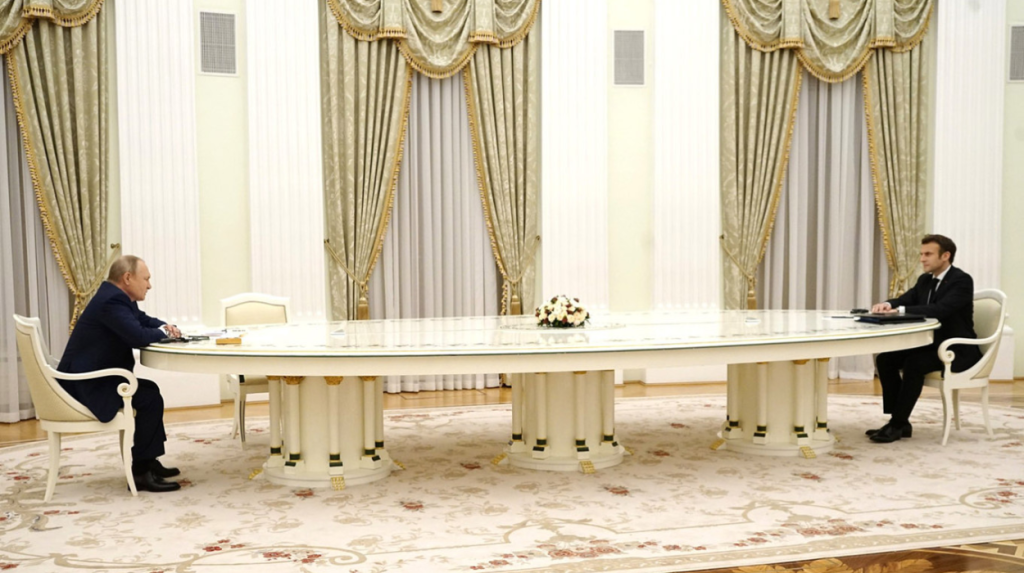
The Kremlin stated that “technical-level” diplomatic talks between Kiev and Moscow have resumed, marking an important move towards re-engagement since full-scale invasion by Russian forces in Ukraine. Kremlin spokesman Dmitry Peskov confirmed reports of diplomatic talks between Kiev and Moscow, which could quickly escalate to higher levels if there is political will to do so.
French President Emmanuel Macron has defined this as necessity and has encouraged European leaders not to allow themselves to be marginalized by US-led peace negotiations. Macron’s action represents a sense of insecurity among Europeans due to fears of being ignored by America in designing the post-war security architecture.
Yet from his own admission, we find the significance and weight of the situation, “What did I gain? Confirmation that Russia does not want peace right now.” Such a difficult situation highlights what the real issue is—Europe continues to negotiate with a country that does not want to compromise, while Russia seeks to use negotiations to divide the West.
Europe’s Strategic Autonomy vs. Geopolitical Reality
Macron’s emphasis on direct communication is a result of his long-held wish to see strategic autonomy achieved in Europe. Macron stated that Europe needs to speak directly to Putin “so as not to depend on third parties.”
Nevertheless, the ability of Europe to take independent action is restricted, as the EU and NATO still largely depend on the military capabilities, intelligence, and logistical support provided by the U.S. For instance, the United States continues to provide most of Ukraine’s sophisticated weapons and finances, with defense spending by European countries being fragmented and uneven.
Macron’s move to address the situation via a European diplomatic track could thus seem symbolic rather than transformative, particularly when Moscow concedes that there is no real aspiration on other European nations’ parts to re-engage.
Russia’s Diplomatic Messaging: Dialogue Without Concessions
Peskov’s comments merely reinforce Moscow’s negotiating strategy of making concessions on paper to appear to engage in talks while making no compromises. Peskov reiterated Russia’s position according to which any agreement to resolve the conflict would have to address what Russia calls the “root causes of the Ukrainian crisis”—a phrase commonly understood to mean demands for NATO withdrawal, Ukraine’s neutrality, and acknowledgment of annexations.
Peskov further cautioned that breaking off contact with Europe is “illogical, counterproductive, and harmful.” It is a rational Russian actor that is seeking dialogue here, implying that it is not them, but rather Western nations, that are to be blamed.
Macron’s Diplomatic Tightrope: Coordination or Fragmentation?
Macron explained that the preparations to restart the talks were carried out “in the most transparent and coordinated manner with President Zelensky and with our European allies.” Yet, the move by the French leader sparks questions on the confusing messages and the timing of the talks.
Historically, unity of action amongst Europeans has been Ukraine’s strongest strategic forte. Inconsistent diplomatic initiatives, outside of consistency in alignment with Ukraine, risk negating leverage over Moscow and complicating sanctions enforcement.
Sanctions, War Economy, and Diplomatic Signaling
Contrary to Russia’s outreach rhetoric, the raft of Western sanctions has hurt the Russian economy hard. Various studies have estimated that these sanctions, along with restrictions in energy markets, were able to apply a substantial loss in GDP and constrained military financing, though Russia has adapted through energy exports to Asia and domestic war mobilization.
At the same time, diplomatic overtures by European leaders risk signaling fatigue and division that could strengthen Moscow’s negotiating position.
Europe’s Silence and Strategic Hesitation
Peskov’s claim that other European countries have not shown interest in dialogue highlights the fractures within Europe’s strategic vision. While some states—particularly in Eastern Europe—advocate a hardline approach, others fear prolonged war and economic fallout.
Macron’s initiative could be interpreted as leadership—or as premature engagement that risks legitimizing Russia’s negotiating posture without securing tangible concessions.