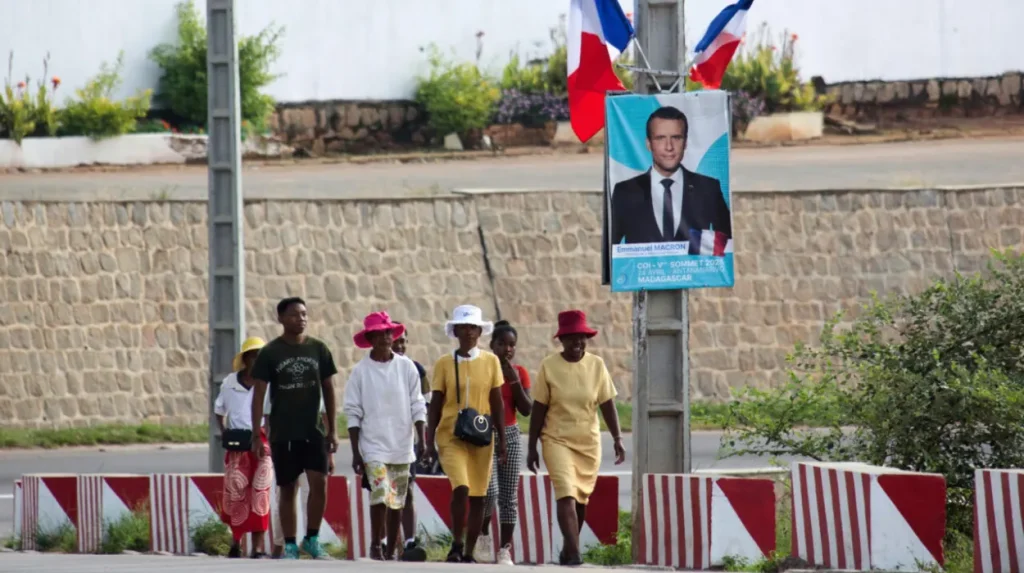
On November 29, 2025, French President Emmanuel Macron made a phone call with the transition president of Madagascar, Colonel Michael Randrianirina, the first phone call at the highest level of intervention in the nation since the October coup. Macron presented what he termed as the backing of France in the continued transition coupled with focusing on anti-corruption reforms, national consultations and elections planned in a reasonable time. He encouraged widespread involvement of youth groups and the civil society, and he tied the aid of France to the success of these democratic processes.
The interview reiterated the toned down diplomatic policy of France after the weeks of speculation over the military coup. The call was also indicative that France accepted the de facto authorities although this had raised some concerns in the public before with Macron expressing his deep concern after President Andry Rajoelina was toppled by the CAPSAT, the elite military unit that spearheaded the mutiny.
The reasons behind the departure of Rajoelina remain to capture interest. On October 12, he took off from Madagascar supposedly in a French military plane at Sainte Marie Airport. Macron refused to add his voice to the details of evacuation in a summit held in Egypt, which only added to the uncertainties regarding the direct role of France in the most unstable hours of the coup. Soon after the takeover, French Ambassador Arnaud Guillois engaged Randrianirina, pushing to the idea of a democratic and inclusive transition, in which the elections are conducted within a respectable time frame.
Madagascar Coup Timeline And Political Turning Points
The crisis started on September 25, 2025, when mass movements were organized on the streets of the main city of Antananarivo due to the main reasons of Gen Z activists who became tired of the constant power outages, lack of water, and the worsening of living conditions. On September 29, President Rajoelina disbanded the government, yet citizens continued to be angry because of economic discontents and the perceived poor governance in the country.
Military Seizure And Rapid Power Shift
On October 12, the CAPSAT division rebelled and took over major installations within the capital with little opposition. The president of the Senate was overthrown by the military, the high officials were pushed out and a military nominee was made the chief of the armed forces. The following day Rajoelina came out to report that he had survived an assassination attempt. He disbanded the National Assembly on October 14; he was impeached by the lawmakers a few hours later, displacing the decree.
The same day the military proclaimed formal control in which they suspended the Senate, High Constitutional Court and Electoral Commission. The majority of institutional organizations were immediately liquidated, with the exception of the National Assembly that still retained some limited functional powers under the leadership of the military.
Randrianirina’s Inauguration And Transitional Roadmap
The transitional president which was sworn in between October 16 and 17 with a promise of a Council of the Presidency of Re-Foundation and new elections within 18-24 months was sworn in to Col. Michael Randrianirina. His government put in place an interim constitution that was to be confirmed through referendum. On October 27, the opposition figures were included in the government through a reshuffle that indicates an effort to demonstrate political inclusivity.
France’s Pre-Coup Ties And Post-Coup Engagement
France had long historical relations with the Rajoelina government with cooperation in economic development, security and infrastructure. The so-called evacuation incident of the coup further inflamed political sensibilities with Macron again reaffirming that France preferred non-interference and a restoration to a constitutional order. The first weeks of turmoil also saw continued diplomatic talks between the country and Prime Minister Herintsalama Rajaonarivelo as Ambassador Guillois discussed economic recovery, better utility access, and anti-corruption measures.
The change occurred after the November 29 phone call. Macron officially recognized the roadmap of the transitional leadership but urged more youth to be engaged. Madagascar however is still suspended by the African Union (AU) due to an unconstitutional change of government. The AU, Southern African Development Community (SADC), and United Nations all remain under a concerted pressure to have a transparent transition process.
Regional And International Dynamics
The involvement of France is carried out concomitantly with the increased questioning by the African regional organizations. The fact that Madagascar is suspended by the AU puts more pressure on the international reactions. Although SADC is pressing towards faster democratic changes, France seems to be practical and this indicates willingness to help the transition without necessarily sanctioning the military rule.
Strategic Interests Shape France’s Policy Posture
The French strategic planning is enhanced by the fact that Madagascar is located in the Indian Ocean. The citizenship of Reunion and Mayotte give France influence in the region and stability in Madagascar helps in the wider maritime security goals. According to analysts, France has been cautious because of the tactics to maintain its presence in regional politics and to counter an increasing competition of other global players.
Economic Interests And Aid Priorities
The French have invested in Madagascar in terms of agriculture, mining, renewable energy and educating programs. The stress of the transitional authorities on anti-corruption is consistent with the long-term French priorities related to the effectiveness of aid. Macron indicated that it will be dependent on convincing reforms, especially in youth inclusion, institutional restructuring, and financial openness of the public.
Navigating AU Suspension And Domestic Pressures
France support for the transitional process is met with the sanctions of the AU which leaves a fine line of diplomacy. On the one hand, the EU requires a rigid observation of the principles of democracy, and France seems to be interested in maintaining political stability and economic control. According to Randrianirina, the international relations that were created after he was inaugurated were a historic turning point and an opportunity for Madagascar to be rebuilt with a new political vision.
Implications For Transition Legitimacy And International Perception
France’s overtures provide a perception that Macron is justifying a military government that is still consolidating its powers. Even though the transitional government has opposition figures, critics claim that true decision-making is still within the military establishments. This narrative can be defeated with the focus on the national consultations and youth participation, still, political skeptics believe that the strategy of France will only end up strengthening the military power.
Election Timelines And Governance Challenges
The promise of elections by the transitional authorities within the 18- 24 months will be the core component of international support. Nevertheless, the reconstruction of electoral institutions, the renaissance of local administrative systems, and control of economic pressures are major challenges. Observers in the international arena are looking forward to the next few months in order to see how the government will be able to implement reforms on one hand and on the other, deal with youth collapses and economic turmoil.
Regional Coordination And Long-Term Stability
The role of the oversight of both AU and SADC, to provide a viable transition is critical. France will be helpful in speeding up the process of reconstruction but may confound regional consensus in case they feel that there is favoritism by the foreign countries. The success of the transition process will be determined by the respect of constitutional limits by the military and the consistency of expectations of the external partners.
The involvement in the changing political position of Macron in Madagascar is important in the conflict between practical stability and democratic rehabilitation. With the transition occurring under the watch of the region and the demands of the youth, the role of France can be influential in a direction that causes Madagascar to either be directed to institutional renewal or become stuck in military rule. What follows between the two governments may define the intersection of geopolitical strategy and internal political pressures in the process of determining the political futures in the Indian Ocean region.