Financial reform will be the core of relations between Africa and Europe due to growing controversy on the equity and inclusivity of world financial governance. The African governments have been left with the burden of the debt that constrain their fiscal space, slows down their infrastructure growth and restricts long term development planning. UN Secretary-General Antonio Guterres once again made the point of urgency to restructure the global financial system, saying that it is necessary to eliminate unsustainable debts and that more lending should be permitted by multilateral development banks. His statements are part of the wider international acknowledgement that the African governments need a more just system in order to embrace sustainable growth.
The Global Gateway project of the European Union fits these priorities rather precisely. The initiative helps alleviate the structural constraints that African countries experience when dealing with global financial markets through mobilizing large-scale investment to enable the digital infrastructure, manufacturing and transport corridors. These investments are also based on the economic volatility that has been experienced up to the early 2025 inclusive of the inflationary pressures that have softened investor confidence and made borrowing in many developing economies more difficult.
Widening fiscal space through structural change
The financial reforms aim at giving the African countries more access to concessional lending as well as minimized exposure to market risks associated with credit. This is aimed at making sure that a long term infrastructure planning is not solely relying on high cost borrowing. The changes in the debt restructuring and governance reform at institutions such as IMF and World Bank are part of these on-going negotiations.
Linking reform to development capacity
This agenda of financial restructuring is closely related to the development requirements of Africa especially with governments focusing on energy, transport and industrialization investments. The assistance provided by European governments and EU institutions is more and more defined not as a traditional development aid, but as a collaborative investment, which is supposed to enhance African agency in the process of constructing global economies.
Green energy investments as a catalyst for sustainable transformation
Africa with its vast capabilities in solar and wind energy and its strategic reserves of important minerals needed in clean technologies have become a symbolic sphere of Africa-Europe interaction in 2025, underpinning green energy. The funding by the Europeans and technical know-how are set as the complementary advantages that could hasten the growth of renewable energy in the continent.
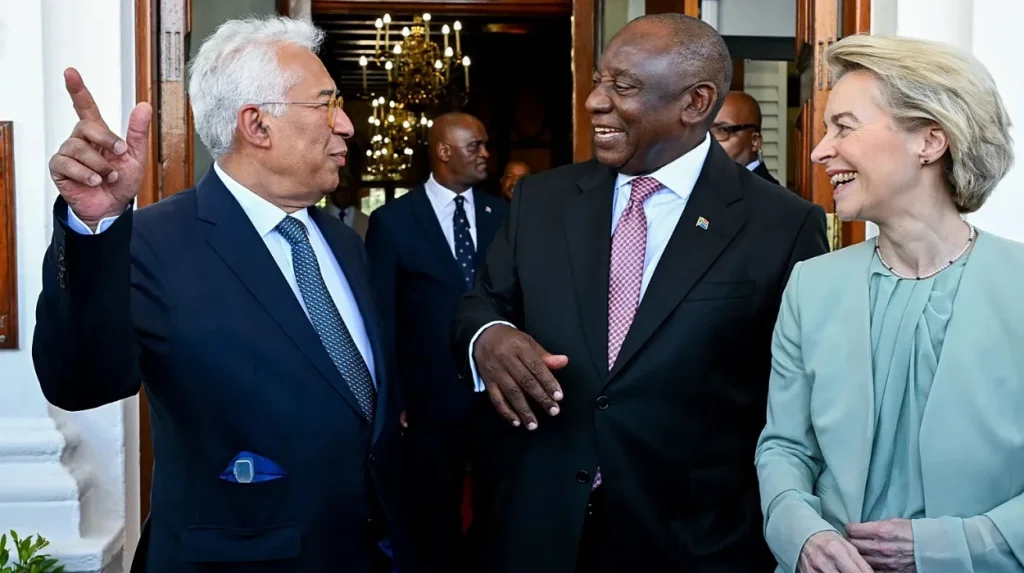
The 12-month campaign on clean energy, which is co-led by the European commission President Ursula von der Leyen and the South African President Cyril Ramaphosa, reflects this congruency. The initiative, by marshaling EUR15.5 billion of funds to renewable energy, will see to it that Africa will have almost or nearly twice its renewable power by the year 2030. The financing covers the large-scale solar farms, grid expansion, and decentralized systems to the underserved communities.
Expanding renewable infrastructure across regions
The European Investment Bank’s commitment of more than €2 billion targets hydroelectric plants, utility-scale wind farms, and advanced solar installations. A substantial portion of this financing is directed toward improving grid stability and interconnection, a critical factor influencing both energy security and long-term industrial development.
Stimulating economic transformation through clean energy
There is a growing perception that the investment of green energy is a driver of job creation, diversification of the market, and local production. The focus on enabling industries, research, and placing technology to implement the clean-energy transition is evident in the description provided by von der Leyen about the campaign as a turbocharged effort by Africa.
Integrating clean energy with social development outcomes
Renewable energy agenda is not only limited within the area of climate obligations. Increased access to electricity facilitates health, education and agricultural development, which complements the multidimensional effects of green infrastructure on the indicators of human development. This is a broad strategy that reinforces the social base through which economic partnerships are established.
Interconnected dynamics of financial reform and green energy cooperation
The strategic relationship between financial reform and green energy investment can be discussed as a change in the Africa-Europe relations towards the combination of planning and development priorities. Financial restructuring would make the African governments financially flexible enough to make long term energy investments without the susceptibility to further debt. Meanwhile, sustainable energy projects open the economic space that allows the growth, diversification of exports, and better credit ratings.
Aligning investment strategies with governance reform
Europe Global Gateway and Africa-Europe Green Energy Initiative have shown that the investment strategies are more and more aimed at the governance-oriented goals. These schemes combine financial collaboration with transfer of technology, regulatory assistance and developing capacity of institutions in order to minimize risks of implementation and in order to assist responsible management.
Addressing shared climate and economic challenges
As the effects of climate change escalate in the African continent the partnership finds that adaptation and mitigation must be financed and rolled out in a stable manner. Through the combination of finance and energy policy, Africa and Europe will place their collaboration as a reaction to both global warming and the structural economic imbalances.
Challenges shaping cooperative outcomes in 2025 and beyond
Although the sphere of Africa-Europe cooperation has visible improvements, there are several structural and operational obstacles that determine the speed and influence of cooperation. Regulatory fragmentation, currency volatility, and infrastructure deficit remain in the path of energy projects making the integration of grids and the involvement of the private sector difficult. This is achievable by coordination of the national strategies, power pools in the region, and the international financing needs.
Barriers to financial governance reform
Any attempt to increase African influence in international financial institutions is met with opposition by the old power systems that are cumbersome to change representation schemes. It is not an easy task to seek reforms to debt restructuring frameworks especially when there are divided creditor groups involving state and non state actors.
Importance of sustained political commitment
Financial and energy cooperation greatly relies on the consistency of political involvement in the two regions. There must be open governance, co-ordinated planning, and uniform policy frameworks to invite long term investment and provide equal results.
Evolving partnership dynamics and future trajectories
The political and financial transition of Africa-Europe relations is characterized by the establishment of the integration of financial reform and green energy investment which is a turning point towards the relations of more balanced and strategically unified partnership. This change is indicative of larger international changes currently happening in 2025, such as reconfigurations of geopolitical power and increasing the focus on sustainable development as a fundamental economic force.
The African resource potential and the European capital and technology as a partnership become important as far as the interests of both parties are successively met. It will have an impact on the global climate targets, industry supply chains, and the maturation of development finance. The next several years will answer the question of how well the reforms will transform the economic governance and whether the new structures are able to stabilize the long-term cooperation in a more interdependent global environment.