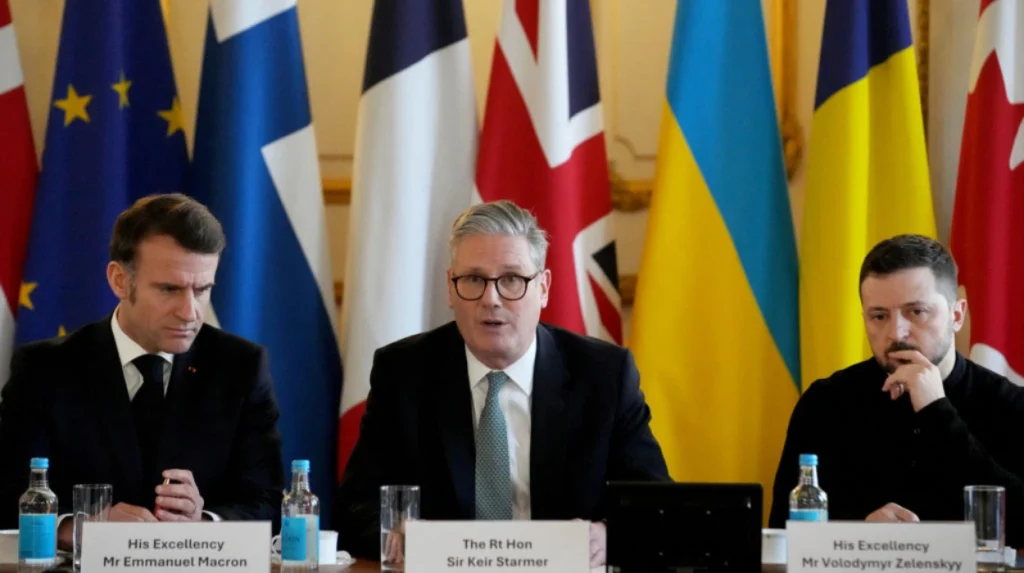
The diplomatic path that France took in its involvement in the conflict in Ukraine is an indication of an active change in its stance of cautionary involvement to proactive leadership. In the initial months of the invasion of the Russian Federation in 2022, President Emmanuel Macron tried intensive diplomatic dialogue with Moscow, underlining that he needed to maintain the stability in Europe through negotiations. His trip to the Kremlin in February 2022, which has since been extensively reconsidered by policy experts, was a gesture of seeking a way to stop escalation by engaging in direct diplomacy. Critics in Kyiv and other European capitals viewed the move as being too conciliatory, as Moscow perceived dialogue with no consequences as a strategic confusion.
Towards the end of 2023 and early 2025 France had recalibrated its policy conclusively. Paris became one of the top-level European supporters of Ukraine, diplomatically and militarily. Policymakers stressed severally that the sovereignty and territorial integrity of Ukraine were principles of European security that were non-negotiable. France has increased its weapons shipments to Caesar artillery systems, SCALP-EG long-range missiles and expanded troop-training programs. According to the French Ministry of Armed Forces, it was necessary to increase the operational preparedness of Ukraine to avoid further deterioration of the European order of security. This development marked a strategic break with the previous care to a more aggressive stance that was in line with the views held in central and eastern Europe.
Leadership in European coordination and defense support
France still remains a key player in bringing the European Union to bear coordinated pressure on Russia. Paris has also strongly supported the idea of enlarging the EU sanctions framework, to include tougher actions against energy income, dual-use technology, and financial networks connected to the military machine in Russia. EU officials pointed out that the long-term pressure of France has helped to move the ball towards a full package of sanctions under a renegotiation in early 2025.
The French government has also been keen on highlighting the importance of long-term planning of the defense capacity in Europe. In February 2025, when a large EU defense summit was hosted in Paris, French leaders gave priority to the production of more artillery and the rapid supply line in ammunition, as well as the enhancement of the coordination of industries among the member states. Those attempts signify a more comprehensive approach to demonstrate to the world that Europe can help Ukraine without depending on foreign allies.
Balancing NATO commitments with strategic autonomy
The call of strategic autonomy in Europe by Paris is the focus of the geopolitical character of the city. Macron has also advocated the idea that Europe needs to be able to defend itself even though he is within the collective structure of NATO. This position, however, occasionally brings to head tensions with the eastern European governments, which are more consistent with the Washington security assurances and have openly confronted France on matters concerning delays in the delivery of weapons.
France has taken a strong stand in support of Ukraine becoming a member of NATO in The Hague in 2025. The delegation of France restated that the future of Ukraine was in NATO and EU, which did not correspond to less ambitious views that full membership was not going to become a realistic option in the near future until the conflict was resolved. This rift indicated ongoing intricacies in the alignment of transatlantic and European strategic visions.
Diplomatic dialogue and new channels for negotiation
In July 2025, Macron had his first direct telephone conversation with the Russian President Vladimir Putin in over three years. French officials called the discussion clear and uncompromising, which strengthens the statement that the complete withdrawal of Russian troops in Ukrainian lands is an earlier condition of any plausible peace talk. The call was a significant change in the engagement strategy of France; instead of pursuing a compromise by making concessions, the 2025 dialogue would aim to reestablish the conditions on the basis of international law.
This is another outreach that was taking place in a busy diplomatic atmosphere. Parallel mediation paths were followed by China, the Vatican and some of the non-aligned states which led France to reassert its diplomacy to avoid the substitution of the European interests by alternatives. French authorities emphasized that any viable peace should embody the Ukrainian agency and the European security needs and placed Paris in a place of a watchdog of regional tranquility.
Supporting reconstruction and institutional resilience
In addition to the involvement in the military and political activities, France has a leading role in the European initiatives to rebuild Ukraine. The French agencies of development are undertaking projects with the Ukrainian ministries on the development of the energy infrastructure, judicial changes and modernization of the administration. These are added to military support with institution-building interventions to enhance the long-term resilience of Ukraine especially during the continued attacks on civilian infrastructures through 2024 and 2025.
France’s influence in shaping the broader European response
The leadership of France stands out especially in its efforts to control the divergent opinions between the EU member states. Whereas some countries in the eastern European region are demanding the peak deterrence by increasing arm shipments and troop presence, other countries are apprehensive of heating up the situation with Moscow. The strategy of France has aimed at balancing these two opposing views by a unity-through capacity model which enhances the defense systems of Europe without jeopardizing agreement.
Paris has also worked harder to ensure diplomatic alignment with Germany, Italy and Nordic states as a way of stabilizing internal EU politics. This has involved collaborative work in the area of energy security, export of technology and cross-border defence procurement all set against the backdrop of European cohesion.
Navigating global diplomatic tensions
The balancing act by France is not only in Europe. With France as a permanent member of the UN Security Council, it still uses the multilateral platforms to emphasize the atrocities committed by Russia on the breach of international law and draws more international support to Ukraine. Meanwhile, France talks to governments in Africa, the Middle East, and Asia-Pacific to deflect Russian influence campaigns and gain wider alignment to European views.
These international affairs support the desire of France to influence not just regional but international discourses on the conflict that serves to reinforce its long-standing reputation as an international diplomatic force.
France’s strategy and the evolving future of European security
The diplomatic leadership of France during the conflict in Ukraine can be taken as a symbol of a more fundamental change in European geopolitics. With the fourth year of the conflict, the French strategy is a combination of security support, sanctions coordination, multilateral diplomacy and peacebuilding efforts. The concept behind this multi-layered approach is the recognition that the future of European security architecture is going to be determined by the outcome of the conflict in the decades ahead.
The trend of the French role implies that its role will only increase as Europe gets used to long-term turmoil, strategic rivalry, and alliances. The current efforts of France pose interesting questions in terms of how the European leadership should develop in the absence of certainty and how diplomatic activities could help to reassess the definition of the regional and international order.