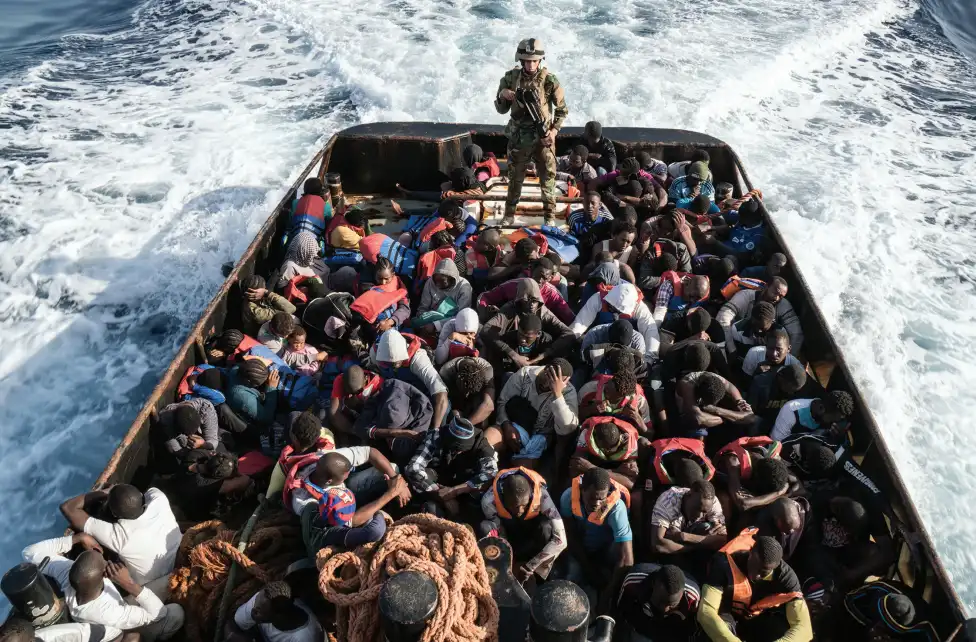
It is a crossover of migration policy and regional security, which can be an issue of the highest priority of the European Union in 2025. The further influx of migrants, which is caused by the conflict, economic instability, and displacement due to climatic conditions has heightened the national discourse and transformed European unity within the Union. Member states are struggling to balance humanitarian obligations with the need to ensure people are safe and secure the national borders.
The migration flows have continued to impact on the social and political stability of the continent. Although migration may trigger economic growth and solve the problem of labor deficiency, it also provides certain security issues connected to trafficking, organized crime, and possible radicalization. This relationship between migration as a dual phenomenon necessitates the need to adopt policy paradigms that go beyond a mere reaction to the immediate pressure of borders to include those structural factors that lead to displacement.
European policymakers now understand that the European equilibrium between humanitarian values and regional security is not a game of zero-sum but evolving in the process of negotiation, adaptation and integration.
Balancing Humanitarian And Security Imperatives In Policy Formulation
The migration policy of the European Union has developed into a hybrid approach that tries to achieve the balance between the protection of humanitarian and increased border security. This change is reflected in the current 2025 revision of the Migration and Asylum Pact which prioritized solidarity, efficiency and collective responsibility among member states. It seeks to streamline the processes of asylum with very strict security checks at entry points.
Policy Frameworks Under Pressure
The adoption of these actions has put the EU to the test on whether it can act as one. Member states that are more inclined to having rigid border controls and externalized migration agreements are opposed by the member states who believe in the existence of protection mechanisms and fair burden sharing. Such a divergence makes it difficult to implement a joint policy response.
Ylva Johansson, the EU Home Affairs Commissioner, said in early 2025 that it was not about closing borders, but controlling them, and doing it with compassion and control. Her comment is a summary of the EU in its fight to integrate humanitarian ideals and practical security principles.
Human Rights And Political Realities
Opponents debate that over securitization could result in damage to the image of Europe as a human rights stronghold. Excessively limiting asylum policies can result in illegal detentions or pushbacks, which are not allowed by the international requirements. In the meantime, political pressure in a number of countries fuelled by the anxiety of cultural transformation or economic pressure will persist in dictating the national migration policies, which are frequently in conflict with EU-based humanitarianism policies.
Operational Measures Strengthening Border And Integration Systems
On the operational level, the EU has increased investment in technology, intelligence, and cross-border cooperation in order to enhance migration management. These initiatives have been led by the European Border and Coast Guard Agency (Frontex) that has been allocated a historic EUR1.3 billion budget in 2025 to increase its surveillance and rapid deployment services.
Expanding Frontex Capabilities
The emergence of new surveillance systems, such as a combination of drone surveillance, satellite surveillance, and biometric recognition, enhanced the identification of irregular crossings in those routes along the Mediterranean and Balkan. The Frontex staff is now permanently deployed in hotspots, which allows the member states to coordinate quicker.
Integration Programs As Security Tools
Simultaneously, the EU is still promoting integration as the essential element of long-term stability. The European Integration Fund funds projects such as language training to employment projects meant to alleviate social isolation. Policymakers see integration not as a humanitarian need but also as a preventive action to marginalization, crime and extremism.
Regardless of these developments, inequality continues in the quality and coverage of national integration policies. There are those states that care more about short term containment than the social planning that is inclusive, and gaps that can breed resentment and instability ensues.
Political Debates And Social Tensions Shaping Policy Outcomes
Migration has been one of the most political hot topics in the EU. Populist movements have been using migration narratives to win electoral momentum, by depicting migrants as a burden on their social services or a danger to their national identity. These stories, which are usually enhanced with digital misinformation, have increased polarization and prevented productive discourse.
Populism And Policy Fragmentation
Italy, Hungary, and Poland are still opposing the quota of relocation imposed by the EU citing that managing migration is a sovereign issue. This opposition has been the cause of tensions amongst the southern states that serve as the entry-point and northern members who are unwilling to share the burden. Consequently, regional security policies tend to be disjointed, reactive and politically limited.
Social Consequences Of Migration Discourse
Heightened anxiety around migration has been converted to episodic social turmoil especially in cities that are challenged by economic disparities. The cases of xenophobia, discrimination, and hate crimes have provoked the expansion of anti-racism instructions in the EU institutions and the enhancement of community dialogue programs. According to the European Parliament debate on migration rhetoric of 2025, the message was that, security starts with social cohesion, and in that regard, it is important to note that the feeling of the people is intertwined with the stability of the nation.
Regional Cooperation And External Partnerships
It is becoming increasingly acknowledged that migration pressures cannot be handled on their own, and the EU has been increasing its diplomatic and security links with both the countries of origin and transit. The EU-Africa Summit 2025 in Addis Ababa reiterated the mutual agreements to address the root causes of the migration by making specific investments in both development and governance as well as climate adaptation.
Cooperation Beyond Borders
There are agreements with the North African countries like Tunisia and Morocco to do joint maritime patrols, exchange of intelligence as well as monetary incentives to limit smuggling networks. The Eastern relationships, especially with such states as Georgia and Ukraine, have aimed at the establishment of the migration management capacity in the wake of the instability in the region.
Conflict Prevention And Economic Stabilization
The strategy of the EU is becoming more and more based on migration management combined with conflict prevention and economic stabilization management. Neighbourhood, Development and International Cooperation Instrument (NDICI) programs are designed to help decrease the displacement by solving unemployment, corruption and political repression problems in the high-risk areas.
Innovation And Best Practices In Migration Management
A few of the member states in the EU have put forward innovative solutions that can show that both security and humanitarian can be achieved. The 2025 migration framework in Portugal focuses on the decentralized governance system, which will allow the municipalities to develop locally tailored integration schemes. This flexibility has enhanced the involvement of the migrants in the workforce and the mitigation of social friction.
Technological And Data-Driven Strategies
The Netherlands has developed real-time information systems by connecting migration authorities and law enforcement and social services, which improved the coordination in the screening as well as support. These models are good examples of how policymaking should be data-oriented that can guarantee accountability and safety.
Building Community Trust
Effective projects would be more focused on transparency and involvement of the citizens. Governments can lessen misinformation and promote collective responsibility by engaging the local stakeholders in the decision-making process. Such strategies prove that the validity of the migration policymaking process relies on communication and trust as much as on the border infrastructure.
The Future Of EU Migration And Security Governance
The changing nature of the migration policy and regional security has remained a challenge to the institutional strength of the EU. The openness and protection are maintained in balance with flexible governance capable of changing new geopolitical, demographic, and environmental realities.
In 2025, migration is no longer viewed solely as a border management challenge but as an enduring component of Europe’s security, economy, and identity. The EU’s success will depend on its ability to sustain unity among member states, invest in human-centered solutions, and address migration pressures at their origin.
As new global crises emerge from climate displacement in Africa to post-conflict migration from Eastern Europe, the European Union’s migration policy will remain a barometer of its strategic maturity and moral resolve. Whether the continent can uphold its humanitarian heritage while safeguarding stability will define not only the future of EU governance but also the global standard for managing mobility in an era of uncertainty.