France’s diplomatic guardian Lebanon relationship can be traced back to the beginning of the 20th century when France governed Lebanon on the League of Nations Mandate (1920-1943). This era not only defined the borders of Lebanon and the modern day rule but also instilled the characteristic political system where the representations of religions are a part of the rule. French control was instrumental in formalizing the confessional system of Lebanon, which remains the current state of affairs of the country in terms of its precarious balance.
The French cultural influence lingered well after the independence in the year 1943. Franco-phone education, law and governance have been entrenched in the institutions of Lebanon. Over 400 schools in the French language are still being used to educate the elite in Lebanon, and this guarantees the continued presence of French culture. The identity of the francophone is still maintained especially in the Christian and urban intellectual communities, which still retain a common language and historical attachment, incomparable to that of other nations with the Lebanese Republic.
It is this strong cultural base that enables France to make a unique contribution to the diplomacy of Lebanon. Mediators French envoys frequently find themselves in a privileged position of being mediators even in politically sensitive conversations regarding Hezbollah, something that has been granted to them by history and subtlety of their interactions. The accessibility of such a state is not easy to Western countries, making France a mediator between the domestic parties of Lebanon and the international community in general.
Diplomatic engagement and mediation in the 2025 crisis context
In 2025, France is still at the critical center of the Lebanese current economic meltdown and political impasse. Its foreign policy is aimed at the twofold goal: to restore the state sovereignty and to facilitate the institutional recovery following the stagnation during years.
French diplomacy and Lebanon’s disarmament initiative
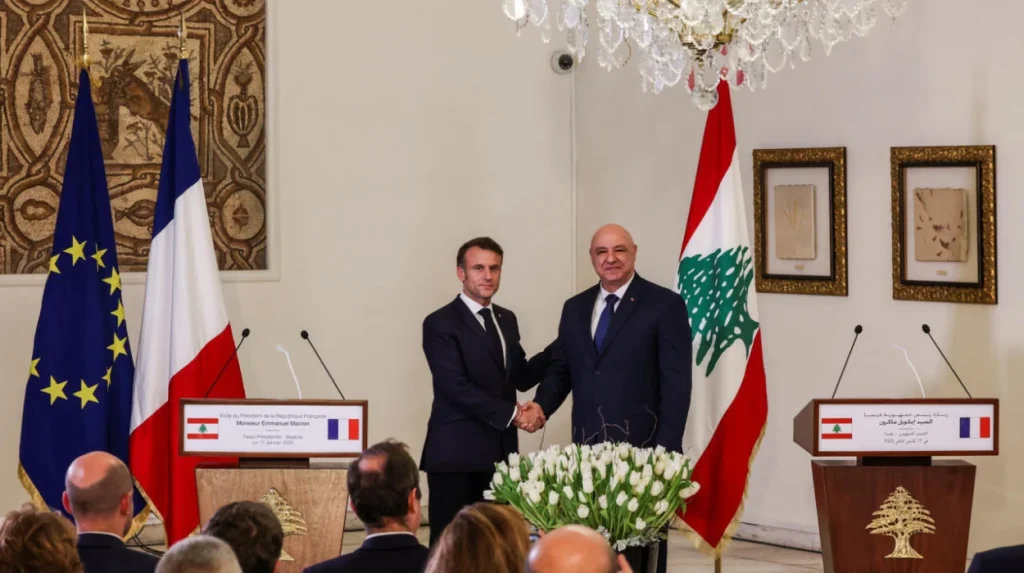
In 2025, the Lebanese government gave its support to a plan to reassert the state monopoly on arms, which became a breaking point of the struggle to disarm Hezbollah. France hailed the step as historic and bold and returned to the theme that disarmament was still the key to national stability. French President Emmanuel Macron reiterated in front of the United Nations general assembly, that Hezbollah disarmament was not a western request, but the sole solution to Lebanon to fully regain sovereignty.
France has now vowed to organize with regional and international allies, such as Saudi Arabia, United States, and European Union, in an attempt to empower the Lebanese Armed Forces. Paris considers these forces to be the institutional backdrop of the Lebanese state and the most legitimate way of maintaining internal security.
Obstacles to France’s mediation efforts
Though there were these diplomatic moves, the leadership of Hezbollah has dismissed the 2025 plan as a sin of great magnitude by claiming that the plan has betrayed the resistance of Lebanon against Israel. This rejection makes the French mediation difficult, revealing the extent to which the West can influence domestic power politics in Beirut.
The impasse has brought back old debates on the question of leverage in France: though cultural and symbolic interests stand, the capacity of Paris to change the political balances seems more and more limited by regional coalition and deep-rooted sectarianism.
Balancing nostalgia with realpolitik in French foreign policy
The French attitude to Lebanon is full of nostalgia and pure realism. Paris is still acting as the traditional protector of Lebanon, but it understands the geopolitical reality that forces it to be flexible and compromise.
Political calculations and credibility challenges
This fine line was demonstrated by France in 2023 when it announced its position in favor of Presidential candidate Sleiman Frangieh, who supported Hezbollah. The action, which was intended to resolve the lack of leadership in Lebanon, attracted a backlash that Paris was undermining its reform agenda. After twelve futile rounds of parliamentary conferences, Lebanon remains without a president, and the failure of external intervention, including that of the traditional acquaintances, to help overcome the deep-rooted differences within the country.
Analysts observe that this has undermined the credibility of France as a neutral actor because when France tries to balance both principle and pragmatism it tends to satisfy neither reformists nor the embedded conservatives. However, the participation of Paris is consistent. Its sustained presence at the donor conferences, technical missions, and UN coordination explains its long term commitment towards stabilizing the weak institutions in Lebanon.
Economic diplomacy and institutional support
France has used economic instruments severally to maintain the sovereignty of Lebanon. In the Lebanese Armed Forces, during the 2024 Paris donor conference, more than 200 million was raised and targeted on technical training, logistics, and modernization. This funding was pursued after previous attempts, as it was preceded by humanitarian aid to Beirut after the 2020 Beirut port explosion, in which France had provided EUR250 million in humanitarian aid and coordinated the efforts of other countries in the recovery.
These actions point to the fact that France is able to blend soft power with financial diplomacy- strengthening institutions that represent a sense of national unity as opposed to partisanship. The policy is in line with the opinion of Paris that political independence is pre-conditioned by economic security and integrity of the state.
Stakeholder perspectives on French involvement
On the one hand, the recent diplomatic activism of France in Lebanon indicates its unchanged faith in multilateralism and alliance with local and global players. But this involvement has polarizing effects on the interests of stakeholders, which demonstrates the divided political situation in Lebanon.
France’s framing of its mission
The French ministry of Europe and Foreign Affairs presents its policy towards Lebanon as an extension of a wider coalition with the European, Gulf and UN partners. Its words focus on the respect to the Lebanese sovereignty, the adherence to the UN Security Council Resolution 1701, and the demand to support the Lebanese army as the only legitimate security institution. This is a framing that places France as an agent of reforms, which are internationally acknowledged.
Lebanese perceptions and regional realities
The attitudes of France among Lebanese policymakers and academics are ambivalent. To others, Paris still represents moral and cultural leadership, an outsider who cares and is interested in the future of Lebanon. Other people see French involvement, however, as paternalistic or old-fashioned, an exercise of nostalgia rather than strategy.
According to Hezbollah and its political associates, the intervention by France is seen as meddling in the affairs of Hezbollah in support of the western and Israeli interests. This dismissal is not only a restriction of the French mediation, but also shows how the historical strength of the regional hostilities that shape the domestic politics of Lebanon can be seen.
International responses and collaborative limits
The United States and partners in the Gulf value the stabilizing effect that France has on the region, but are wary of excessive reliance on the initiatives of France. They see France as an efficient middleman who can approach groups that Washington or Riyadh can not but never as the key planner in the restoration of Lebanon. The role of France is therefore becoming more of a coordinator and not a commander in multilateral diplomacy.
Quantitative and qualitative indicators of influence
Although Lebanon has more than 400 French education institutions, their influence on the country has resulted in the continuation of the soft power of France through the elite of the country who are now francophone. French is still needed as it demonstrates the social prestige of the cultural model of France despite the economic crisis in Lebanon.
Financial commitment and aid mechanisms
Another important indicator of French involvement is humanitarian and institutional assistance. The 2024 donor conference pledges of France totalling 200m and the preceding EUR250m relief package to Beirut is a clear example of a recurrent trend in focused financial diplomacy. These initiatives strengthen the institutions of the state against the sectarian groups as a long-term recurrence of France to have a unified Lebanese government.
Political developments and reform milestones
Lebanon’s September 2025 decision to assert a state monopoly on arms endorsed strongly by France marks an important institutional step. Yet the absence of an elected president after multiple failed parliamentary sessions underscores the persistence of paralysis. For France, such developments encapsulate the contradiction between symbolic progress and structural stagnation.
France’s evolving role amid shifting regional dynamics
The France diplomatic guardian Lebanon narrative is increasingly defined by adaptation. While France retains unparalleled cultural and historical connections, it must navigate a Middle East transformed by new alliances, energy politics, and post-conflict realignments.
Paris now faces the challenge of redefining influence without dominance maintaining its role as mediator while acknowledging the limits of nostalgia. As U.S.-Iran negotiations, Gulf investment, and regional defense alignments reshape Lebanon’s strategic environment, France’s capacity to remain relevant depends on its ability to blend heritage with innovation.
Whether France can sustain its position as Lebanon’s diplomatic guardian will depend on how effectively it balances cultural continuity with geopolitical pragmatism. The coming years may determine if this century-old partnership endures as a model of resilience or fades into history as an emblem of a vanished diplomatic order.