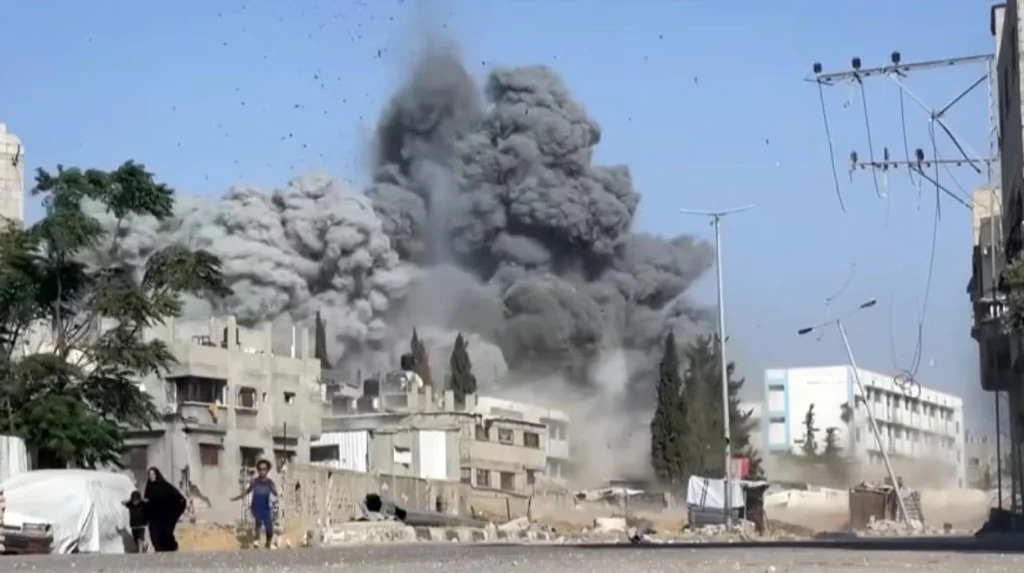
France has been particularly active in the diplomatic life of the Middle East, having used its position as a permanent member of the UN Security Council along with its influence both in the Euro-Atlantic and Indo-Pacific regions. By 2025 France is becoming increasingly engaged in the context of a new wave of geopolitical instability, especially following the revival of conflict between Israel and Iran and the long-standing instability in Gaza and Lebanon.
France also has good bilateral relationships in the region, especially with the United Arab Emirates. In May 2025, the 2009 accord to install French military bases in the UAE was renewed, which once again gave France the operational potential in the Gulf. Emirati leaders refer to France as a strategic economic and defense ally, which allows both countries to cooperatively contribute to the security of the region and the diplomatic affairs.
These alliances are not also empty words. A military presence in France enables the country to respond to the region in a swift manner, which is part of crisis containment and de-escalation operations. This bi-polar war player and peace broker has been intensified by the region in dealing with interconnected crises.
Defending international law and the two-state principle
France has been a champion of international law, especially concerning the Israeli-Palestinian dispute. It is still rooted in its support of a solution of two states and is pegged on the 1967 borders with agreed land swaps and joint sovereignty over Jerusalem.
Still following the words of the United Nations Security Council Resolutions (242, 476 and 478) the French government is still denouncing settlement expansion as illegal and destabilizing by the Israelis. France has recently (as early as 2025), restated its objection to any new housing construction in East Jerusalem, and in the West Bank, stating that it constituted a grave obstacle to peace.
French resistance to one-sided plans of annexation is also very strong. France then reiterated that any annexation of West Bank territory in accordance with the revived proposals of 2020 by Israel would breach the international law and will put the future relations of Israel and the European Union at risk. It is a common role among the EU allies, where France tends to be an outspoken leader in such talks.
Diplomatic engagement and support for Palestinian political unity
France’s involvement in the Palestinian political interaction involves promoting internal reconciliation between Fatah and Hamas, an activity which seeks to restore the role of the Palestinian Authority in Gaza. The French diplomats have stressed on the necessity of coherent and valid Palestinian representation in peace negotiations and at the same time insisted that the authorities in Gaza should not only denounce violence but also acknowledge the right to Israel to exist.
France was also one of the major supporters of an international proposal to reclaim awareness of Palestinian statehood in 2025. In a move to respond to increasing calls to move towards formal recognition in keeping with the two-state model, President Emmanuel Macron hosted a diplomatic forum in Paris, where he invited more than 50 foreign ministers. Although the project found backing on the part of a large majority of the Global South and the European Union, the failure of the United States and Israel to follow suit underscored the protracted nature of regional politics.
The New York Declaration and renewed peace frameworks
France co-chaired the September 2025 United Nations conference on the two-state solution together with Saudi Arabia in order to advance the document, the New York Declaration, which spelled out steps that could not be turned back toward the sovereignty of Palestinians. The declaration demanded civilian populations to be protected, settlement activity to stop and timetables on state-building efforts. The co-leadership of France showed its adherence to concrete time-limited structures of peace and not open-ended negotiations.
France’s security footprint and regional stabilization
The French presence in the Gulf gives France a strategic advantage when it comes to regional instability. Having bases in the UAE, France can provide a direct contribution to maritime security, counterterrorism and speedy humanitarian response. When the tensions with Iran escalated once again in June 2025, after the Israel drone strikes on civilian infrastructure. France was in the background trying to lower the chances of escalation, such as meeting with both Tehran and Tel Aviv.
President Macron has once again reiterated that France supports partners in the Gulf in terms of security, providing defense coordination and intelligence-sharing systems. In early 2025, the French Armed Forces completed joint training with the UAE and Qatar, solidifying collective preparedness and operational interoperability.
Multi-regional positioning as a strategic advantage
France is a Euro-Atlantic country with Indo-Pacific access, which enables them to mediate between the international actors and institutions in the region. Its capability to interact with ASEAN, African Union and Arab League places Paris as an interface point between geopolitical theatres. This has been handy in creating more broad coalitions in the Middle East peacebuilding activities and especially in the areas where the US influence is seen with suspicion or where neutrality is the major factor.
France takes advantage of this stand to advance initiatives that incorporate economic recovery, governance reform and involvement of civil society- especially in weak states like Lebanon and the Palestinian territories. The objectives of these programs are to lessen factors that contribute to extremism and allow sustainable peace.
Humanitarian principles and the migration-security nexus
The Middle East policy of France is more and more related to human rights and migration issues. As the humanitarian crises in Gaza, Syria and Lebanon continue, France is a key contributor to the relief efforts. The financial assistance provided by the country to the UN Relief and Works Agency (UNRWA) has increased with a new EUR150 million pledge of financial assistance announced in February 2025 in health and education programs.
Mex Nexus The migration-security nexus is also in question. France is tracking the flows of refugees in conflict areas with further focus on the necessity of long-term integration routes and stability in regions to avoid further displacement. At the domestic level, France has strengthened language and vocational training to enhance social integration between migrant populations.
In connection with long-term peacebuilding, France contributes to the rebuilding of infrastructure in Gaza and Ramallah, which is often carried out together with the EU partners and local development banks. These projects include water, power, and digital education projects that are targeted at building resilience in the area.
France’s integrated approach to future peace prospects
The integrated strategy of France to conflict resolution in the Middle East is based on its legal advocacy, regional associations, military intervention, humanitarian aid, and multilateral relations. All these elements are strategically connected and are aimed at the treatment of the immediate symptoms and the underlying structural factors of conflict.
This framework has been put to test by the events of 2025 such as renewed Iran-Israel tensions, Gaza violence, and regional political changes. Nevertheless, the ambitious but steady message and constructive involvement of France is a sign of long-term peacebuilding instead of short-term profits.
As new challenges emerge, from AI-enabled warfare to cross-border cyber threats, France’s multi-regional identity and emphasis on international law position it as a uniquely capable actor in navigating the evolving security landscape of the Middle East. The country’s role, bridging diplomatic, military, and humanitarian spheres, will likely remain pivotal in shaping the region’s trajectory for years to come.