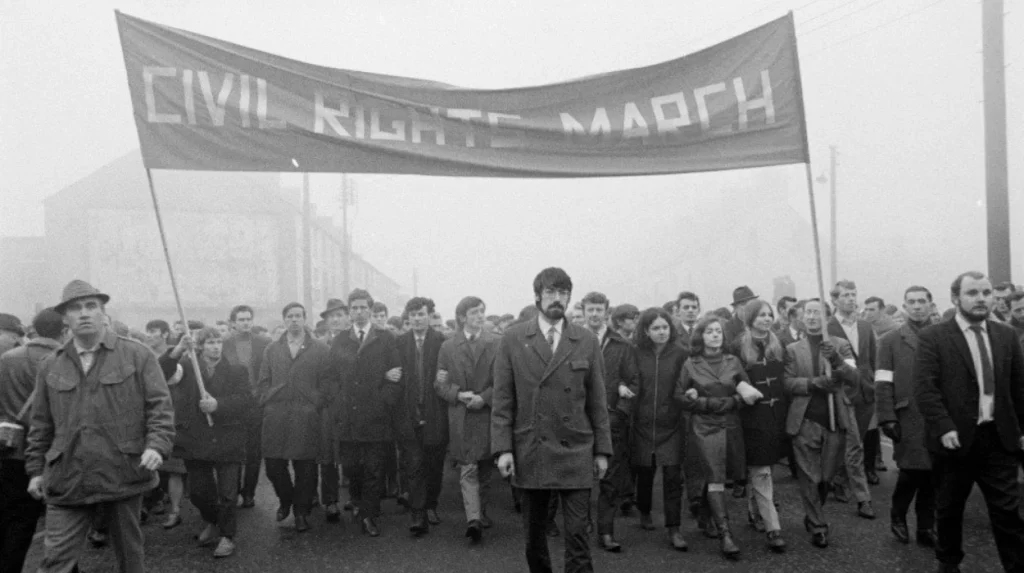
On April 10, 1998, a landmark event in the history of Northern Ireland occurred with the signing of the Good Friday Agreement that concluded decades of sectarian violence and political instability that preceded it, the Troubles. By this agreement, the Belfast Agreement as it is referred to, was the product of multi-party talks between the British and Irish governments and the political parties of the nationalist and unionist parties. The Agreement was passed in parallel referenda in Northern Ireland and the Republic of Ireland, and provided a complex power-sharing scheme, giving precedence to the human rights and institutional co-operation. Its legacy is still reflected on the political, legal, and societal norms in Northern Ireland in 2025.
Foundations Of The Good Friday Agreement
The main point of the Agreement was to establish a devolved political system that would be in place so as to make it inclusive and representative. The Northern Ireland Assembly which was formed under the accord assumed a consociational system that demanded inter-communal agreement. The d’Hondt system of ministerial distribution was implemented to keep the balance of power between the nationalist and unionist blocks with the distribution of power proportionally.
The post of the First Minister and Deputy First Minister was designed in such a way that both had an equal power and this was in line with mutual appreciation and the need to work together. This structure was to avoid the control of a particular group and promote bipartisan leadership in issues concerning healthcare and education among others.
Constitutional Arrangements And Principle Of Consent
The Agreement officially recognized that Northern Ireland would continue being a part of the United Kingdom unless a majority of its population chose otherwise in one of the future referendums. This declaration of the doctrine of consent was a move to alleviate nationalist anxieties with continuation to the constitutional status quo of the unionists.
Significantly, it acknowledged the validity of several nationalities. People who were born in Northern Ireland had the freedom of being British, Irish or British and Irish, with their citizenship rights attached to it. This devotion to identity plurality still lingers as one of the most culturally charged clauses of the Agreement.
Human Rights And Equality Commitments
The Agreement established powerful neutrals to civil liberties requiring legal and institutional mechanisms to ensnare equality. To oversee the protection of human rights, the anti-discrimination, and equitable treatment, the Northern Ireland Human Rights Commission and the Equality Commission were established.
Provisions were also made to promote the formation of a Bill of Rights which was to be unique to Northern Ireland to protect freedoms and also that should represent the needs of the region in society. Those human rights mechanisms were aimed at correcting the past injustices and creating a more inclusive post-conflict society.
Security And Disarmament
Disarmament of the paramilitary was a major aspect. The Independent International Commission on Decommissioning was formed with the responsibility of managing the disarmament of weapons that were possessed by parties that had participated in the conflict. The developments in this direction contributed to the alleviation of the fear of new violence, as well as to restoring trust by the communities.
Policing reform was also key. The Police Service of Northern Ireland (PSNI) was created replacing the Royal Ulster Constabulary according to the suggestions of the Patten Report. The reformations were to bring forth a service representative to and answerable to every community to enhance confidence in law enforcement.
North-South And East-West Cooperation
The Agreement established new cooperation structures to mirror and control the intricate interdependencies between Northern Ireland and the Republic of Ireland and the United Kingdom, in general. The North/South Ministerial Council promoted the coordination of policies on various matters such as agriculture and transport in Belfast and Dublin.
At the same time, the British-Irish Council and the British-Irish Intergovernmental Conference facilitated the communication within the three islands. These were mechanisms that enabled the normal interaction between sovereign governments, devolved administrations and other stakeholders making it clear that the Agreement was dedicated to multi-level governance.
Legacy Of The Good Friday Agreement
The Good Friday Agreement has been successful, in most aspects since its implementation, in the ending of large-scale violence and giving a structure through which political participation would occur. Although instability has disrupted devolved governance such as the suspension of 2017-2020 and another ongoing standoff after 2022, the institutions themselves have survived and evolved.
The Northern Ireland Office indicates that the level of trust among the citizens has continued to be ambivalent but resilient according to the 2025 report. Even in modern times, the Agreement is still regarded by many communities as the most important aspect of peace.
Challenges And Ongoing Political Dynamics
The political divisions have not been eliminated especially with Brexit and its effects on the position of Northern Ireland in the United Kingdom and its relations with the Republic of Ireland. The Democratic Unionist Party (DUP) still complains about elements of the implementation of the Agreement, particularly those that come into conflict with the Northern Ireland Protocol which imposes customs checks between Great Britain and Northern Ireland.
Though it is an effective power sharing model, it has been a weak idea in practice. Language rights disagreements, legacies and economic policy issues have led to recurrent government failure. Nevertheless, it is not inactive in terms of international interactions, such as the assistance of the United States and the European Union. The fact that president Joe Biden took a new diplomatic interest in Northern Ireland, indicates that the world has long had an interest in its stability.
Impact On Ireland-UK Relations And Brexit
The Agreement has been at the heart of the post-Brexit settlement. Its clauses contributed to the definition of Northern Ireland Protocol, a set up aimed at preventing the existence of a hard border between North and South without jeopardizing the integrity of the single market within the EU. Although this was a controversial move politically, it is a sign of the focus of the Agreement on maintaining open borders and peaceful coexistence.
There are still discussions between London and Brussels in 2025 that mention the Good Friday Agreement as a guiding document, so that the policy decisions do not ignore its fundamental principles of consent and cooperation.
Cultural And Societal Transformation
In addition to political and legal influences, the Agreement also helped to change the culture in Northern Ireland. Its focus on equality and mutual respect towards each other and equal treatment of cultures preconditioned the integrated education and cross-communication and more inclusive public discussions.
The younger generation of those who were born later than 1998 has been raised in an environment that is very different compared to their predecessors. Although sectarianism has not disappeared, more inter-community interaction has diluted historic differences. These benefits have been maintained through the civil society organizations, artists and educators who at times have also been performing without the institution of political offices.
The Good Friday Agreement has stood the test of time as a template of governing post-conflict framework that rests on a premise of inclusion, consent and cooperation. As long as political gridlock and regional wrangles are still hurting its implementation, the principles presented in 1998 are still at the centre of the peace architecture in Northern Ireland. The way it has developed during the past 27 years demonstrates how valid its vision remained, as well as the need to keep constantly renewing itself to meet the challenges of emerging complexity. The legacy of the Agreement provides indispensable lessons regarding the long-term usefulness of negotiated peace and institutional creativity in 2025 when Northern Ireland addresses new political and economic realities.