President Emmanuel Macron is in his second term of office in 2025, which is characterized by economic crises and political instability. The introduction of a EUR44 billion austerity budget in August, which led to the resignation of prime minister Francois Bayrou, resulted in wave after wave of protest. His successor, Sebastien Lecornu, had been bequeathed an unstable climate with little political space to maneuver. Though Lecornu pledged a more accommodative strategy, the austerity framework, such as the pensions, healthcare, and social welfare reforms, which Macron had claimed were the only solution to stabilizing the skyrocketing French debt, were maintained.
The long term problem that is faced by the administration of Macron is the balancing of the fiscal discipline and the established social model in France. The austerity measure, which according to critics were biased against the working and middle classes, revived doubts regarding the political viability of the economic reforms of Macron. In its effort to trim the budget deficit and re-adjust to the EU fiscal rules, the government is faced by widespread opposition of the masses based on an even greater dissatisfaction with the economic disparity and declining provision of state services.
Magnitude and mechanics of the strikes
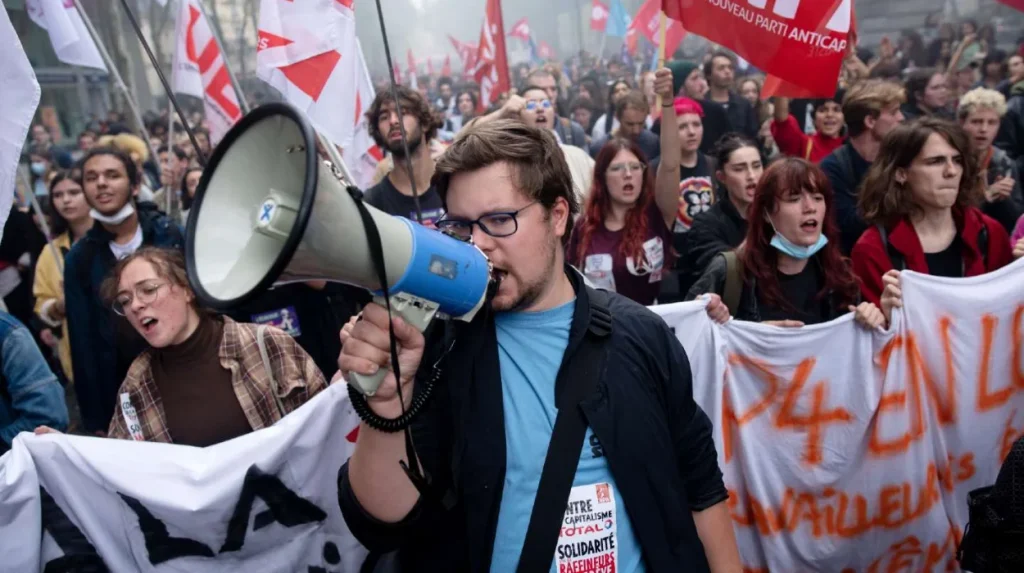
On September 18, more than a million people went to the streets in more than 250 cities of France. This was the biggest protest movement since the 2023 pension reform protests. The most active ones were education, transportation, energy, and healthcare sectors where the unions had a historically high rate. Most lines of the metro were shut in Paris, and regional trains experienced delays and cancellations.
The role of teachers and school employees was especially visible. According to official estimates some one-third of primary school teachers and close to half of secondary school teachers went on strike and affected the classes of millions of students. The hospitals, pharmacies, and administrative offices were shut down and the utility workers insisted on better wage systems considering the increasing inflation and energy costs.
Security response and civil unrest
To control the protests the French government sent about 80,000 law enforcement agents to the streets. The presence of police was heightened in the big cities to curb the situation by anarchists at the margin and the far-left activists. Single incidents were reported in Paris, Lyon and Marseille with dozens of people arrested and injured. In a bid to preserve the freedom of expression, authorities underlined that they took care of the upholding of the order in the country.
The size and organization of the strikes highlighted a tactical change in approach by the unions which was a sign that dissatisfaction was no longer confined to certain reforms and was an expansion of a wider disapproval of the economic course taken by Macron.
Political symbolism and leadership challenges
The issue of labor strikes can be attributed to the increasing perception of lack of connection between the electorate and the Macron administration. The appointment of Lecornu was to create confidence among the people due to the controversial politics of Bayrou but his first steps, which included postponing instead of withdrawing unpopular governments, did not help him to appease the protest leaders. The union leaders such as Sophie Venetitay of Snes-FSU were openly distrustful, pointing to a trend of governmental noncooperation on social problems.
As indicated in the public opinion polls carried out in late September 2025, Macron has the lowest approval rating since his re-election in 2022, with only one-fourth of the participants demonstrating confidence in his managing economy. The political vulnerability of the administration is also exacerbated by the fact that it is struggling to make its budget reforms pass after a divided National Assembly.
Reform fatigue and public sentiment
A lot of protestors believe that the present austerity measures are the result of decades of systematically weakening social safeguards. The recommended changes in the pension system, increasing the retirement age to 64, and decreasing the benefits- are especially delicate. Combined with the rising cost of living, increased healthcare payments, and minimized subsidies of basic services, the people have become frustrated to the extent of defiance.
In an effort to settle domestic backlash, the political capital that Macron built up by a pro-European, technocratic image, is now being worn down. The strike is not only a policy conflict but a vote on the larger economic agenda of the government.
Economic implications and fiscal urgency
By the year 2025, the public debt in France was over EUR3.3 trillion, which translated to over 114% of the GDP and its budget deficit was 5.8, almost twice the 3% limit of the EU Stability Pact. These signals are raising alarm in the world markets and European institutions thereby putting pressure on France to show fiscal discipline. The idea behind the austerity budget prepared by Bayrou was that it would help mitigate the crisis, preventing the country from spending on unnecessary things in addition to sending a message to the investors that France was still serious about financial responsibility.
Nevertheless, the political opposition makes one wonder how much further austerity is possible. Economists caution that, without popular approval or legislative consensus, such actions will only create greater instability than savings, in particular, in the event that strikes undermine economic productivity and investors lose trust in the direction of reform in France.
Risk to Eurozone cohesion and market confidence
The economic plight of France has an international implication. France is the second largest economy in the Eurozone and long term instability or inability to make any policy decisions may impact the stability in the region. The ratings agencies have already alluded that they may downgrade in case fiscal consolidation is stalled or the intended reforms are aborted by the people.
Though foreign investors remain quite interested in the long-term fundamentals of France, they have become more sensitive to the political signals. The ongoing labour violence and deteriorating control authority may bring instability in bond markets, undermine the euro, and strain the European central bank to adjust its growth perspective.
Societal undercurrents and evolving political dynamics
The protests reveal more than fiscal policy, revealing a greater mistrust in political institutions. Austerity has been perceived as unfair to low- and middle-income citizens by many protestors because it has been beneficial to corporations and the rich. Claims of two-speed France of urban elites enjoying the fruits of globalization and rural and working-class citizens shouldering its consequences have been reiterated, with echoes of previous movements such as the Gilets Jaunes protests.
This increasing gap can question the party lines. The left-wing parties, especially the La France Insoumue, have also been gaining momentum by appealing to those disillusioned with mainstream politics, as they joined the side of the organizers of the protests, with the far-right National Rally denouncing the protests and the government itself.
Prospects for policy recalibration
The government of Lecornu is under increased pressure to rework important austerity measures or postpone them. There has been increased calls to have national dialogue between unions, opposition leaders, and the civil society. The fact that Macron can enter into such a conversation without seeming to surrender or undermine the commitment to reforms will be a personal breakthrough in determining the fate of this crisis.
According to policy analysts, the introduction of more progressive taxation, postponement of controversial changes and investment in selective social programs would help soothe tensions. There is, however, a scarcity of time and political capital and a non action can encourage more widespread social discontent or even upset the existing regime.
France’s labor strikes in 2025 present a critical moment not only for President Macron’s economic mandate but also for the social contract underpinning French governance. The convergence of fiscal strain, political polarization, and public resistance illustrates the fragility of enacting reform in a deeply divided society. How France navigates this impasse will influence not just its own trajectory, but potentially reshape the balance between austerity and social justice across Europe.