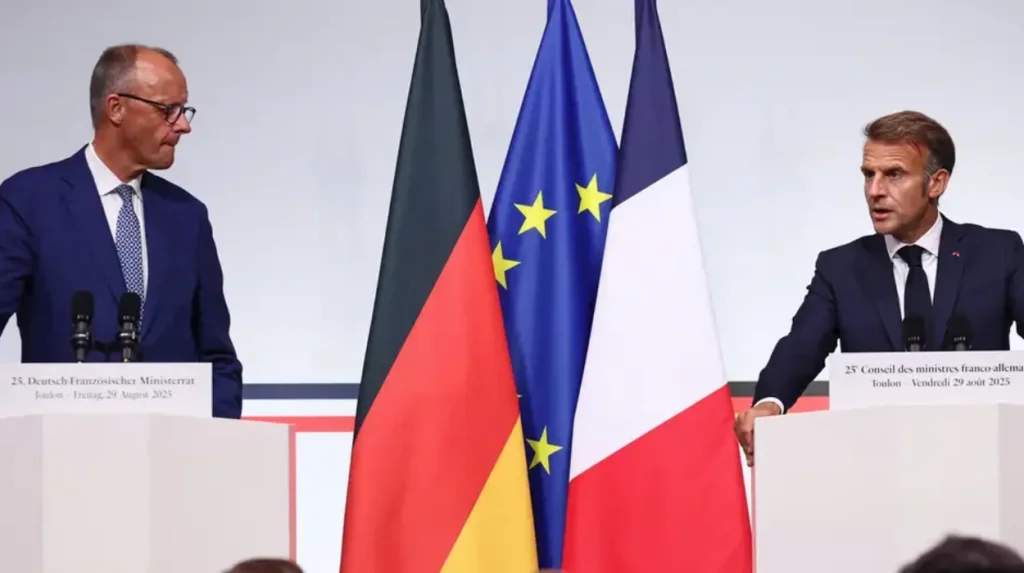
German chancellor Friedrich Merz and French President Emmanuel Macron reaffirmed their commitment to bolstering bilateral security cooperation in August 2025, declaring their partnership to be the cornerstone of peace and stability in Europe. At the Franco-German Ministerial Council on the French Riviera, both leaders emphasized the need for a coordinated defense strategy in light of the escalating severity of the conflict in Ukraine, and a new wave of Russian aggression across the eastern flank of Europe.
Chancellor Merz stated,
“Our security in Germany is closely tied to European solidarity and the resilience of our neighbors.”
President Macron elaborated it by stating,
“Only through deeper integration of our defense and strategic policies can Europe face the threats of today and tomorrow.”
The collective statement set out new steps, such as institutionalized strategic dialogue that aims to harmonize the nuclear deterrence beliefs of the two nations- a particularly significant move considering the history of French nuclear independence and German NATO obligations.
Strategic Defense Alignment And New Initiatives
The step up in the Russian air attacks of drones and ballistic missiles has resulted in accelerated change in European defense planning. In reaction, France and Germany announced a new bilateral missile early warning system. It is an initiative that is designed to ease the sharing of data and give real-time threat detection among the member states with NATO interoperability in consideration.
This tactical venture is developed based on the prior German investments in air defense infrastructures like IRIS-T and incorporates French technology in the radar. The new architecture will serve to inform frontline allies and NATO command of any impending threat, within a few seconds, in order to improve defensive response times.
Reinforced Military Aid To Ukraine
A major deliverable from the August meeting was the agreement to increase the quantity and technological sophistication of military aid sent to Ukraine. The two countries are shifting to episodic support to an organized supply chain of defense gadgets, such as mobile air defense batteries and anti-drone systems. It is aimed at protecting Ukrainian power plants, transport hubs, and civilian districts against constant bombing.
Making the aid effort institutionalized, Merz and Macron will send a message of long-term assistance to Kyiv, but will also discourage further escalation by the Russians. The coordinated strategy is also supposed to support wider NATO and EU members to make more predictable support packages.
Broader Security Cooperation Amid Sanctions And Economic Pressures
In addition to military support, Merz and Macron highlighted the economic levers of the strategic value of the security architecture. They both pushed the case of tightening secondary sanctions, particularly on players in Asia and the Middle East that provide Russian energy incomes. Their thrust is to seal gaps in the sea trade and to break up circumvention through transshipment centers.
This economic front constitutes a two-fold approach, weakening the war potential of Russia at the same time strengthening the internal unity of Europe. Merz, in particular, emphasized the necessity of a single approach to procurement of energy and emergency stock, Macron insisted on a faster European Green Deal in the name of less dependence on fossil fuels.
Focus On Technological Sovereignty And Strategic Autonomy
The Franco-German summit as a component of the greater dialogue announced an investment in both defense and energy technologies next generation through joint R&D. Special emphasis was placed on quantum computing, artificial intelligence and battlefield robotics-areas in which both leaders singled out as defining the future of European strategic independence.
Macron stated,
“The defense of tomorrow will be coded, not just armored,”
while Merz emphasized the importance of “technological sovereignty as a safeguard against coercion.” A Franco-German Defense Innovation Council was declared to manage research across borders and hasten the implementation of dual-use technologies.
Political Context And Domestic Challenges
As the summit was characterized by togetherness, both leaders are sailing through rocky political seas back home. The unpopular pension and energy subsidy changes present Macron with a crunchy budget confidence vote in the French National Assembly. He seized the opportunity of the Ministerial Council, despite the backlash of opposition, to demonstrate once again his long-term role in the leadership of European security issues.
Analogous to the situation, Chancellor Merz who took office less than a year ago is dealing with mounting tension in the EU over collective defense budgets and sovereignty. Eastern states members, especially Poland and the Baltics have complained that bilateral actions between Paris and Berlin could marginalise larger EU processes. But Merz has always asserted that Franco-German leadership is neither exclusive, but constitutive.
This individual has addressed the subject, highlighting the historic significance of Franco-German collaboration as the foundation of Europe security and resilience in the face of changing global dangers:
Wir stehen in Einigkeit und Stärke zusammen, um unsere gemeinsamen Werte sowie die Freiheit und Sicherheit unserer Bürgerinnen und Bürger zu verteidigen – das haben Präsident @EmmanuelMacron und ich in einem Gastbeitrag in der @ft geschrieben. 1/4 pic.twitter.com/DjraYVqSAS
— Bundeskanzler Friedrich Merz (@bundeskanzler) June 24, 2025
Merz in his more recent statement has again made the point that the renewal of the Franco-German compact is symbolic as well as operational in the future of Europe-that it constitutes a legacy-building effort in a time of geopolitical flux.
Future Implications For European Defense Architecture
The coordinated moves by Merz and Macron are increasingly being interpreted as the nucleus of a potential European Defense Union. Although such a structure remains aspirational, the alignment in doctrine, procurement, and threat assessment marks a significant evolution from earlier decades, where security cooperation was often fragmented or reactive.
This strategic depth also opens the door for future interoperability with Nordic and Eastern European partners. Talks have reportedly begun with Finland and Estonia regarding joint training exercises and cybersecurity drills under the Franco-German framework. Such efforts may extend to intelligence fusion centers and cross-border rapid deployment forces in the years ahead.
Observers note that the Merz-Macron dynamic may define the post-NATO recalibration of European defense. With uncertainty over U.S. election outcomes in 2024 still casting a long shadow, European leaders appear determined to minimize reliance on transatlantic guarantees.
What This Renewed Cooperation Signals For Europe’s Trajectory?
The coordinated vision emerging from Paris and Berlin in 2025 signals more than immediate responses to the Ukraine war. It reflects a foundational recalibration of Europe’s strategic identity. By institutionalizing bilateral defense frameworks, linking economic resilience to military readiness, and projecting leadership in emerging technologies, Merz and Macron are attempting to reframe Europe’s posture for the next decade.
While the full impact of these efforts will depend on wider EU participation and sustained political will, the August summit marks a pivotal point. It is a measured yet ambitious bet that a tighter Franco-German axis can anchor a more resilient and autonomous Europe. How this bet plays out may well decide the continent’s capacity to navigate an increasingly multipolar and volatile world.