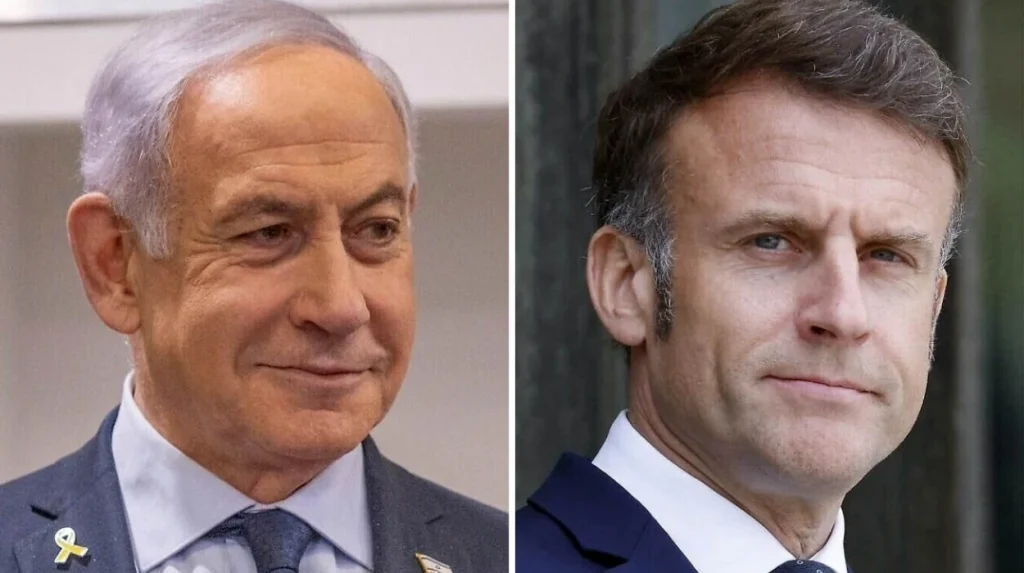
The diplomatic row between the Israeli Prime Minister Benjamin Netanyahu and the French President Emmanuel Macron has escalated into a symbolic one that entails general tensions between antisemitism, statehood recognition of Palestine and consequences on global relations in 2025. The accusation by Netanyahu that Macron is propagating antisemitism after France recognized an almost-country plan showed the profound differences laid down by history, political interests and the course taken by the Israeli Palestinian conflict.
France’s policy shift and the political context
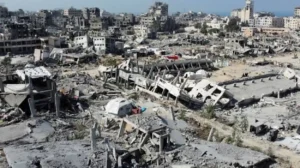
The support of a Palestinian state in 2025 has been the ground-breaking move in the policy of France toward the Middle East. The announcement in Paris brought it on par with the increased international pressure toward a two-state solution given that over 145 UN member states have already recognized Palestine. The action was taken after the human rights situation in Gaza worsened with reports of displacement and mushrooming of casualties on a civilian level.
French policymakers posed the move as an effort to resume stagnant negotiations, doing this through renewing Palestinian political legitimacy. The transition coincided with increased sensitivities, however, as Israel was embroiled in more aggressive military action in Gaza and on the face of more international attention because of Israeli domestic politics and judicial reform efforts. The combination of these accentuated the positive reception of France of the announcement of recognition turning into a flashpoint.
Netanyahu’s reaction and strategic framing
The rhetoric to come was speedy and biting. In an open letter to Macron, he criticized the move as adding “fire to the antisemitic flame” and said that such a recognition would spur the Hamas and other hostile parties. He has also urged Macron to act upon the surging antisemitism in France ahead of the Jewish New Year as the linkage between foreign policy and the disintegrating safety of Jews in the diaspora is considered.
This framing was driven by the need to recontextualise Israel not only to create a geopolitical actor but also as the protector of the world Jewish population. By correlating state recognition and antisemitism, Netanyahu tried to turn the debate around and make a matter of diplomacy into a matter of moral duty.
France’s response and stance on antisemitism
French authorities, on the one hand, accounted for the accusations of Netanyahu, on the one hand, and the advisers of the president Macron, as well as the representatives of the Foreign Ministry on the other hand, excluded the accusations. They described the allegation as “demeaning” and as “untrue” with France emphatically arguing that it has a continued resolve to fight antisemitism in all levels of society. Speaking to the Guardian, the Minister for Europe, Benjamin Haddad was categorical that France has nothing to learn in this context at all in terms of protecting the Jewish community and some of the acts of civil rights that were being pursued.
The reaction of France was conditioned by the domestic reality. The largest Jewish community in Europe is that of France, where antisemitism has been on the increase the past years especially during flare-ups in the Middle East. Nevertheless, the administration of President Macron argues that the domain of foreign policy should be separated with the security policies at the national level and that the acceptance of the statehood of Palestine does not mean a compromise with the security of Jewish people.
Separating diplomatic action from community security
The line of argument put forward by Paris is that policy toward Palestine does not follow a rejection of commitments toward fighting hate by strategic vision policy towards peace. This distance allows France to walk a narrowing tightrope of a highly polarized debate on the one hand, and of protecting diplomatic independence on the other.
This is part of a broader European tendency, as support of Palestine is becoming an instrument of reorientation of the terms of relations in the peace process, especially in the conditions of the stagnation of efforts and deterioration on the ground.
The antisemitism debate in a globalized conflict
In such fears enabled by the letter, Netanyahu exploits a wider fear of the Jewish people world-wide which includes the fear that a change in international policy towards Palestine will be accompanied by a negative change towards the Jews in the West. Such a concern is not baseless. Evidence provided by European monitoring agencies indicates that the rise of antisemitic rhetoric has often been induced by changes in the Palestinian-Israeli dispute, with or without the presence of a causative relationship.
Critics however, believe that smoking equality between the acceptance of Palestine statehood and antisemitism will lead to the introduction of such an important distinction between political critique of Israel and the hatred of Jews. This blurring may complicate the task of separating out and combating real antisemitism and may have the effect of sinking cold water on true diplomatic efforts.
Instrumentalizing antisemitism for political ends
The Macron-Netanyahu row shows how both mobilizing against antisemitism and anti-semitising in state politics are a risk open to backfiring. Although antisemitism needs strict attention and invariable opposition, it could be considered as politicisation of the human rights issue, which also makes cooperation and mutual understanding more difficult under the specific circumstances connected to the usage of the antisemitism term in the discourse of bilateral diplomatic criticism.
The danger is that allowing weaponization of antisemitism in a diplomatic dispute can eventually erode the mutual resolve concerning fighting it.
Fallout across international diplomatic fronts
Consequences of this conflict do not stay within the French-Israeli relations only. Netanyahu has also vented his anger at Australia whose Prime Minister Anthony Albanese has leaned towards accepting the Palestinian state and limiting the entry visa of some Israeli political leaders. This gaping chasm indicates a trend: these efforts by governments to use diplomacy to recalibrate the situation in Palestine is being met with increasingly hostile Israeli diplomatic pushback.
These disputes have become visa cancellations, reciprocated travel bans and public admonishment. The envisage casts light upon the long-term ability of the Israeli-Palestinian conflict to transform global organisations and mobilise emotional response in various political arenas.
Shifting international dynamics in 2025
What the aggregate effect of these tensions means is a retuning of what international unity over the Israel-Palestine question can mean in 2025. Although the U.S. continues to be Israel’s closest supporter, the European and Pacific countries are getting increasingly independent in their policy decisions. The outcome is a multipolar field of diplomacy whereby words of Palestine have ceased to be a domain of a Global South or Muslim-dominated world.
This mix of diversity itself can be seen as an indication of a structural change in the overall framing of the conflict on the global level, since the binary format of Cold War-era alliances shifted to a more polyvalent process of alignment based on an issue.
Jewish and Palestinian communities watching closely
For Jewish communities, particularly in France and elsewhere in Europe, the tone of this diplomatic dispute has deep implications. Community leaders have expressed concern about whether international recognition of Palestine could be followed by societal hostility. At the same time, many emphasize the importance of not conflating diplomatic actions with animus toward Jews, stressing the need for strong public messaging that antisemitism will not be tolerated under any circumstance.
Palestinian communities and advocacy groups, on the other hand, view these recognition moves as overdue acknowledgments of statehood claims that have long been marginalized. France’s decision is seen not only as a political gesture but as a moral one, intended to rebalance an asymmetrical conflict and accelerate pathways to self-determination.
This dual focus on identity and diplomacy was reflected by Aviva Klompas, who noted that such clashes affect more than just foreign ministries—they influence the daily lives, political identities, and cultural affiliations of global communities watching the conflict evolve.
Prime Minister Netanyahu sent a sharp rebuke to French President Macron: “Your call for a Palestinian state pours fuel on this antisemitic fire. It is not diplomacy, it is appeasement.” pic.twitter.com/1aWgWAa9C5
— Aviva Klompas (@AvivaKlompas) August 19, 2025
The growing discord between Netanyahu and Macron over accusations of antisemitism and the recognition of Palestinian statehood reveals the increasing complexity of international diplomacy surrounding the Israel-Palestine conflict. As more nations reassess their policies, old lines of alliance are shifting, and the stakes for communities on both sides are intensifying. The challenge moving forward will be to navigate these decisions with clarity—ensuring that political recognition and humanitarian principles coexist without sacrificing social cohesion or moral integrity. The question remains whether diplomacy can evolve fast enough to match the expectations and anxieties of a world watching for justice and peace in a region that has seen too little of either.