French President Emmanuel Macron had already pledged to add 6.5 billion to the French defense budget in two years and to reach the level of 64 billion per year of military spending in 2027. Such speeding up of the modernization of French defense, which was to have taken place in 2030, is a key indicator of the strategic move of Macron to protect national and European security in a gradually deteriorating geopolitical situation. It is also an assertion of French military sovereignty at a time when the reliability of the Americans is questioned, the threats posed by Russia are steadily increasing and the overall evolution of the globe alliances is unclear.
Macron’s Urgency and the Rationale Behind the Defense Surge
Security Deterioration Since 2022
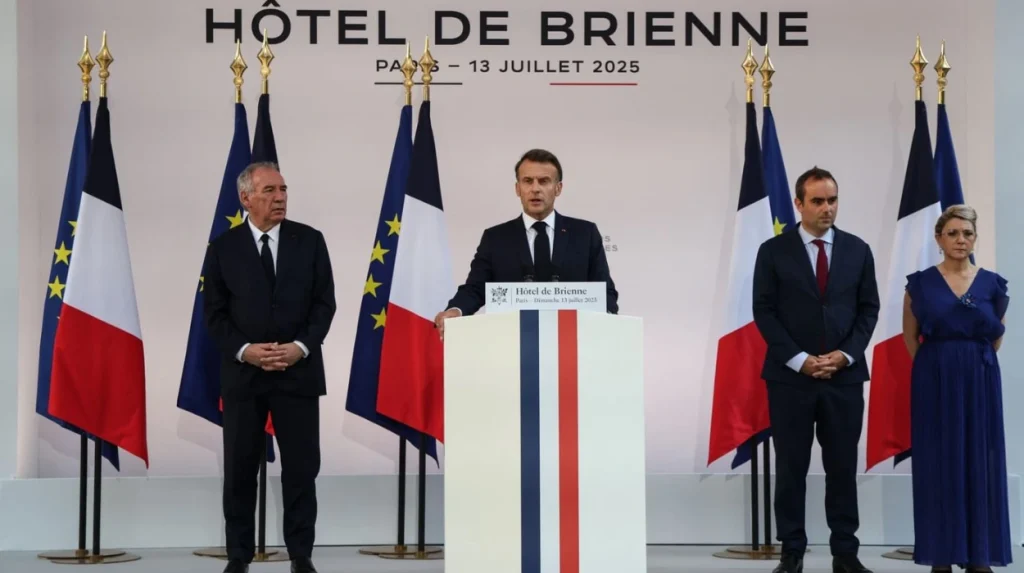
The revelation given by Macron on the 13th of July in 2025 as part of the yearly pre-Bastille Day speech to the armed forces pointed to an immense decline in the international security situation. Citing the Russia-Ukraine war, the rise of cyberwarfare, and an increasing campaign of disinformation against European democracies, he said,
“Since 1945, our freedom has never been so threatened,”
our freedom has never been so in danger.
The chronic crisis in the Middle East along with the threat of nuclear proliferation and the growing tendency towards self-determination in military technology have been exerting an immense strain on the preparations of NATO members. France being among the two nuclear powers in the EU has also taken counter measures such that its defense budget has doubled as compared to that of 2017.
Compression of the 2030 Target
The additional funding of 6.5 billion euros in 2026 (3.5 billion euros) and 2027 (3 billion euros) takes overall military expenditure to 64 billion euros, or 75 billion dollars. Macron pointed out that this rise was not to be accompanied with borrowing, despite the fact that the French government coded its 113% of GDP worth of public debt by mid 2025. Rather, he made the growth to be pegged on the expected improvements in productivity and industrialization.
This strategic fiscal positioning is intended to keep investor confidence stable while allowing France to pursue rapid military transformation.
Sovereignty as Strategy: Macron’s Vision for a Stronger France
Autonomy Beyond Alliances
Macron’s doctrine has long championed the concept of strategic autonomy. His remarks during the July 2025 speech further advanced this theme: “To be free in this world, we must be feared.” The phrase encapsulates his effort to reassert France’s military independence, particularly in light of concerns over the reliability of the United States in future European crises.
Though France remains a central NATO member, the defense boost is meant to reinforce its capacity to act unilaterally or lead coalitions without complete dependence on transatlantic support.
Expanded Nuclear and Conventional Capabilities
The increased spending will focus on expanding France’s nuclear triad and on enhancing its conventional arsenal. Macron has initiated talks with the UK on nuclear coordination and has suggested discussions with European partners on the continent’s broader deterrence strategy.
France also aims to increase its stockpiles of precision munitions, develop next-generation drones, strengthen cyber defense, and expand ground-based air defense systems—lessons taken directly from the Ukraine war.
General Thierry Burkhard, France’s top military commander, noted that
“our adversaries no longer test our limits—they attempt to bypass them entirely.”
The defense spending aims to close those gaps before they are further exploited.
Domestic Reactions and Political Debate
Broad Political Backing on the Right
Right-wing and centrist parties have largely supported Macron’s decision, describing it as overdue and aligned with a European trend toward military expansion. Several conservative lawmakers cited the €100 billion German defense boost and Polish increases as evidence that France must act decisively to retain its leadership role.
This move also comes as NATO allies prepare to standardize their defense contributions, pushing towards a 3.5% of GDP target. France currently sits below that threshold but is trending upward.
Criticism from the Left and Fiscal Watchdogs
Macron’s critics on the left have raised concerns over social trade-offs. With unemployment still hovering near 8% and ongoing pressure on housing, healthcare, and education, they argue that prioritizing defense exacerbates inequality.
La France Insoumise leader Jean-Luc Mélenchon accused Macron of
“sacrificing the social contract in favor of war games,”
pointing to insufficient investment in climate transition and public services. Additionally, fiscal experts have questioned whether France can genuinely fund the increase without deep structural reforms or increased taxation.
Economic Ripple Effects and the Role of Industry
Linking Defense to Domestic Innovation
Macron’s strategy aims to position the defense sector as a pillar of national economic revitalization. By demanding accelerated production and deeper investment in R&D, he hopes to turn defense spending into a growth engine.
This involves reshoring key manufacturing facilities, reducing dependence on foreign components, and fostering public-private partnerships in arms development. France’s shipbuilding, aerospace, and cybersecurity industries stand to benefit, with job creation framed as a secondary dividend of military buildup.
Financing Without New Debt
Prime minister Francois Bayrou will present the budgetary framework which would allow the increment of the budget. His proposal involves some redistributions of the current non-security public expenditure, some modest increases in the taxation of corporations, and economies on civil service efficiency.
These assertions still need to be put to the test. France has been guilty of expenditure excesses on military spending and there is a threat that any slight miss on budgetary predictions, the economy could become unbalanced.
Strategic Implications for European and Global Defense
A Rebalancing Within NATO
The action of France will readjust strategic calculations in NATO. As the U.S. has shown intention to shift to Asia and tensions between members are increasing in the alliance, European powers are playing an increasingly proactive role. The European security leadership will be more simply re-anchored around Paris by the defense stance of Macron, in the event that the defense program of Germany is slow-moved through bureau delays.
The insistence on the independent strength in France also acts as a warning to Brussels regarding the prospect of future European defense projects outside of the U.S-led set up in NATO.
Responding to Global Uncertainty
Outside of Russia, the agenda by Macron indicates some understanding of international instability – be it the situation in the Taiwan strait or cyber warfare in Europe. French leaders have attributed the necessity of mobile and swiftly deployable troops that would be employed both in traditional and simultaneous operational contexts.
This already resembles a French-spearheaded maritime task force which is working in the Red Sea halting international shipping. Future operations are also expected to be similar and only boost French military presence in the world.
This person has spoken on the topic and posted analysis relevant to Macron’s acceleration in a recent thread on military strategy and sovereignty. The summary underscores how the defense boost is being framed not as reactionary spending, but as a deliberate, future-facing security recalibration.
🇫🇷 Macron announced that France will double its defense budget
— Lord Bebo (@MyLordBebo) February 3, 2025
He also wants more European funding and buy preferentially European. pic.twitter.com/VYqYfqZBt3
The Stakes Behind Macron’s Military Bet
France’s defense surge is more than a response to external threats—it is a gamble on a national identity rooted in sovereignty, capability, and deterrence. Macron has chosen to define freedom through military strength at a time when the global order is strained, alliances are questioned, and conventional deterrents are tested.
It is more than fire power or money that will determine the success of this strategy. It will need to have societal acceptance, financial strength and good governance. So with Macron redefining the French contribution to European and international security, the world will be observing whether it is true that power that is based on preparedness can be converted into enduring influence.