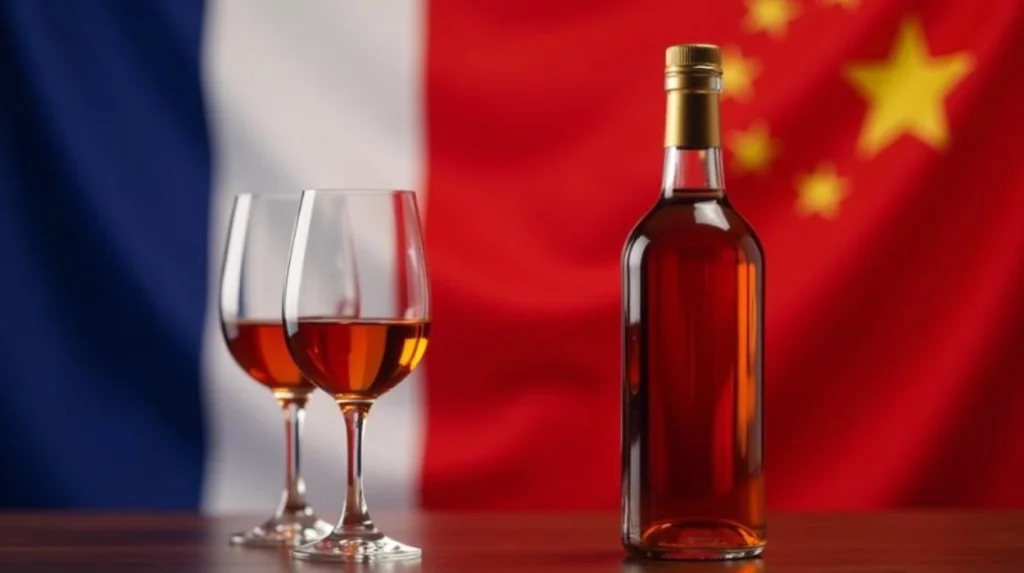
France’s world-renowned cognac industry is entering a precarious phase in 2025. On July 5, China imposed anti-dumping duties on European brandy imports—most notably affecting French cognac—following an 18-month investigation. The move has sparked alarm amongst French trade and diplomatic quarters with the maximum duty on both containers of less than 200 liters set at between 27.7 per cent and 34.9 percent. One of the more celebrated French exports, Cognac, is facing a budding trade conflict between the European Union and China as more countries enter the fray.
This by Beijing as part of its retaliatory measures against EU acts against Chinese electric vehicles highlights a re-arrangement of trade in the world. All French manufacturers, Chinese officials and even the EU official ambassadors are adjusting with the declining economic situation at a very high rate.
The Tariff Regime: Terms and Industry Impact
Duty Levels and Producer Exposure
China’s Ministry of Commerce finalized the tariff decision after concluding that brandy from the EU was being dumped at unfair prices and harming local industry. The new measures impose heavy duties for five years on all European brandy shipped in smaller containers—a standard for high-end cognac exports.
Such iconic brands as Hennessy, Martell, and Remy Martin are the most exposed. The long-term cost is heavy as others have done that with signing minimum price agreements with Beijing, but not to the full extent. Hennessy faces a 34.9% duty if its pricing commitments are breached, while Martell’s rate is fixed at 27.7%.
This framework presents a dilemma. Price guarantees preserve access to China’s market, but limit pricing flexibility and undermine premium branding strategies.
Economic Stakes and Market Pressure
China accounts for about €1.4 billion in annual French cognac exports—roughly one-third of total global sales. Due to provisional duties which have been announced at the end of 2024, the losses in the industry are said to be up to 50 million euro on a monthly basis. According to analysts, the ultimate tariff regime would cannibalize the margins, break the supply chains, and even reorient the consumer favors to domestic alternatives.
The damage extends beyond tariffs. Since December 2024, China’s major duty-free markets have closed to French cognac brands, blocking a vital sales avenue that previously contributed around 20% of in-country consumption. This double blow has pushed the industry into a state of cautious crisis.
Diplomatic Overtones and Strategic Dialogue
Retaliation and Reciprocal Measures
The timing and scope of China’s move suggest more than mere concern over brandy pricing. The inquiry prompted by Beijing was in response to that conducted by the European Commission against Chinese electric cars, an industry that the EU accused of receiving an unfair advantage in subsidies by the state. It is against this background that the aim by China at luxury liquor, which represents prestige of the French and Europe can be viewed as symbolic as well as planned.
Early this month, a meeting of EU foreign ministers including France Jean-Noel Barrot with Wang Yi, China Foreign Minister covered China-EU, seeking to calm tempers on the eve of a summit planned later this month in Beijing. But Barrot was not reticent of his opinion, advising that there are still issues that are unresolved, and are of a major nature.
The summit is billed as a litmus test of whether top-level diplomacy can check something that is becoming a trade war.
France’s Calculated Response
While the EU broadly condemned China’s duties as excessive and inconsistent with WTO rules, France has taken a more measured tone. Aware of how crucial China remains to the cognac sector, the French government has opted for dialogue rather than confrontation.
Trade Minister Franck Riester acknowledged the economic impact but urged calm, stating that negotiations were “still open” and that commercial ties must be “preserved and recalibrated—not broken.” This strategy reflects France’s complex position: balancing national economic interests with EU-wide solidarity on trade policy.
Industry Adaptations and Tactical Compromises
Minimum Pricing and Compliance Strategy
For leading cognac houses, compliance with China’s price demands offers a lifeline. Rémy Cointreau described the terms as “not ideal but manageable,” noting that avoiding the full tariff allows continued distribution without immediate losses.
These price floors act as unofficial trade settlements. By agreeing to set a baseline export price, producers retain access while conceding to Chinese regulatory leverage. Nevertheless, such compromise is associated with reputational and financial risks, especially in case the local consumers start to consider French cognac as too expensive luxury which lacks the cultural connotations.
Producers are, therefore, attempting to find a thin balance between preservation of prestige and coming into new geopolitical economics.
Smaller Brands Left Behind
For smaller producers, the situation is far more precarious. Without the scale or resources to enter price agreements, many face full tariff exposure. The outcome is the probable shrinkage of the Chinese market diversity, where only the biggest can afford to enter.
Taxes on companies have hindered others like some of the fashion label currents operating as boutique labels who are already pulling out of their channel in the Chinese market because of unsustainable margins and legal vacuum. Others are making a shift to emerging markets in Southeast Asia, Africa and the Gulf but this shift takes time, capital and the education of customers.
The Broader Trade Landscape and EU Implications
Beyond Brandy: Other Sectors at Risk
China’s brandy tariffs are not an isolated incident. At the same time, Beijing has initiated investigations on European pork and dairy imports- still more signs of a tit-for-tat policy aimed at exerting pressure on a variety of sectors.
Such conflicts follow the rise in economic nationalism on both parties. The EU’s push for anti-subsidy investigations into Chinese green technology has triggered a chain reaction. Although presented as counter moves to unjust competition, the two blocks are currently engaged in a wider battle to battle over trade regulations, management of regulations, and shape of industries.
The notes of money tonight have turned into an order of brutal retaliation enforcement, which could be a disaster in the long term to world supply channels.
Challenges to Trade Multilateralism
The World Trade Organization’s mechanisms remain largely paralyzed, offering little recourse for affected industries. With dispute resolution systems gridlocked, states are increasingly relying on unilateral tariffs and bilateral negotiations—undermining the postwar architecture of free trade.
The cognac dispute underscores this reality. Despite WTO obligations, enforcement depends on political will rather than legal clarity. This uncertainty leaves exporters exposed and trade policy driven more by strategy than by rules.
Market Psychology and Brand Equity in Flux
The Risk to Brand Loyalty
Luxury brands depend not just on product quality but on image. In China, where prestige, heritage, and exclusivity drive consumer choices, the perception of French cognac is deeply intertwined with its price and presentation. If tariffs push prices beyond acceptable limits, or if product availability falters, brand equity could erode.
Consumers may turn to domestic substitutes or other foreign spirits less entangled in diplomatic rows. For the French industry, the danger is not just short-term financial loss, but the slow attrition of cultural relevance in its most lucrative export market.
Maintaining visibility and loyalty under these conditions will require marketing recalibration, cultural outreach, and—if possible—diplomatic breakthroughs that reset the tone of engagement.
Voices from the Global Trade Sphere
This person has spoken on the topic in an interview with Bloomberg, emphasizing the delicate balance French producers must strike between complying with Chinese demands and maintaining their brand integrity and global competitiveness.
🇨🇳🇫🇷 CHINA TO FRENCH COGNAC MAKERS: PLAY BY OUR RULES, GET YOUR MONEY BACK
— Mario Nawfal (@MarioNawfal) July 1, 2025
China’s offering a juicy tax refund to big-name French cognac brands like Hennessy and Martell if they agree to set a minimum price and follow Beijing’s rules.
But there’s a catch: smaller producers say… https://t.co/6E7HRAElRE pic.twitter.com/vF6ucHHKoR
Such insights highlight the strategic complexity behind corporate decisions in an increasingly politicized global economy.
Future Trajectories for France’s Export Crown Jewel
As the cognac industry navigates China’s anti-dumping duties, it finds itself not only in a trade dispute but in a broader struggle over global trade governance. What began as a pricing conflict has become emblematic of shifting power dynamics between Europe and China—one where luxury exports, not just industrial goods, are caught in the crossfire.
French producers now face difficult questions: Can they continue relying on China for consistent growth? Will diplomatic efforts at the EU-China summit lead to tariff relief or further escalation? And what strategies are necessary to retain prestige and profitability in a fractured marketplace?
How France answers these questions may well determine whether its most celebrated spirit remains a global icon—or becomes a casualty of 21st-century trade warfare.