The state visit to Norway by the French President Emmanuel Macron for 2 days in June 2025 was a new milestone in the Franco-Norwegian relationships and European security at large. It is the first visit by a French president to Norway since 1984, as the countries stressed the need to ramp up cooperation on defence and security in a swiftly changing geopolitical environment. The trip led to development of strategic partnership agreement, where both countries recognised the common challenges and wanted to strengthen European resilience and deterrence.
A Renewed Commitment to Security in Europe
The Geopolitical Backdrop
The visit of Macron coincided with a time when Europe was experiencing increased security alert. The continuing Russian-Ukrainian conflict, unstable Middle East situation and the emergence of hybrid threats have necessitated the need for strong allies and a closer relationship among NATO members. Both France and Norway, being leading members of NATO, have admitted that European security no longer means only military preparedness but also political integration, and technological advancement.
La Norvège et la France sont désormais liées par un partenariat stratégique complet. Un pacte pour nos intérêts partagés : défense, sécurité nordique et arctique, décarbonation, technologies, intelligence artificielle. pic.twitter.com/mM3fDRuJ0M
— Emmanuel Macron (@EmmanuelMacron) June 23, 2025
The leaders argued over the ultimate need of shared strategic vision of security threats that the world faces, especially those in the High North and North Atlantic.
Norway’s closeness to the Russian nuclear submarine bases and a region of strategic interests to France, makes the Arctic security issues an area of attention by both governments.
Strategic Partnership Agreement
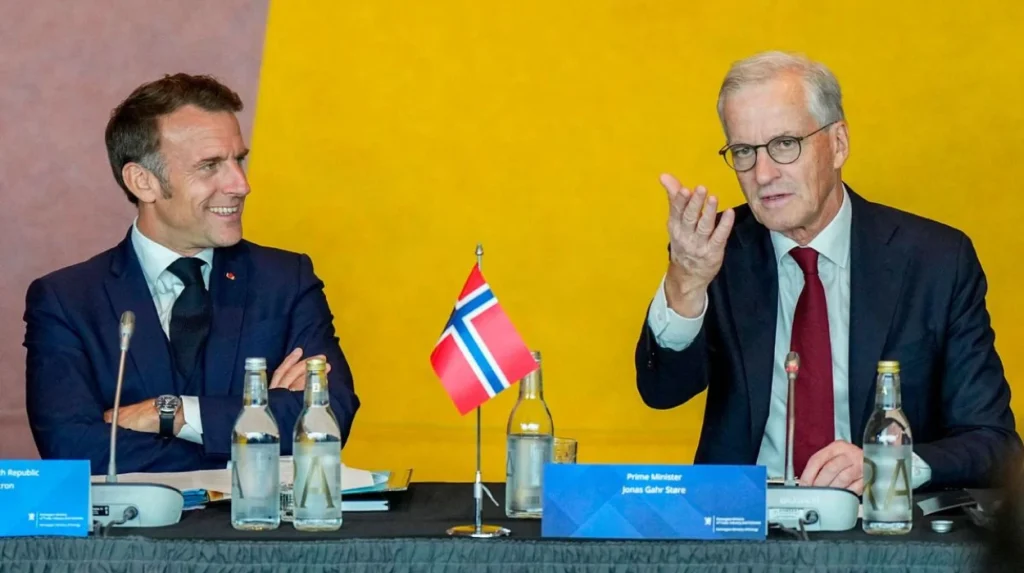
The visit saw the signing of a strategic partnership agreement with a wide element of defense and security between Macron and the Norwegian Prime Minister Jonas Gahr Store. The Memorandum is also expected to institutionalize the process of combined military training exercises, defense sector cooperation and the handling of hybrid menaces, such as those engaging critical infrastructure, e.g. undersea cables and energy distribution systems.
The two governments gave a commitment on what is becoming a safer and stable Europe, and they stressed on collective action as threats are transforming. The joint venture also symbolises a larger European undertaking to upgrade collective security features and decreasing outside reliance.
Defence Industry Collaboration and Modernization
Naval Procurement and Industrial Ties
Between 2025 and 2036, Norway is making huge defense investments with at least five new frigates, five new submarines, long-range surveillance drones, satellites and improved air defence capabilities. France Naval Group is the key competitor to provide the new frigates which would become the biggest investment in Norwegian history in terms of defense.
Supplier selection is not a technical competency issue but also an issue of strategic alliance. Both states have made it known that decisions related to defense procurement will be informed by the extent of bilateral collaborations as well as the presence of mutual strategic interests. The Norwegian participation in European approaches to defense procurement and the European inclination on military equipment are points highlighted by French Defense Minister, Sébastien Lecornu.
Training, Exercises, and Joint Operations
France and Norway are already cooperating in military activities and drilling games, especially in the areas of the Arctic. In May 2025, Norway hosted the largest air missile marksmanship exercise of NATO in its maritime air defense, involving France and other allies. It was held with 2,500 soldiers and various modern weapon systems that showed how the alliance can secure Norwegian airspace and prevent the threat of sophisticated capabilities.
The Norwegian Vice Admiral Rune Andersen, the Commander Norwegian Armed Forces Operational Headquarters, described the significance of these exercises in keeping the allied presence, control, and preparedness in Norwegian territories. The consistent presence of allied activity in the area also serves as a decisive sign concerning the capabilities that can be used in order to protect both Norway and the alliance.
Responding to Hybrid Threats and Critical Infrastructure
Countering New Security Challenges
The main point of focus with regard to the strategic partnership agreement deals with countering hybrid threats which have in the recent past gained a lot of prominence. Both nations will also increase joint training and activities in Norway, including security of undersea cables and energy supply lines, an important infrastructure which is vulnerable to sabotage and cyberattacks.
The Russia-Ukraine war has revealed the dangers of the new form of war called hybrid warfare which includes the use of disinformation, cyberattacks, and attack of energy facilities. The fact that France and Norway have chosen to focus on resilience and collective answers to those threats highlights a more general process by NATO to reorient through its new ways of conflict.
NATO Forward Land Forces and Regional Deterrence
Further commitment of France and Norway to European defense is their participation in the Forward Land Forces (FLF) initiative of NATO in Finland. France and Norway are also participating with Denmark, Iceland, and the United Kingdom in building FLF presence in Finland that will be based in Lapland and operational in 2025.
The idea of this multinational force is to train and exercise with national home defense forces and thus provide with rapid reinforcement as well as to strengthen the deterrence posture of NATO in the north. The governing plan to enhance FLF is an expressive gesture of coalition strength and willingness to carry out the altering security trends in the area.
Climate, Green Transition, and Economic Resilience
Integrating Climate and Defence Strategies
The Franco-Norwegian alliance is no longer confined to the classic security framework since it also touches on climate change and green transition. The two nations are aware of how climate change increases risks and threats, which poses consequences on international peace and security. The Ministry of the Armed Forces of France has come up with an integrated plan, called “Climate & Defence”, in which it expects all its defense efforts to be carbon-neutral by the year 2050, with a dovetailing of national and European climate goals.
As a result of a visit by Macron, the leaders committed to step up work with each other on the green transition, with a view to meeting climate targets, generating new employment, and strengthening European supply chains. This strategy is part of the new realization that long-lasting security and economic stability includes environmental sustainability.
Sustainable Investment and Economic Cooperation
Debates in the visit also addressed the management of a sovereign wealth fund in Norway named as Government Pension Fund Global, which is one of the largest in the world. The interest by the two countries in sustainable funds and economies that would withstand the environment reflects on the significance of integrating financial policies with the general security and climatic goals.
The alliance will combine Norway and France skills in climate policy and sustainable finance so that the countries can contribute to innovation and resilience in Europe. This multi-dimensional collaboration shows the interdependence of security, economic and environmental issues in the 21st century.
European Solidarity and NATO’s Northern Flank
Reinforcing NATO’s Deterrence
The enhanced collaboration between France and Norway is also at a time when NATO is fortifying its Northern flank. A more active involvement in the Arctic and North Atlantic is a direct stage of reaction to the actions by the Russian military forces and in general, to the necessity to have the presence of allied forces in the strategically important areas.
Recent NATO drills in Norway, like Formidable Shield, have also shown the ability by the alliance to carry out operations in a complex manner as well as to defend strategic airspace. The involvement of France, Norway and other allies in this exercise implies that interoperability and mutual preparedness are serious priorities in preventing aggression and ensuring stability.
Shared Strategic Vision
The two nations have provided a collective vision on European security which focuses on solidarity, resilience and adapting to the changing environment. Prime Minister Store referred to France as a “close ally and partner” and Macron underlined the need to intensify their cooperation in various fields, including the defense sector as well as the green transition.
This vision was institutionalised in the form of a strategic partnership agreement, which offers a platform of continuity of collaboration and joint efforts in order to address the changing nature of threats. Not only is the agreement a bilateral market breakthrough but a feature of the larger initiative of European defense inclusion.
The Road Ahead: Opportunities and Challenges
Defence Spending and Industrial Cooperation
Norway will meet the NATO target, spending 2% of its GDP on defense, in 2024, and is to increase its expenditure further. The decisions to be made on the procurement of frigates and other large investments will prove how strong is the Franco-Norwegian partnership and the capacity of European partners to coordinate industrial and strategic interests.
Sébastien Lecornu, French defense minister, has pushed European preference in defense acquisition and urged a greater merging between EU and NATO defense sectors. The consequences of these policies will determine European defence capabilities and the role of France and Norway as the key contributors.
Sustaining Momentum in the Arctic and Beyond
The Arctic is still of strategic importance and both France and Norway are adamant to continue having an effective presence of allies and increase situational awareness. Climate change, hybrid threats, and great power competition issues will demand a long-term investment in capabilities, collaborative training, and technological development.
Further collaboration in the form of exercises and intelligence as well as guards on the infrastructure will prove to be a crucial practice of keeping deterrence and guaranteeing protection of the northern flank of NATO. The success of the partnership will rely on the capability of the two nations to adjust to the unraveling threats and seize opportunities in terms of greater integration.