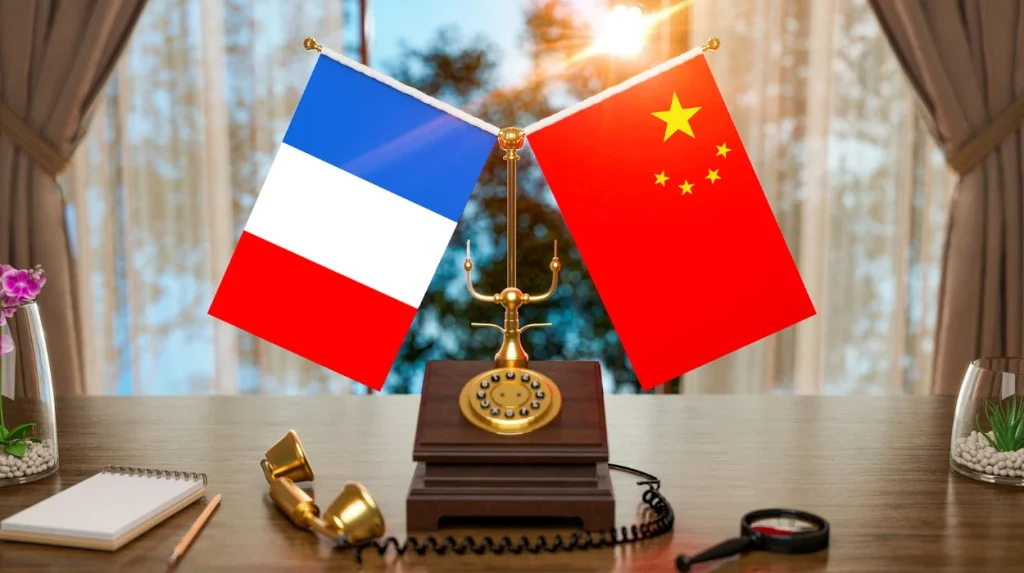
The recent phone conversation between French President Emmanuel Macron and Chinese President Xi Jinping, which Macron arranged, is not your average diplomatic exchange. It is a strategic conversation between two powerful nations amid a period of unheard-of world instability.
Their conversation highlights a larger theme: China-France ties, and therefore China-Europe collaboration, are becoming more and more important for global stability, economic resiliency, and multilateralism.
Why are China-France relations gaining global significance now?
The international community’s need for a more inclusive and multipolar world order is in line with Xi’s focus on the founding principles of China-France diplomatic relations, which include independence, mutual understanding, strategic vision, and win-win cooperation. These ideals are not only theoretical; they are the cornerstones that made it possible for France to become the first significant Western nation to formally establish diplomatic ties with the People’s Republic of China in 1964.
This historical legacy has gained new significance as both nations maneuver through a multipolar era filled with protectionist tendencies, regional conflicts, and geopolitical fragmentation.
What sectors are central to China-France cooperation today?
While investigating cutting-edge areas like the digital economy and green development, the phone conversation highlighted the strategic significance of preserving high-level interactions and strengthening collaboration in established industries like nuclear energy and aerospace. This two-pronged partnership shows a practical understanding of one another’s advantages and the necessity of coordinating on forward-thinking areas that will determine global competitiveness.
Why does Xi support Europe’s strategic autonomy?
A strong diplomatic message is conveyed by Xi’s reaffirmation of China’s support for Europe as an independent global pole: China wants to promote Europe’s strategic autonomy rather than split it. Since Macron has continuously spoken for a Europe that is neither separated from the Global South nor servile to American hegemony, France takes the lead in this respect.
How are China and France responding to global instability?
As Europe finds itself at the intersection of growing protectionism and a changing transatlantic relationship, this assistance has become even more crucial. The Trump administration’s unilateral actions and punitive tariffs have highlighted the dangers of depending too much on one partner. As leading proponents of multilateralism, China and France share the duty of upholding international trade regulations, promoting inclusive global growth, and serving as pillars of global governance institutions like the UN.
The international issues that Xi and Macron discussed, such as the Israel-Palestine conflict, the Iranian nuclear problem, and the Ukraine crisis, are indicative of a world that is becoming less and less characterized by stable leadership. Both nations have a special moral and political obligation to prevent further deterioration of the post-war international order as permanent members of the UN Security Council.
Macron’s reaffirmation of the one-China concept in the face of mounting international pressures and realignments is significant because it demonstrates diplomatic constancy and respect for the sovereignty of another nation, which promotes communication and trust rather than conflict.
China and France have the chance to establish a different tone—one based on communication, balanced diplomacy, and shared responsibility—at a time when international institutions are under strain, and the non-intervention principle is frequently ignored.