As prospects for a breakthrough in Ukraine peace talks rest on a planned 30-day truce, France has taken the lead in mobilizing partners in the European Union to seek additional sanctions on Russia.
French officials are advocating for “massive” sanctions that would target Russia’s banking and energy industries in the event that President Vladimir Putin rejects the terms of a ceasefire and declines to participate in peace talks following a high-stakes diplomatic weekend.
How is France leading the push for sanctions?
Jean-Noël Barrot, the French minister of European affairs, said on Monday that EU leaders had formally requested that the European Commission draft further measures in addition to the already-developed 17th package.
“What we are preparing are additional sanctions which target the energy and financial sector,” Barrot said in Normandy during a discussion with US Secretary of State Marco Rubio and European peers. This past weekend, we requested that the European Commission draft fresh, more significant penalties to compel Russian President Vladimir Putin to adopt a more peaceful stance.
What is the EU demanding in the 30-day truce?
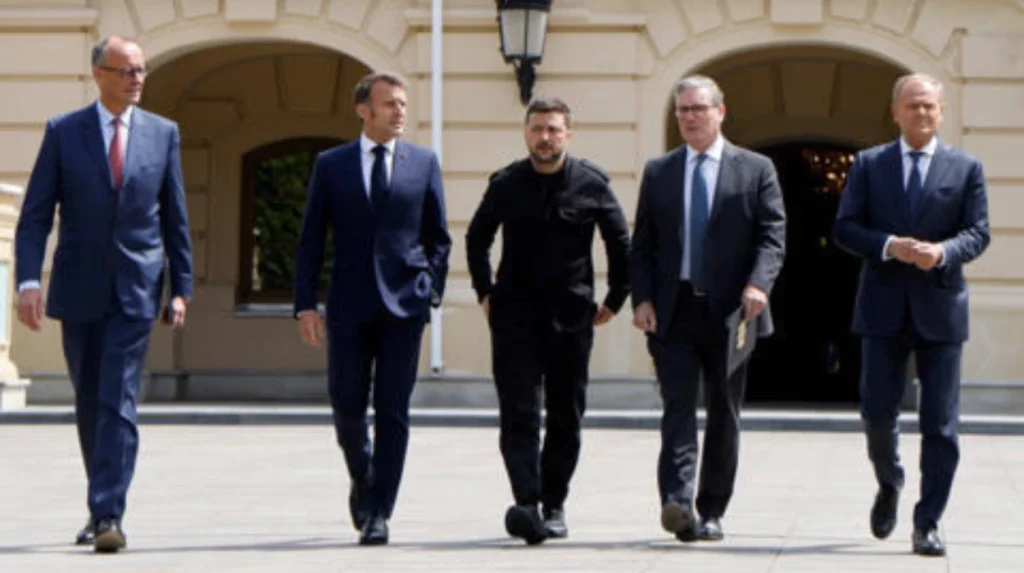
This diplomatic endeavor comes after leaders from France, Germany, the UK, and Poland made a significant trip to Ukraine and then participated in a video conference with Ursula von der Leyen, the president of the EU Commission, and other international leaders.
In order to facilitate direct peace negotiations, the organization demanded a “immediate, complete, and unconditional” ceasefire. Russia has not yet replied to Ukrainian President Volodymyr Zelensky’s request to meet in Istanbul on Thursday despite the unified front.
US President Donald Trump, who has promised to visit Turkey in an effort to assist the talks, may also take part in the scheduled discussions. “For serious discussions to happen, there needs to be a ceasefire,”
Barrot emphasized, emphasizing that hostilities must end before negotiations can proceed. Drones and airstrikes make negotiations impossible. “We are preparing powerful and massive sanctions if [Putin] doesn’t accept a ceasefire,” he said.
What sectors will the new EU sanctions target?
These new sanctions are intended to severely tighten the economic screws on Moscow, and they are being paired with a US sanctions measure that would impose 500 percent tariffs on nations that purchase Russian oil.
In a joint statement with EU foreign policy leader Kaja Kallas, European foreign ministers echoed the urgency in London this week, calling for Russia to make “unimpeachable progress” toward a “just and lasting” peace. Russia has not yet demonstrated a sincere desire to advance. The ministers from France, Germany, Italy, Poland, Spain, and the United Kingdom stated that it must act immediately.
They reaffirmed their backing for Ukraine’s request for a ceasefire and issued a warning about “ambitious measures” to stop Russian war funding, including imposing stronger price controls on oil exports and interfering with the so-called ghost fleet that is used to get under sanctions.
In addition, the ministers reiterated their determination to freeze Russian sovereign assets until the Kremlin halts its aggression and makes amends. “We need to exert pressure on Russia because it is playing a game,” Kallas stated. And we need to use the resources at our disposal to exert pressure on them.
What is included in the EU’s 17th sanctions package?
During the London discussions, France’s European Minister Benjamin Haddad stated that “an unconditional truce in the air, at sea, and on land for 30 days” is a must for any peace process. He cautioned that time was running out.
The 17th sanctions package, which would increase actions against Russia’s shadow oil fleet, is anticipated to be formalized at the next EU foreign ministers meeting in Brussels on May 20.
“Putin has a route if he desires peace. If not, Barrot said, “he will bear the full brunt of our economic response.”