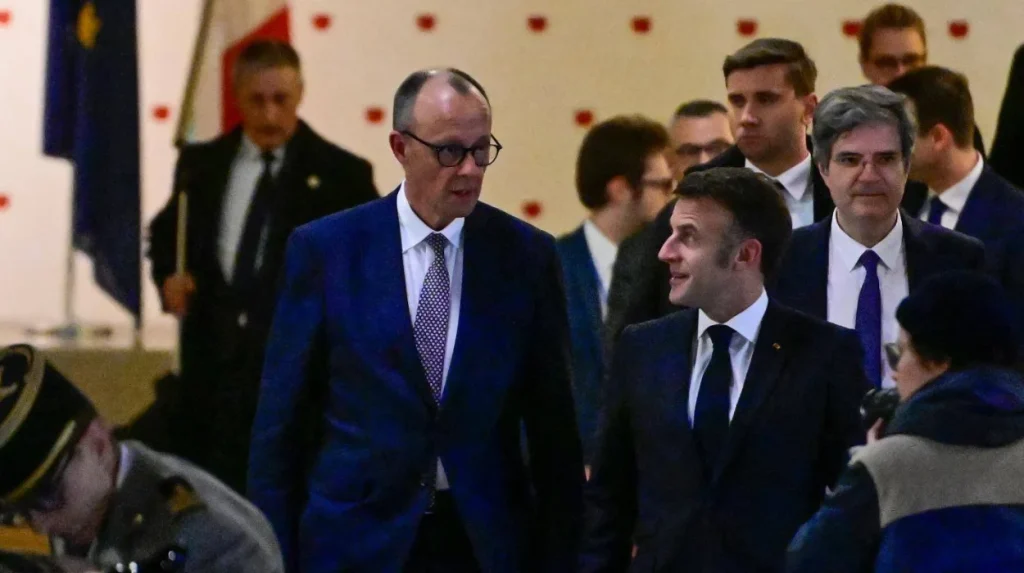
The relationship between France and Germany appears to be improving when Friedrich Merz takes over as German chancellor on May 6. Emmanuel Macron, the president of France, and Olaf Scholz, the former chancellor of Germany, never got along well, and their administrations continued to disagree on a number of important strategic issues despite persistent efforts. For far too long, the Franco-German engine in Europe has been operating on empty.
For domestic reasons as well, the engine stopped. Germany frequently found it challenging to make its stance clear due to internal conflicts within the departing three-party coalition. In France, the president’s hold was undermined by the absence of a consistent majority in the legislature. The nation’s four government changes in 2024 perplexed its European allies.
There is a reassuring sense of déjà vu in Paris when dealing with a German chancellor described as a Rhenish, Francophile Christian-Democrat, who has European integration in his political DNA and intends to invest in EU affairs. Merz’s personal long-standing commitment to Franco–German relations facilitates common understanding.
Most importantly, he shares many key positions with Paris. Nevertheless, the situation is drastically changing. Germany is returning to its familiar “grand coalition” (CDU/CSU–SPD) government and the incoming chancellor has already begun acting as such. The two leaders have already begun developing a dynamic working relationship.
Agreement on essential policy matters
France is in favor of deploying long-range weapons to support Ukraine. Despite Scholz’s opposition, Merz has advocated for Kyiv to get Taurus missiles. Both nations now support Ukraine joining NATO, something Scholz had previously opposed.
France applauds Germany’s new “whatever it takes” defense strategy. Merz has relaxed the nation’s public debt cap in order to fund infrastructure and defense projects. Despite his longstanding support for transatlanticism, he advocated for Germany’s independence from the US on the eve of the elections. However, in light of NATO’s uncertain future, Merz previously proposed that Germany could profit from French and British nuclear deterrence, but the coalition agreement does not employ such Gaullist terminology or advocate for this.
Regarding energy, the incoming chancellor has consistently seen his nation’s decision to abandon nuclear power as a strategic mistake. His view might resolve a policy impasse over EU climate objectives for 2040 and the funding of new reactors with additional European resources, even if restarting reactors would be impractical. Compromise will be necessary in other critical areas, though.
Merz supports the EU’s trade agreement with Mercosur, which Paris has obstinately opposed. However, France’s isolation on the Mercosur problem and Trump’s trade battle may force Paris to gradually soften its stance.
However, it is anticipated that both governments will work to maintain common stances during the discussions on the EU budget for 2028–2034 and will advocate for a Savings and Investment Union, as outlined in the Letta report on the future of the single market. In order to support European industrial champions against overseas rivals, both also seek to amend EU competition legislation.
However, stronger bonds, common interests, and a readiness to make concessions are insufficient to boost the Franco-German engine; further elements are required. The political haste of both leaders is one motivator. Merz is eager to demonstrate Germany’s return to Europe, while Macron’s term is set to expire in two years.
Taking the EU forward requires political leadership
European political leadership is urgently needed in the current geopolitical environment. There is a sense of urgency brought forth by the US’s rapid withdrawal from Europe and the growing threat posed by Russian hybrids. The European Commission and the rest of the EU cannot afford for its two most important members to be lacking momentum at such a pivotal point in the history of European integration.
The EU as a whole can no longer be said to be powered by the Franco-German engine. In today’s EU of 27, it takes more than two to tango. Through the resurrected Weimar Triangle concept, the pair is increasingly forming a three with Poland.
Merz and Macron’s tight and productive connection goes beyond a Franco-German comeback. Closer links between these two important European nations will continue to be crucial in managing the current volatile geopolitical shifts because of their distinct histories. If Paris and Berlin concentrate on important problems and stay close but open to new partners, they will restore their motivation.