A few months after Russia’s invasion of Ukraine, French President Emmanuel Macron declared in June 2022 that “we are entering a war economy.” He urged France’s arms producers to increase their output, be more creative, and work more quickly.
KNDS, a French-German defense firm, reacted immediately. The Caesar truck-mounted self-propelled howitzers, and the 155mm rounds they fire are currently its most well-known product. However, it also manufactures weapons, ammunition, artillery systems, and armed vehicles. Caesar systems are capable of firing up to 40 kilometers at a rate of six rounds per minute with surgical accuracy. Approximately 90% of the 100,000 shells they make are now being used on Ukrainian battlefields, while they are utilized in 16 other nations as well.
“By the end of 2025, we will have sent 113 Caesar canons to Ukraine,” KNDS France CEO Nicolas Chamussy briefed journalists in March.
“The last remaining canonry in France,”
said Gabriel Massoni, a spokesman for KNDS France.
The Caesar canons are manufactured at the company’s facility in Bourges, central France.
After such installations were relocated inland for security reasons, Napoleon turned the area into a center for the production of weapons.
The state-owned KNDS France has actively adopted the war economy model since the start of the conflict in Ukraine. With the installation of temporary hangars and cutting-edge equipment, the plant is growing quickly. Massoni said, “Over the last three years, we have spent €600 million of our own capital to triple the output of both the Caesar howitzers and the 155mm shells they fire.” “We’ve enlarged the plant, purchased new equipment, and employed more employees. Every day, we live in this war economy.”
KNDS only made one or two Caesar systems every month before 2022. According to Laurent Monzauge, general manager of the facility, “We’re at six now, and we seek to achieve eight by the end of the year.” To be designed to the closest micrometer, the eight-meter, three-ton metal tubes are transported from the Aubert & Duval metallurgy facility in Lyon, which is around 300 kilometers south. After completion, the weapons are shipped to Roanne to be mounted on the cars.
Following the collapse of the Berlin Wall and the end of the Cold War, France reduced the manufacturing of weapons and restricted its defense sector. To avoid losing industrial know-how, however, it kept up output at a minimal level.
The sector still employs around 4,000 small businesses, and KNDS urged its 2,000 suppliers to expand their operations, even though it wasn’t always simple for them to fund the spike in demand. Some contracts were paid in advance, but Monzauge adds, “We’ve supported every one of them.” “KNDS’s ability to produce eight guns per month while our suppliers were only willing to deliver three or four would be absurd.”
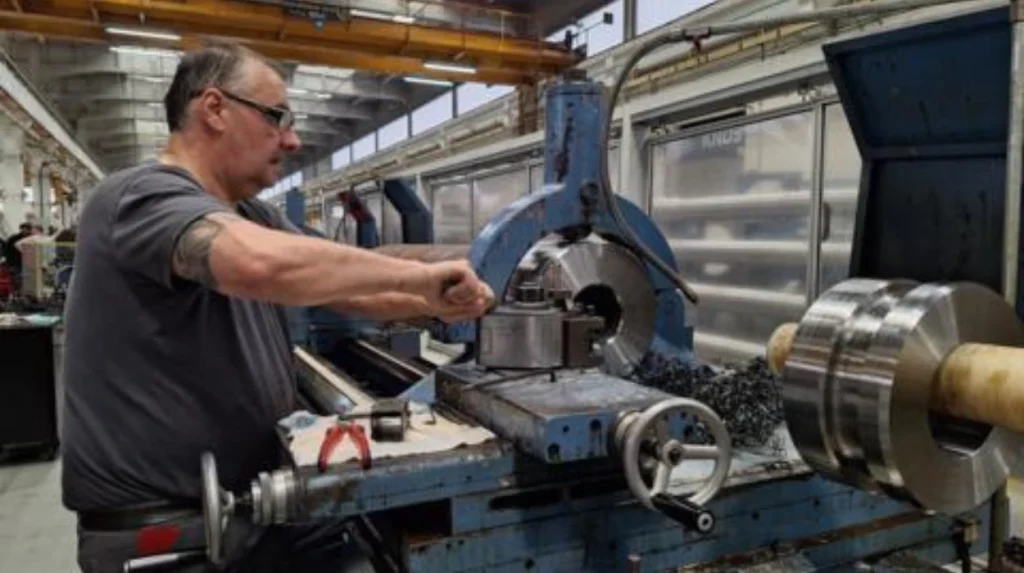
He said that 90% of the group’s suppliers are located in France, with the other 10% being spread out across Europe. He points to an imported lathe that costs €2.5 million. “Unfortunately, we couldn’t find this kind of machine in France,” he explains. “No one in France had the skills or capacity to make this kind of lathe because there had been no need for it over the last 20 or 30 years.”
The Bourges site employs about 200 people, and over the past two years, the employment has grown by a third, according to manufacturing chief Stéphane Ferrandon.
“We’re going to raise the factory payroll by a further 10 to 15 percent this year.”
KNDS wants to hire 50 new employees for specialized jobs like robotic welding at the Bourges location.
It takes highly precise expertise to weld the unique high-elastic-limit (HLE) steel, which can be bent and then snapped back into place. “We’re operating in the goldsmiths and silversmith trade,” said Massoni. Caesar canons are not made like Peugeot 3008 chassis. These are uncommon abilities that are not widely available. In order to teach machinists to improve their abilities through a one-year apprenticeship, KNDS has established a campus at its La-Chapelle-Saint-Ursin location, where the 155mm shells are built.