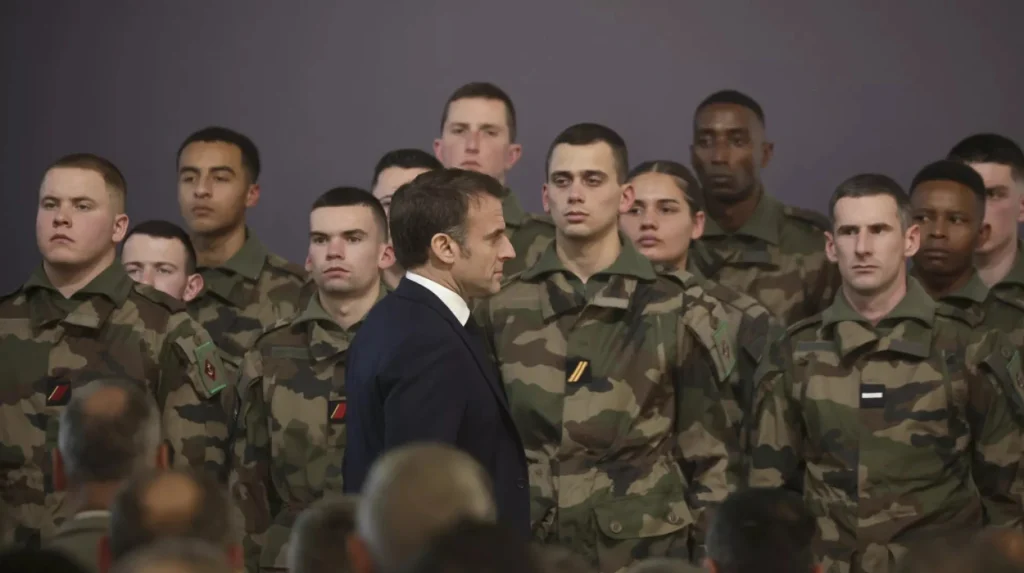
Amidst the increasing security challenges facing the EU, some have questioned whether France has the military capability to lead a joint defence initiative. After the US-Russia rapprochement, French President Emmanuel Macron placed France at the centre of European rearmament initiatives.
In light of the fact that the US is scaling back its military protection of Europe, as well as the fact that Russia is posing a growing threat to the continent’s security, there is a push by the EU to increase spending and pool resources for joint defence projects.
As a result of Macron’s election in 2017, France has greatly increased its spending on defence.
A total of €295 billion has been allocated to defence in the country’s Military Programming Act (LPM) for 2019-2025. According to the 2024-2030 LPM, that figure increased by 40% to €413bn.
The French economy is still playing catch up despite these investments. Senator Cédric Perrin, a member of the Republican party and chairman of the Senate’s Defence Committee, noted progress but said funding was not sufficient to meet new challenges, such as Russia’s invasion of Ukraine in 2022.
Expenditures of arms: a paradox
The defence industry in France is strong, and it is the second largest arms exporter in the world, according to the Stockholm International Peace Research Institute’s latest analysis. A distinction must be made between French arms sales and the military capabilities of the national army, according to Emmanuel Dupuy, a military analyst and president of the Institute for European Perspective and Security Studies (IPSE).
According to Dupuy, France’s military supply chain is flawed. “We’ve become the leading European arms exporter by selling Rafale fighter jets and Caesar cannons, yet we are short of ammunition because we no longer have the capacity to manufacture it in France,” he said.
Despite the fact that France manufactures a lot of high-quality equipment, Perrin said the country doesn’t buy a lot of such gear. In response, Dupuy said, “We can’t be an exporting power without supplying our own security with the materials we need”.
As well as international suppliers, the French military-industrial complex depends on foreign sources for critical materials. Gunpowder is imported by French ammunition manufacturers from Australia, according to Dupuy. As part of the launch of the new gunpowder production line, French Armed Forces Minister Sébastien Lecornu and Finance Minister Eric Lombard visited Eurenco, a powders and explosives company. There will be 1,200 tonnes of gunpowder pellets produced at the factory each year, which would be used in approximately 100,000 artillery shells for Caesar cannons in Ukraine, among other countries.
Despite its military assets, France lags in several critical domains. There is also a pressing need to develop more drones, which have revolutionized war, especially in Ukraine. It is particularly important to pay attention to surveillance issues. Detecting and responding to threats in an era of cyber warfare and electronic surveillance requires France to strengthen its ability to act in real time.
In recent years, France’s military doctrine has been more inclined towards expeditionary warfare than large-scale direct conflicts. France’s forces were designed to intervene anywhere, but their fragmented nature limits their scale. Likewise, France cannot engage in a major conflict without the support of NATO and EU allies.