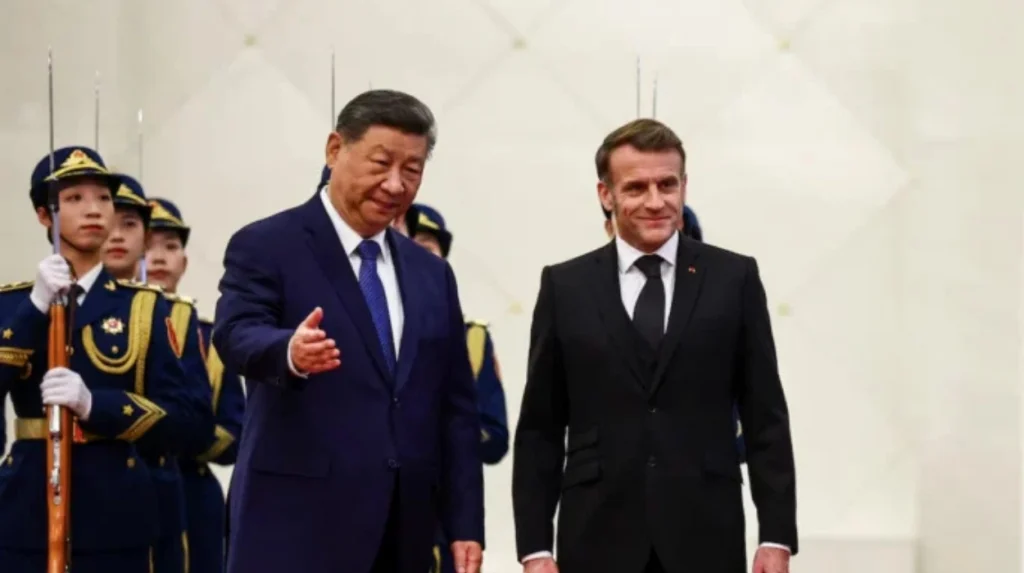
The December 2025 state visit of the French President Emmanuel Macron to China was conducted in a more than ever-generous ceremony, which is an indication that Beijing is keen on improving its relationship with Paris amid growing global economic and political repositions. Although in the past this fifth visit has been met with the highest honors, this time around, special protocol violations were witnessed that highlighted the level of strategic signaling that was being done. Xi Jinping, the Chinese President, took Macron personally to Chengdu, where they were shown around the Jincheng Lake Park and a large hydropower project, which was symbolic in its nature as well as included an outreach to the stories of mutual cooperation that China has been actively selling in its engagement with Europe.
What may have seemed like close interpersonal friendship was reified with the help of light-hearted publicity, such as Macron jogging in the middle of Chengdu people and returning to the panda conservation facilities associated with the French custody programs. These fabricated scenes also served the purpose of Beijing in promoting the Franco-Chinese goodwill in an era when the trade jingoism of Europe has been accentuated. China also positioned the visit as an extension of mutual respect and Macron took the occasion to demand recalibration of a fundamentally one-sided trade relationship that he described as structurally unsustainable.
The two governments declared twelve cooperation commitments in nuclear energy, education, agricultural exchange, aging-population programs, veterinary science, green transition programs, and aviation cooperation. Although the latter were general thematic congruence, none of them had financial engagement disclosed. The exclusion highlighted the disconnect between recognitive hospitality and the real economic reorientations that Macron had been intensifying in the months preceding the visit.
Persistent trade deficits deepen France’s strategic concerns
France went into 2025 with one of the most asymmetric trade profiles with China in Europe. French treasury records showed that the country has a EUR47 billion goods trade deficit with China in the year 2024–almost half of the overall foreign trade deficit. The French authorities interpreted the imbalance as an indication of skewed access to the market, regulatory restrictions, and structural imbalances.
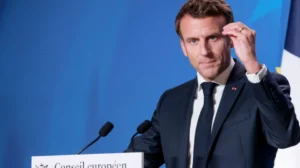
Macron repeated them in his meetings in December and said that the failure of France to increase its export in pork, cognac, cosmetics, and luxury goods were the indication of the continued lack of reciprocity. His open mention of the imbalance as being unsustainable and unable to last long without stability being threatened, accords the greater EU economic security messages. However, hopes of tangible improvements were too high. China failed to seal the long awaited Airbus deal, which was said to be based on a purchase of up to 500 planes, even though there were initial signs of this deal being made by the French industry.
Beijing had indicated a readiness to expand the French imports as long as the Chinese firms are given a reasonable environment in Europe, a term which referred to the worry of tightening EU regulation. The analysts observed that as long as China is experiencing domestic slowdown, global tariff pressures, and preferences of sector-specific over systemic market openings, China economic concessions are still limited.
EU-China asymmetry intensifies across key sectors
Trade differentials between the European Union and China have increased sharply since 2019 across the European Union. According to Eurostat reporting in late 2025, the EU goods deficits have increased nearly 60 per cent in the last six years as subsidized manufacturing in electric vehicles, batteries, biotech parts, and industrial gear have contributed to the increase. This context influenced the words of Macron when he threatened in a statement of December 7 that Europe might need to develop coordinated trade defenses, including tariff tools that were consistent with the EU economic security policy.
Noted analysts such as Alicia Garcia-Herrero of Bruegel had reported that France had anticipated very high bids on the part of Xi, especially in the area of aviation or farm concessions. Rather the visit seemed to strengthen the diplomatic stand of China without substantially altering the balance of trade. In spite of the fact that the Chinese direct investment frameworks in France were discussed, the inflows are low in comparison with the promises made on the previous summits.
Symbolism and substance diverge during macron’s chengdu visit
The manner in which Xi chose to go with Macron during the Chengdu part of the trip was an indicator rather than a mere form of courtesy. It symbolized a deliberate forecast of unity amid the time when European capitals discussed getting closer to the United States concerning China on the economic front. It was what both governments characterized as a very constructive relationship that Macron publicly said he was very touched by the gesture.
Seminars conducted in Sichuan also had top management of big companies in France dealing with aerospace, luxury goods, agriculture and nuclear technology. Although on the high level, there were no significant breakthroughs made. The optics of cooperation thoughtfully refused concierge of the parkside walks, picturesque backgrounds, and the cultural activities of engagement gave good symbolic overtures, but the lack of big contractual declarations highlighted the stalemate in negotiation.
Limited progress in sensitive and strategic industries
While the signed cooperation documents advanced sectoral ties, they avoided areas Although the signed cooperation documents promoted sectoral relations, they were not in the areas where it would have caused the highest imbalance. Macron was stressing that France wanted to have a fair and mutual access to markets, which was also stated in late November by EU trade officials on the control that China had over the export of green-tech products. The state planners of both countries have been keen on developing domestic aircraft programs in the aviation sector, which is a strategic sector to the two nations, and this makes it hard to acquire Airbus in large numbers.
Other topics that were discussed were related to global security, such as the war in Ukraine. China once again affirmed its support to the territorial interests of Russia but did not present any new ideas of ending the ceasefire. In relation to Middle East tensions, Xi gave a commitment of 100 million dollars in humanitarian aid to Gaza but did not give any multilateral pledges that would bring Beijing more in line with European diplomatic tactics.
2025 geopolitical dynamics frame Macron’s limited leverage
The visit to China of Macron in December 2025 was also associated with controversial plans of EU officials on increasing tariffs on Chinese electric vehicles. Member states are torn in between protectionism in favor of industry and the economic reprisal of implementing the protectionism policy. Macron has made France a leading power in the initiative of stricter trade enforcement in the sense that without the rebalancing of European industry, the neighborhood will be at a risk of long-term erosion.
At the same time, the United States was still on the trajectory of escalation in tariffs with the Trump administration of 2025. The strategic expansion of China to the European region, including the ballet of Macron and his welcome, is supposed to counter the increasing American economic pressure. Beijing is interested in avoiding the united front of the West, and Paris is considered one of the main points of influence when forming the debate inside the EU.
China’s diplomatic calculus and its constrained economic environment
There is an increasing economic pressure at home, anyway, in Beijing: real-estate instability, the fall of local government income, and an external demand meltdown. These restrictions curtail the readiness of China to make concessions which may be cost-ly economically to the partners who are held in high esteem. The mixed strategy of cooperation and firmness utilized by Macron proves to be the effort of France to find the middle ground between being engaged and being protective.
The France initiative to establish itself as a mediator between China and the EU has structural constraints. The stalemate over Ukraine is an example of the geopolitical riftage that has existed between Beijing and the European capitals and makes the prospect of wider strategic convergence less probable.
Strategic implications for Europe’s economic posture in 2026
Macron’s December 2025 visit reinforced France’s commitment to recalibrating its economic relationship with China while revealing the narrow bandwidth for bilateral breakthroughs. Xi’s hospitality strengthened diplomatic channels, yet did little to reduce France’s or the EU’s dependence on Chinese imports. With 2026 expected to bring accelerated implementation of EU protective measures, the visit is likely to be interpreted as a precursor to more assertive European action.
In the months ahead, policymakers across the bloc will continue evaluating how symbolic rapport translates into enforceable economic terms. As global tariff tensions escalate, whether Xi’s overtures evolve into concrete market access initiatives or remain largely ceremonial will determine how Europe reshapes its trade strategies and addresses the persistent asymmetries that have defined its economic ties with Beijing.