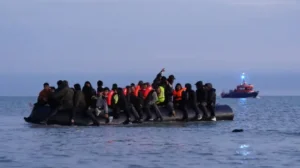
In August 2025, the UK and France signed a broad-based treaty to coordinate the growing crisis of irregular migration across the English Channel. In this new one-to-one plan the migrants who entered the UK illegally by boat are to be returned to France and in exchange France is willing to receive the same number of asylum seekers with family or humanitarian links to the UK who have not taken the boat. Months of diplomatic negotiation have borne fruit in the agreement, which is a major intensification of cross-Channel cooperation.
The treaty reacts directly to the over 25,000 irregular crossings that the UK authorities have registered in the first half of 2025. This migration pattern has grown to be a political headline in both nations, with the UK Home Office citing the humanitarian risks of the Channel traffickers and France citing the overstretched Calais and Dunkirk resources. The new mechanism is set to discourage dangerous sea trips, interfere with smuggling rings, and recalibrate coordinated border control.
Operational structure and administrative scope
In the agreement, the Home Office of the UK is charged with the responsibility of apprehending individuals on arrival at immigration removal centers as their status of returning is determined. Quick application is focused on approximately 50 returns a week which is likely to increase with the logistical capacity. French migration services would then take care of asylum claims on returned persons, according to the European asylum norms.
Notably, the agreement has exceptions of unaccompanied minors who are the most susceptible to irregular migration cases. Their omission is an attempt to make the policy in line with the international conventions on the rights of the child. It will also include health screening and identification of the returns with an option of appeal against removal.
Data sharing and access constraints
One of the main shortcomings of the UK is its failure to access the database of Eurodac fingerprint- a central EU database in tracking asylum applications. In the absence of this access, the UK has to depend on French officials to confirm that an individual has already applied for asylum to other EU countries. This dependency introduces a degree of uncertainty and can delay the processing of return cases.
Verification procedures are further complicated by a lack of harmonization in biometric data standards between the UK and France. In response, joint technical committees have been proposed to streamline data exchanges, improve interoperability, and enhance identity validation without compromising privacy standards.
Legal and political constraints on enforcement
The methods through which the agreement will observe the international humanitarian principles, especially the prohibition against refoulement have been questioned by legal scholars. The UK courts can be requested to assess the risks of inhumane treatment or structural inability to seek asylum in France of deported migrants.
In 2025, the UK also made changes in its legislation aimed to facilitate faster removals but in the context of legal scrutiny about its compatibility with European Convention on Human Rights obligations. The continuous court battles and legislative discussions indicate that the returns process might not be impertinent to disruption by the courts and policy u-turns.
National political pressures
To UK Prime Minister Keir Starmer the deal is a means to show responsiveness to domestic migration fears, which have escalated amidst widely publicized Channel arrivals and protests outside asylum facilities. The Labour government has positioned the policy as a moderate act that is balancing both compassion and control.
French officials, such as Interior Minister Bruno Retailleau have welcomed the deal as an all-win deterrent to illegal migration. The domestic situation in France, however, is also a complicating factor: the country is characterized by an increased use of anti-immigrant rhetoric and a series of regional elections in the future. Issues of how to handle the intake of returned migrants, particularly in border areas are still an issue of concern among local French authorities.
Regional outlook and EU-level migration discussions
Although this agreement is bilateral, it creates opportunities to expand UK-EU collaboration in the area of migration management. France has presented the accord as a prototype of multi-country agreements in the future that include joint asylum processing centers, common databases and coordinated return strategies.
Belgium, the Netherlands and Germany have taken a reserved interest in watching the UK-France model. Nonetheless, the problem of data sovereignty, burden-sharing and differing asylum regulations are some of the obstacles to the expansion of the arrangement. The UK will not be a member of the official EU migration platforms once it is not part of the EU but it could continue to engage through bilateral or multilateral settlements, which are ad hoc.
Scope of coordinated enforcement
The fight to destroy smuggling networks currently relies on more intense intelligence collaboration. Narcotics and arms trafficking task forces that are already in existence are being transformed into cross-border law enforcement task forces that will deal with migrant smuggling rings that run across North Africa and Northern France.
In 2025, joint operations have resulted in the arrest of a number of high-profile trafficking organizers, but the flows of migration processes persist. The need for better aerial and maritime surveillance is cited by authorities, especially of small craft involved in overnight crossings. French and UK coastguard maritime coordination is also necessary particularly in unfavorable weather conditions which result in high death tolls of migrants.
Humanitarian implications and future scenarios
Within the treaty returns must not only observe minimums of legality but also of ethical nature. Advocacy groups caution that even as practical, the deal may unintentionally have migrants stuck in a cycle of removal and reentry unless resettlements and legal access are opened up. Humanitarian screening (inclusive of trauma, trafficking and family reunification factors) has always been an essential component of eligibility and equitable treatment.
The UK and France have committed to provide more funding to refugee shelters and law aid in processing hubs. However, implementation tends to be faster than the support infrastructure is ready. NGO oversight agencies are insisting on autonomous audits of the returns process to determine its adherence to human rights.
Communication and public awareness
The treaty has had its fair share of false information mass-pushed by people on social media, with most assuming it to be a mass deportation program or a betrayal of the borders. Both governments have engaged in open communication with the communities affected yet people have little understanding.
The integration program of those asylum seekers who are accepted and particularly those who are transferred to the UK under the treaty should also be increased to avoid the social marginalization and guarantee the cohesiveness of the community in the long run. It is considered necessary to coordinate with the civil society and local councils.
This individual has addressed the subject, underscoring the importance of strong UK-France collaboration as a practical yet difficult basis on which irregular migration could be addressed in a massively politicized and dynamic environment:
This is my message to the people smuggling gangs: we will end your vile trade.
— Keir Starmer (@Keir_Starmer) July 10, 2025
For the very first time, migrants arriving via small boat will be detained and returned to France.
My government has led the way in taking our countries’ co-operation to a new level. pic.twitter.com/9AufY74T9J
Their stance represents a balance between deterrence, diplomacy, and legal process in order to contain irregular migration and to deal with the humanitarian and political aspects of the problem.
The irregular migration treaty between the UK and France of 2025 is a significant but complicated experiment in cross-border migration governance. With the onset of returns and with fresh admissions, both nations encounter the dilemma of matching the level of operational capacity with legal protection and social demands. The results of this collaboration would rebrand regional migration policies and impact on larger deliberations on how movement is handled in an ever-parceled geopolitical landscape.