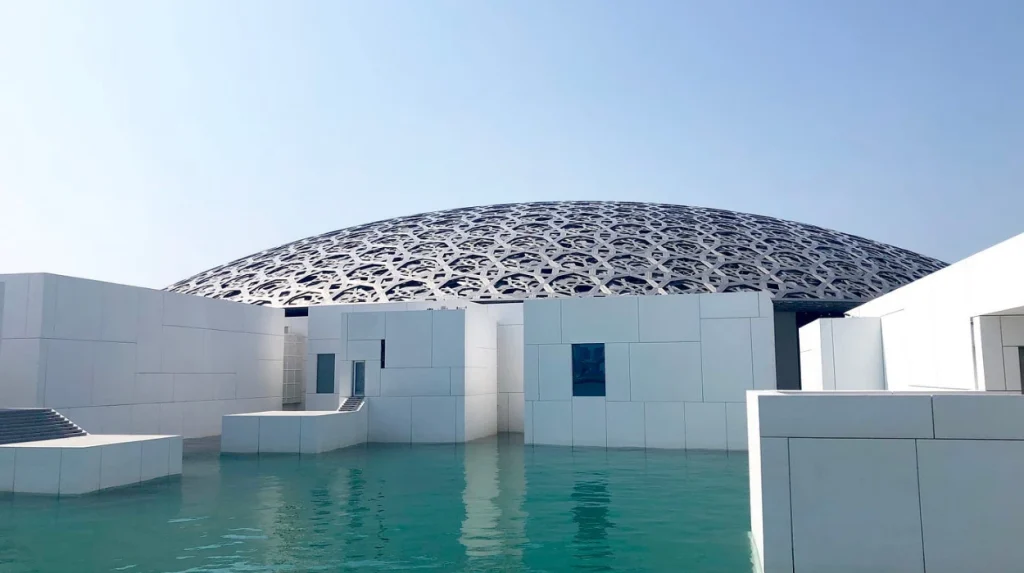
France has traditionally seen cultural expansion as a crucial tool of state. The Louvre Abu Dhabi, which opened in 2017, was the most extreme manifestation of this high-level diplomatic philosophy. The partnership was based on a one billion euro deal to exchange experience, lend artworks, and license the Louvre name as a symbol of twin goals: the United Arab Emirates wanted to be internationally linked in the field of culture, and France wanted to extend its influence in the area of economical and strategic construction of the post-oil era.
The initiative placed France at the centre of culture building in the Gulf, exporting its universal museum template and skills in assisting the UAE to create its own account of openness to the world. This cooperation created the environment in which the Islamic, European, and Asian art met, which corresponded to the long-term idea of France about the cosmopolitan traditions and humanistic dialogue.
This cultural fusion is however accompanied by complications. Since France invests soft-power in the Gulf by placing the assets of the Louvre in Abu Dhabi, the Louvre Abu Dhabi has become the demonstration of how cultural universality can work in political contexts where censorship policies, labour laws and the prospect of speech restrictions shape the life of people. The museum is more than just a collaboration on the artistic front but it is also a bargaining between values, interests and the realities of working in an authoritarian system of governance.
Louvre diplomacy and France’s global reputation
The Louvre diplomacy is a sub-strategy of the wider France to enhance its international relevance with the help of cultural capital. Exportation of museum expertise, which has been encountered in regional coalition, such as China to Brazil have turned into pillars of its presence in other parts of the world. The Emirati project is unique because of its duration, magnitude and geopolitical importance.
In the case of France, the Louvre Abu Dhabi strengthens its image as a protector of the culture and the promoter of the civilizational dialogue. In the case of the UAE, it validates the plans to become an intellectual intersection of civilizations. According to Emmanuel Macron in the opening ceremony, the museum is addressed to our common humanity. This is the language that represents the diplomatic approach of France: soft power, which is constructed as a contribution, rather than dominance.
The more deeply the cultural diplomacy enters the politically sensitive worlds, the more the moral weight of the latter is subject to criticism, however. The French intellectual community and actors of the civil society still argue about whether export of culture to controlled spaces is weakening the values that universal museums purport to uphold.
Navigating censorship and controlled expression
In the UAE, compared with Paris, where the freedom of the press is guaranteed by the constitution, there are regulatory limitations on the art exhibition. Publications with nudity and those with political content or religious touchy subjects are restricted. Consequently, there is a tendency towards controlled presentation instead of more uninhibited presentation in the curatorial work at the Louvre Abu Dhabi.
Quiet accommodation and cultural sensitivity
These adjustments are described by French officials as decent cultural adjustment. The opponents then respond that they are some sort of silent compromise, and that this undermines the purity of universalism. The question is whether universal museums can be fully operational in the case when some of the narratives are censored so that it fits the political and cultural constraints.
Broader impacts on cultural institutions
This is identical dynamic concerning the French cultural networks in the UAE, such as the Institut Francais and Alliance Francaise. Curation of programs is made based on social or political subject matter to ensure continuity. This act of balancing is what makes the difference between the Louvre diplomacy and the cultural outreach in liberal democratic grounds and what international cultural governance cannot achieve when the fundamental freedoms are at variance.
Labor concerns and ethical accountability
The Louvre Abu Dhabi construction attracted global publicity over the labour conditions on the Saadiyat Island. Supporters of workers reported late payments, seizure of passports as well as poor housing of the migrant workers. As Abu Dhabi officials declared reforms and France urged increased standards, 2023 and 2024 third-party evaluations found out that there were still gaps in enforcement.
Institutional responsibility and public expectation
The influence of France is indirect but very visible as the museum has symbolic weight. Parliamentarians and the French unions believed that there was no way that labor exploitation could sit well with cultural prestige. The discussion is still underway to influence the debate on ethical diplomacy, as the cultural power is related to the social responsibility.
Legacy and reform efforts
The UAE asserts that labor protection has been enhanced significantly, citing the mechanisms of inspection and the corporate compliance program. But subcontracting and transparency are still questioned. With the development of Louvre diplomacy, the moral legitimacy is becoming more and more related to not just artistic excellence but to equitable labour practices on which cultural infrastructure is built.
French-Emirati strategic alignment
France and the UAE have growing diplomatic and security relations, such as energy relations and defense relations. These areas are enhanced by the cultural sphere that gives the relationship a symbolic and societal richness. The long-term contract which continues the cooperation of the Louvre till 2047 shows the belief in the long-term cooperation.
The UAE officials reiterated their plans to make the country a cross-cultural hub in 2025. The cultural diplomacy of France is the predictable pillar of influence given that the country is facing increasing great-power rivalry in the Gulf by the United States, China, and India. But the long life span of the Louvre diplomacy generates a major question of the French foreign policy: is it possible to sustain the principle of cultural relationships with state partners who have confining political systems?
Cultural power in a shifting global landscape
The Louvre Abu Dhabi is a part of the large Emirati projects, including the Abrahamic Family House and the Museum of the Future. These are projects that intend to develop cosmopolitan identity and interfaith coexistence. The presence of France gives this vision a sense of historical authority and global credibility but also puts French diplomacy in question when it comes to narrative control and ideological limits.
Universalism tested by controlled pluralism
French curators focus on general stories of intercultural associations. The UAE is adopting universalism as a modern form of nation-branding. But the concept of universalism works not as well in closed systems as it does in the open societies which is why there is a controversy of whether or not cultural universality should have an unrestricted critical discourse to be considered genuine.
Digital control and future cultural partnerships
With the change of cultural space to online, the changing digital regulation of UAE meets museum diplomacy. France approaches the terrain with some skepticism, understanding that cultural authority is turning more and more reliant upon access, transparency and autonomy both at the physical and virtual level.
A measure of modern diplomatic influence
The Louvre Abu Dhabi is still one of the greatest projects in the field of cultural diplomacy of the 21st century. It shows how art and heritage can establish the bridges between the political ideologies that do not match- and how the bridges are supposed to crossover the ethical issues. The museum is an acclaimed international institution with a high number of visitors and international recognition but it is in an environment where cultural involvement exists alongside control and where universalism is responsive to political drawlines.
With a growing geopolitical rivalry and a more disputed world in terms of culture, Louvre diplomacy signifies a pattern of tactful forbearance, symbolic expenditure as well as negotiated ideals. The development of this collaboration perhaps indicates whether global museums can sustain universal narratives operating in limited civic contexts or whether universalism itself will undergo some change as cultural diplomacy becomes more embedded in multipolar political realms.