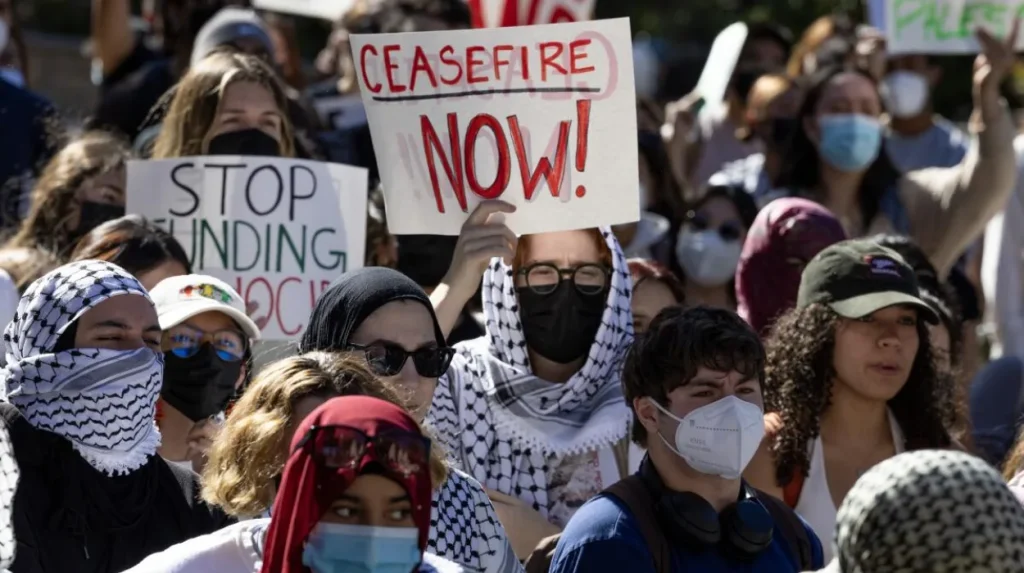
In 2025 the border between the political sphere and the sporting one has become more indistinct with political protests becoming more apparent at the international sport event. One of the most striking instances was the Tour de France incident, in which a pro-Palestinian protester attempted to stop the race by blocking the Israeli-Premier Tech cyclists’ path with a metal barricade and chants. It was not a single event, even though quickly suppressed by the French government, and reflected a developing trend of activists using the prominence of international athletic events to increase the volume of geopolitical complaints.
The recent series of protests has repeatedly centered on the Israeli-Palestinian conflict, in the wake of the Gaza escalation of 2023. Demonstrators have also blocked roads, and unraveled banners during various high profile cycling events such as the Giro d’Italia and Vuelta a Espana. The particular aspect of this stage of protest is not only its frequency, but the change in tactics, direct physical interference with the activities of athletes and races, which is a turn toward less symbolic and more aggressive actions.
Tactical challenges in balancing protest rights and security needs
Incidents at such events have also been of increasing safety concern. The protest-related roadblocks were clearly seen to slow down or divert riders of Israel-Premier Tech. Such interference at the Vuelta a Espana cost the team precious time, leaving the team out of the top ranking. Since then race organizers have increased security measures, with plainclothes escorts being used to accompany athletes and urgent-response teams being deployed along the areas prone to security issues.
Insider trading A demonstrator who made his way into the main bunch before he could cause any trouble was removed in a burst of speed at the Tour de France, reflecting the importance the security agencies are putting on the integrity of the race. The apparent presence of police along team buses and start lines is indicative of the fact that athletic competition now has to coexist with a political battlefield of political symbolism.
Navigating legal and ethical frameworks for protest
Although one cannot deny that the necessity to protect the participants is undeniable, the suppression of peaceful protest can be discussed as the problem that is lawful and controversial at the same time. The proponents of advocacy groups state that tourism events such as the Tour de France are the best global platforms to expose international wrongs. Others who protest include the Extinction Rebellion Toulouse members who claim that organizers of this event are complicit in letting Israeli-sponsored teams take part.
Race organizers claim to defend the freedom of expression, however, they are very strict on any form of activity that jeopardizes safety or interferes with the race. Israel-Premier Tech in its turn have stated defending the right to protest and blaming endangerment. Those contradictory opinions represent a dilemma that sport organizations should walk the fine line: to support democratic values without undermining the essence of sport as a fair, safe and nonviolent competition.
The broader geopolitical context influencing sports protests
The momentum of the existing sports-related protests cannot be dissociated with geopolitical trends, especially the Israeli military actions in Gaza since 2023. The war that led to massive loss of civilian lives and destruction of infrastructures is still ringing in the ears of the world. In their view, activists complain that the toleration of the involvement of Israel-Premier Tech in races by Western countries is a kind of support to state activities in Gaza.
Key to the scandal is Sylvan Adams, the billionaire owner of the team and vocal proponent of Israel. The protesters have also described Adams as a mouthpiece to a genocidal army and they have directly connected his presence in the world of cycling to their greater campaign against Israeli policies. It makes every encounter of Israel-Premier Tech a political scrum, amplifying critical attention on the choices of organizers.
Social media and public discourse on protests and sports
Since the protests happen in real time, social media has turned into amplifiers and judges. The activists use these sites to rally protests and release videos of fights. In the meantime, race organizers, athletes and fans do the same thing through the same digital channels to dispel allegations, provide updates and defend race integrity.
In response to the protests and the implications this has on international sport, commentator Collin Rugg has recently focused on the increment in the polarization of the public debate as well as whether race organizers are in a position to deal with protests of such scope and depth.
NEW: Anti-Israel protester gets thrown over a fence after interrupting the Tour de France by running down the track.
— Collin Rugg (@CollinRugg) July 18, 2025
The incident took place just 25 yards from the finish line.
The man was believed to be protesting the Israel Premier-Tech team, which ironically didn't have any… pic.twitter.com/4tOENLiSCm
His remarks fit into a wider discussion of sports commentators entering the freedom/responsibility/protest debate in the context of current athletic events.
It is more than commentary, this real-time discussion will influence the opinion of the people, potentially change sponsorships and potentially impact regulatory decisions. Others have even demanded specific protest areas or more specific protest guidelines at events, whereas others consider such to be a restriction of freedom of expression.
Managing growing tensions in sports arenas
Governing bodies now face a critical challenge: developing mechanisms that allow for political expression without turning sports venues into contested zones. This could involve drafting clearer codes of conduct for protest, creating structured channels for grievances, or fostering dialogue with activist groups prior to major events. Several event organizers have begun informal talks with human rights organizations to assess how future race setups might be modified to minimize confrontation.
Technology could also play a larger role. Enhanced crowd analytics, geofencing, and AI-assisted monitoring may help predict flashpoints without infringing on privacy or peaceful assembly. However, these measures must be implemented transparently and subject to public oversight, or they risk fueling the very distrust they seek to defuse.
Ultimately, event organizers must anticipate that major competitions—especially those involving teams or sponsors linked to controversial governments—will attract politically motivated actions. Building resilience into event planning, including ethical frameworks and security playbooks, is now essential for maintaining both competitive fairness and the rights of global citizens to dissent.