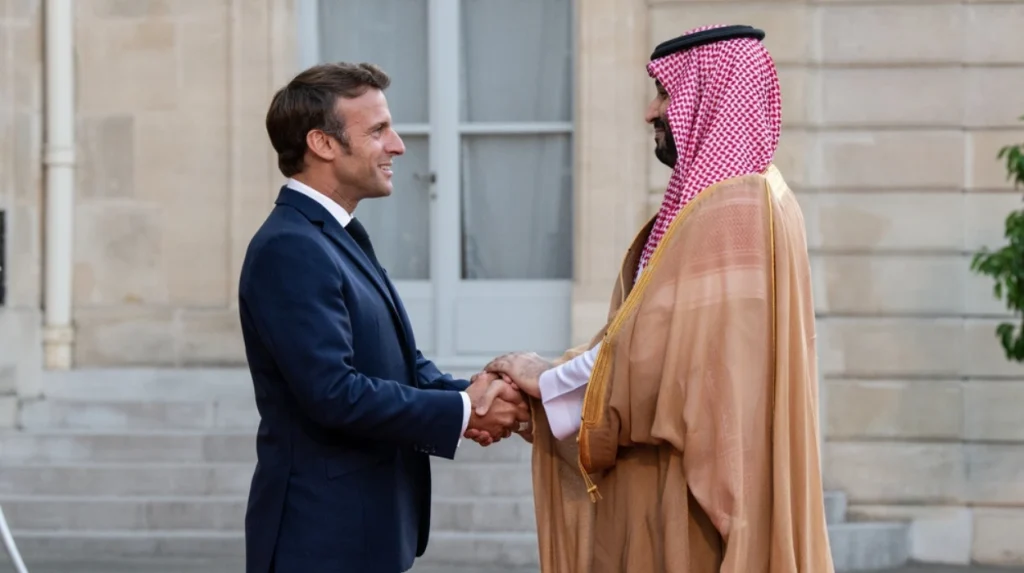
The French-Saudi relationship in 2025 is a reflection of the tense diplomatic balance in terms of the promotion of human rights and the protection of strategic relationships. Although the world has continuously criticized Saudi Arabia over its human rights, Paris continues to hold what many analysts actually term its silent partnership, a combination of private advocacy and public restraint which is meant to keep the influence alive without fueling diplomatic tensions.
French policymakers admit that international human rights organizations report about the limitations of the freedom of speech, sex inequality, and oppression of the opposition in the kingdom. Nevertheless, there are the restricted and cautious public denunciations. The French authorities believe that through personal conversations, which is carried out in the shell of diplomatic relations, there is more room to operate and safeguard bilateral collaboration in the long run in the field of defense, energy, and counterterrorism.
In a way, the policy of France towards Riyadh operates on two levels. Paris publicly insists on cooperation, stability and common interests in the region. On the low profile side, it brings human rights concerns to closed-door meetings, and leverages economic and strategic relationships to bring about a gradual reform. This two-track approach indicates the long term quest of France to have a voice in the region where aggressive frontal competition frequently derailses long term strategic goals.
Balancing Advocacy and Economic Interests
The economic interests of France continue to be the key to its policy towards Saudi Arabia. The kingdom is one of the most significant trade and investment partners of the kingdom of France in the gulf especially in fields of defense, infrastructure and energy technology. French firms like TotalEnergies and Airbus still have significant operations in the Saudi market, and the Saudi investment funds are still pumping finances into the French businesses.
It is these overlapping economic interests that tend to moderate France in her public pose on rights questions. Paris is still one of the leading arms exporters to Saudi Arabia in Europe in 2025, and this fact is still being criticized by the advocacy groups, which fear the use of the French weaponry in Yemen and in other war zones. French officials justify these exports because of end-user controls and adherence to European Union weapons trade rules.
Although the French government states that it recognizes the importance of universal human rights, it does not often make economic contracts conditional upon the rights. Rather, officials desire gradual involvement citing that economic cooperation offers access as well as power. This juggling act brings out the practical aspect of French diplomacy in which ethical obligations sit ill with strategic and business needs.
Private Advocacy and Diplomatic Discreetness
French diplomats work out a more discreet kind of interaction behind closed doors. Constant bilateral meetings include discussion of judicial reform, women empowerment and freedom of expression. According to diplomatic sources, such exchanges are indicative of preference for constructive dialogue, as opposed to open confrontation.
In 2025, the French Ministry of Europe and Foreign Affairs re-emphasized that dialogue and partnership was still the basis of the French approach. The role is based on apparent indications of social liberalization through the Vision 2030 program of Saudi Arabia, such as the increased involvement of women in the labour force and entertainment. However, rights groups like Amnesty International and Human Rights Watch warn that such reforms are still selective as they do not cover more structural problems like arbitrary arrests and freedom of association.
The practice of a low-profile diplomacy in France tends to indicate that the country is trying to incorporate advocacy within realism. Paris attempts to covertly engage Riyadh hoping to promote reform without putting the broader cooperation on both security and economic fronts at stake, which is in line with its long-time Middle East policy.
Human Rights Context Within Saudi Arabia’s Transitional Period
The Vision 2030 reform agenda being pursued by Saudi Arabia still sends the message of modernization and development. The program aims to diversify the economy, to make women more involved as well as less dependent on the oil proceeds. Saudi officials frequently rely on the examples of legal changes like the weakening of male guardianship and the introduction of entertainment rights in their international forums as a sign of the continued transformation.
Nevertheless, there is still repression that is reported by human rights groups. Dissent is still a criminal offense and activists such as women rights activists note that they are kept in detention or a travel ban. There is still no clear-cut control over the judicial system of the kingdom, and independent journalism is practically non-existent.
The fact that France acknowledged these two realities in gradual reform amid constant repression is why it favored moderate diplomacy. Authorities claim that placing too much pressure on the people will weaken those within the government who are ready to change and empower those who are hard to reach.
Regional Geopolitical Implications
The geopolitical position of Saudi Arabia is a major influence on the strategy of engagement of France. Being the largest economy in the Arab world and one of the most influential in the sphere of regional relations, Riyadh has a strong influence in the sphere of the energy markets, counterterrorism alliances, and the Gulf security structures.
By 2025, Saudi Arabia has still been insisting on mediation in regional wars, such as stabilizing Yemen, and rebalancing relations with Iran after a new regional discussion. These developments are seen by France as an opportunity to strengthen its influence by means of partnership and not isolation. The strategy of Paris is consistent with the wider European as well as NATO policies towards pragmatic interaction in lieu of ideological conflict.
In this geopolitical scenario, France puts itself as a friend and critical constructor. It attempts to favor reform and protect the mechanisms of cooperation that are necessary to govern common security issues in the Middle East and North Africa.
Evolving Dynamics and Future Vectors in France-Saudi Relations
The attitude of France towards Saudi Arabia in 2025 is indicative of the tendency of the world in diplomacy as a whole, and countries are inclined to engage and interdepend with each other more than to adhere to moral absolutism. As both countries adjust to changing energy conditions and technological changes, the bilateral relationship will probably evolve in the new areas of renewable energy and technological infrastructure.
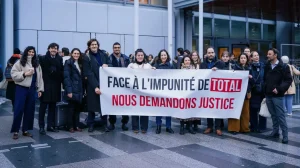
But the civil society and European institutions are putting pressure. The French human rights groups are still urging the government to be more transparent in the exportation of arms and foreign policy making as they want the government to balance the world leadership in human rights advocacy with its Gulf practices. In 2025, the debates in parliament show an increasing uneasiness on the part of lawmakers who claim that the silence poses a threat to the credibility of France as a moral actor in the international arena.
Saudi Arabia, in its turn, is not left behind in its bid to shape its image in the world. The events of international profile and international relations are used to promote the selective reforms, despite the existence of systemic limitations. The reaction of France to such image campaigns will challenge its diplomatic nimbleness to stay within the frame of a private persuasion or be more vocal about rights violations.
The future of France-Saudi relations can be characterized by the interaction of the pragmatism of economics and the diplomatic ethics. With the growth of energy diversification, arms trade and digital collaboration, Paris needs to constantly adjust the way it incorporates human rights advocacy into its policy framework that builds on the shared economic gain and regional peace.
France’s cautious diplomacy in Saudi Arabia illuminates the modern challenges of value-based foreign policy. The “silent partnership” model offers influence without confrontation, yet it also raises questions about the limits of quiet persuasion. As the kingdom advances its Vision 2030 ambitions amid sustained international scrutiny, France’s strategic restraint may either secure a seat at the table of reform or risk being remembered as a bystander to unfinished change in one of the world’s most consequential diplomatic arenas.