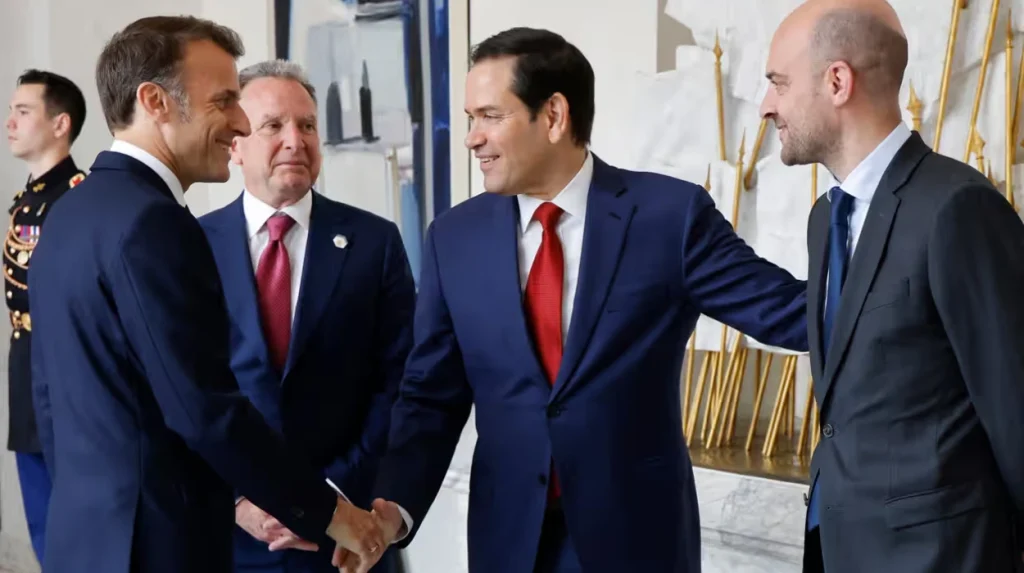
On Thursday, the high-level meeting was led by French President Emmanuel Macron and included US Secretary of State Marco Rubio, US representative Steve Witkoff, UK Foreign Secretary David Lammy, representatives from Germany, and Ukrainian ministers.
Negotiations centered on the establishment of a unified diplomatic effort to bring an end to a war now in its third year. France was pleased to see European powers included and emphasized unity. “Today in Paris, we initiated a positive process with the Europeans at the table,” according to the French presidency.
The second round of negotiations will come next week in London, but with the same main players: the US, France, Britain, Germany and Ukraine. The negotiations came on the heels of President Donald Trump‘s own peacemaking efforts being knocked off course by Russia’s President Vladimir Putin continued refusal to grant a full ceasefire.
A day after the Paris gathering, Rubio had a phone conversation with Russian Foreign Minister Sergei Lavrov, reaffirming Washington’s determination to achieve a lasting peace.
“President Trump and the United States desire this war to end,”
Rubio said.
“The positive reaction to our framework in Paris indicates that peace can be achieved – if everybody is sincere.”
Moscow, meanwhile, showed guarded optimism. Lavrov reaffirmed Russia’s willingness to keep talking, and both sides committed to keeping fast channels of communication open before the London talks.
A place for Europe at the table
Ukrainian President Volodymyr Zelensky, who has had a public fight with Trump over the course of US diplomacy, embraced the role of European powers. His top aide, Andriy Yermak, publicly thanked Macron for “his efforts in securing a just and lasting peace”.
French Foreign Minister Jean-Noël Barrot highlighted the importance of the summit: “For the first time, American, Ukrainian, and European leaders sat around the same table. Europe must be part of the solution”. Barrot added later that Washington now realizes that stable peace cannot be obtained without the active participation of Europe.
Not all were so optimistic, though. The Kremlin’s spokesman Dmitry Peskov downplayed the Paris summit, saying it was just another appeal to extend the war.
In the meantime, there are fears about the trajectory of US foreign policy following Trump’s unilateral talks with Putin created alarm among allies.
New strikes highlight urgency
While diplomats were talking about peace, violence goes on in Ukraine.
Russian overnight attacks killed two and injured dozens in Sumy and Kharkiv, underlining the need for rapid progress.
Tensions ran high recently when Zelensky accused US envoy Witkoff of parroting Russian propaganda, particularly on occupied Ukrainian lands. “It’s dangerous,” Zelensky said, warning that Witkoff’s statements threatened to legitimize Moscow’s position.
Putin still refuses to give in, having spurned a complete ceasefire last month and floated the notion of overthrowing Zelensky – something that elicited an acrid denunciation from Trump, who dismissed the idea as “deeply unacceptable”. Meanwhile, in the US capital, French Defence Minister Sébastien Lecornu visited US Defence Secretary Pete Hegseth, urging France to increase its military input to Europe’s defence.