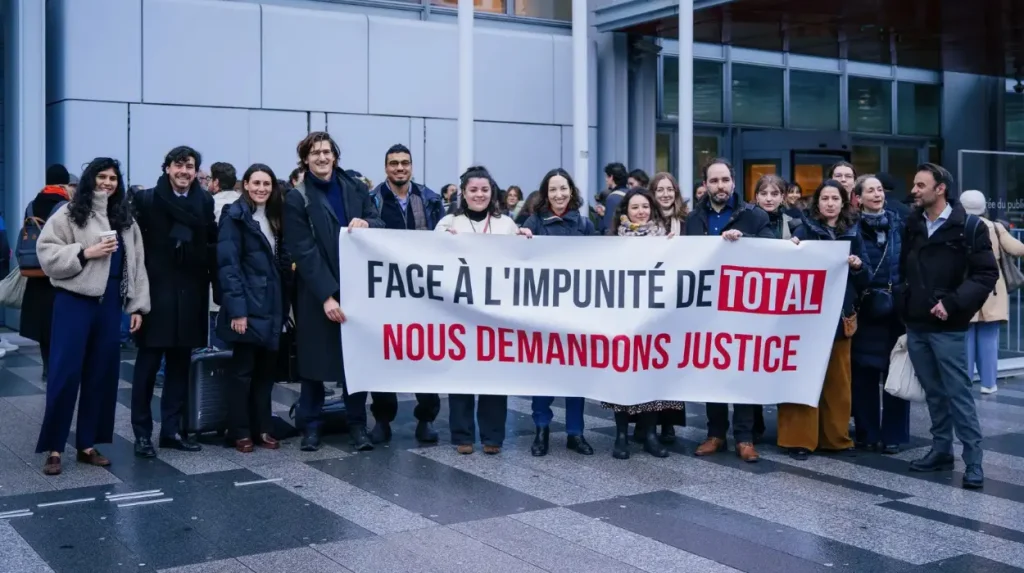
The Paris Court case is the first climate lawsuit in France which aims at imposing direct production restrictions on a large oil and gas company. The lawsuit, submitted in 2020 by the City of Paris, several local authorities, and various environmental NGOs, such as Notre Affaire a Tous, opposes the production course of TotalEnergies based on the duty of vigilance doctrine in France. The plaintiffs consider the corporate expansion plans to be incompatible with 1.5°C of global warming.
The legal justification is based mostly on the 2017 law of duty of vigilance and the clauses of the civil code that deal with imminent environmental damage. In contrast to the previous cases that dealt with advertising or disclosure activities, this case aims at structural modifications to fossil fuel production. It will be one of the most impactful climate decisions in Europe as a ruling is expected in the coming months.
Duty of Vigilance and Corporate Responsibility
The law of duty of vigilance obliges large firms to determine and remove the risks associated with their operations and supply chains. Plaintiffs claim that climate change is a foreseeable and preventable harm that is within this obligation. They argue that further growth contradicts legal obligations by connecting corporate production quantities with the world carbon quotas.
The court will then have to consider whether or not the production decisions can be limited by law in case they lead to systemic environmental risk. This meaning might increase vigilance responsibilities beyond procedural supervision to substantive limits of operations.
Scientific Evidence and Carbon Budget Constraints
Scientific evidence has been a major focus in the case, with climate scientists citing carbon budget models which align with the Inter-governmental Panel on Climate Change pathways. The focus of the argument is the remaining global emission quota that can be used in conjunction with the 1.5°C stabilization. According to the plaintiffs, a number of the scheduled projects would take a disproportionate portion of this remaining budget.
This framing changes the discussion of the preference of corporate policy to measurable planetary limits. The evaluation of the court can depend on the extent to which the national law can be able to incorporate global climate science into enforceable production constraints.
TotalEnergies’ Strategy and Expansion Plans
TotalEnergies asserts that its transition plan is an equaliser between the present energy needs and decarbonization in the long-term. The executives of the firm have claimed that limiting production will not curb the consumption of oil and gas in the world, as they highlighted that the market will only move the supply to other places. Lawyers reported in a court that it would be both economically and legally incoherent to stop the manufacture of fuels which are still used in the global energy system.
The company invests a huge proportion of its capital in hydrocarbons, but at the same time, it is increasing renewable energy resources. Critics claim that the rate at which fossils are growing will compromise its net-zero goal by the middle of the century. The conflict reflects the incompatibilities between incrementalist transition policies and radical emissions cutting policies.
Scope 3 Emissions and Market Demand
The main aspect of the lawsuit is related to the Scope 3 emissions that make up the largest part of the overall footprint of TotalEnergies. The emissions are caused by the ultimate consumption of the sold products but not of the actual operation of the operation. According to the plaintiffs, the disregard of the effects of Scope 3 would make climate commitments incomplete.
TotalEnergies responds that they shift the blame to the consumption to end users and policymakers. The legal issue is, should the duty of vigilance apply to downstream effects of climate as a result of selling products?
Expansion Projects Under Judicial Scrutiny
The plaintiffs cite several in-progress or proposed projects which they allege are not in line with 1.5°C pathways. These are liquefied natural gas infrastructure and offshore exploration projects. The argument continues by stating that additional investment in new fossil resources entraps decades of emissions.
Provided that the court accepts this argument, it might lead to the suspension or redesign of some of the projects. That would be the first step in a serious change in climate litigation, which has been concerned more with disclosure and advertising practices.
Greenwashing Precedent and Litigation Momentum
This legal case comes after previous legal cases in France dealing with climate communications. A Paris court in an interesting move in 2025 decided that TotalEnergies had defrauded consumers about its carbon neutrality advertising, requiring corrections and financial fines. Although narrow in its scope, that ruling strengthened judicial eagerness to evaluate corporate climate representations.
The lawsuit as it is now mails the responsibility of messaging to the production. According to the legal observers, availability of the changing climate jurisprudence in Europe is manifested in the shift of advertising controversies to output restrictions.
Subnational Plaintiffs and Standing
City officials claim that the effects of climate have a direct effect on city infrastructure, city budgets and resilience. Their standard arguments include flood risks, heatwaves and coastal adaptation expenses. They want to show personal interest in restraining corporate emissions by incurring local damages.
This subnational approach is in line with wider European tendencies in climate litigation. The local governments are ever applying local legal instruments in order to impact the global energy producers.
European Context and Comparative Cases
In other countries of Europe as well, cases have been heard in court challenging corporate climate strategies, such as cases involving large energy companies. All these cases pose the question of whether national courts are able to render international climate agreements enforceable obligations on corporations.
The case of Paris is unique since it directly sought production cuts in line with carbon budget calculations. The result of its performance may impact on litigation policies in the continent.
Economic, Market, and Policy Implications
The possible consequences are not limited to the court. Climate litigation is a risk that the financial markets are keen on because unfavorable decisions may have an impact on the value of assets and long-term investment planning. Increased pressure on energy companies may be imposed on institutional investors assessing the exposure to transition risks.
A move to force production reduction would change the approaches to capital allocation in the energy industry. It can also impact the balance of fossil revenues and renewable investments of companies.
Corporate Transition Models Under Review
TotalEnergies has positioned its strategy as a model of energy transition based on a combination of hydrocarbon cash flow and renewable growth. The firm believes that a gradual transition is one that does not create energy shortages and price shocks. Plaintiffs respond that climate thresholds need quicker structural changes.
The court is forced to balance corporate discretion against the statutory environmental requirements. This equilibrium can inform the further interpretation of the provisions of the vigilance law.
Broader Climate Governance Impact
An order that supports required cuts would bolster juridical contention in additional territories. It can also be used to influence policymakers to clear up the role of courts in implementing climate targets. On the other hand, a dismissal might strengthen the lines between the climate policy in the legislature and the judiciaries.
The ruling will probably influence debate on the interaction between and among national and international climate commitments. It can also guide future changes in corporate accountability models.
Strategic Significance for Energy and Climate Policy
This case arrives at a moment of heightened global climate scrutiny. Governments continue to implement regulatory instruments aimed at achieving long-term emissions reductions, while energy security concerns remain significant. The Paris court’s interpretation will signal how far domestic legal systems can go in aligning corporate behavior with global temperature goals.
If the court orders production reductions, it could establish a precedent for integrating carbon budget science into binding corporate obligations. Such a development would represent a structural shift in climate accountability.
As the ruling approaches, attention focuses not only on the legal reasoning but also on the broader implications for energy transition models. The outcome will test whether vigilance law can serve as a mechanism for enforcing alignment with 1.5°C pathways, or whether courts will defer to corporate transition strategies within existing regulatory boundaries. The decision may ultimately redefine how production, responsibility, and climate science intersect within national legal systems, setting a benchmark for future litigation across Europe and beyond.