Recently the judo matches between Israel and Palestine were held. These matches were more than a competition as both teams were influenced by the continued Gaza war. According to a recent report no side won the match and both teams lost their matches badly. But their matches explore the personal situation and emotions deeply. For the organizers, achieving an Olympic truce amid ten months of conflict between Israel and Hamas in Gaza has been a tough challenge.
One of the Palestine athletes, Feras Badawi lost his fight and raised his frustrated voice. He felt that the Olympic ideals of peace clash with the ongoing violence in his country. His comments reflect the broader struggle of maintaining the Olympic spirit when real-world conflicts continue to affect the lives of athletes and the Games themselves.
It is very troubling to see that the Gaza war badly affected the Olympic games. This ongoing conflict also affected the athletes capability to win the match. Recently a Palestine player refused to play with an Israeli opponent. He also refused to shake hands with the person that belongs to the nation who kills many Palestinians. He claimed that still 39,000 Palestinian lives have still been lost since the recent escalation. The Olympic games are badly affected by this personal conflict. Additionally, this personal conflict highlights the tension between the Olympic ideals and the harsh realities of war.
On the other side of the picture, Israeli judoka Gili Sharir, also faced tough questions from the broad political situation. She was the one who lost to French champion Clarisse Agbegnenou. She felt proud despite her defeat, as Sharir belonged to Israel and was also wearing the national flag. Recent reports suggest that many casualties attributed to Palestinian forces might have been caused by the Israeli military, adding to the complexity of the situation. This shows how athletes are caught between national pride and the broader political conflicts surrounding them.
It is really sad to know that politics affect the spirit of sports. Many players expressed their frustration about not being able to shake hands with opponents just because of political tensions. Israeli judoka Gili Sharir also wished that it is good for athletes to focus on the competition rather than the political landscape. This complexity was also pointed out when an Algerian judoka was disqualified from a match with an Israeli, showing how the ongoing conflict is affecting the Games.
Before the Olympics, the Israeli actions spread tensions and worries across the world. But during the Olympics these tensions are more severe as compared to expectations. Many players belonging to different nations support Palestine and criticize the Israeli actions.
Additionally, there have been disturbing incidents, like hostile chants at soccer matches and threats against Israeli athletes, reminiscent of the tragic events of the 1972 Munich Games. These issues remind us how deeply global conflicts can impact the world of sports.
Furthermore, during the opening ceremony an athlete from Palestine wore a jacket having a political symbol on it. Also this sign criticizes the Israeli actions during the Gaza war. However, officials argues that wearing this types of clothes violated the Olympics rule
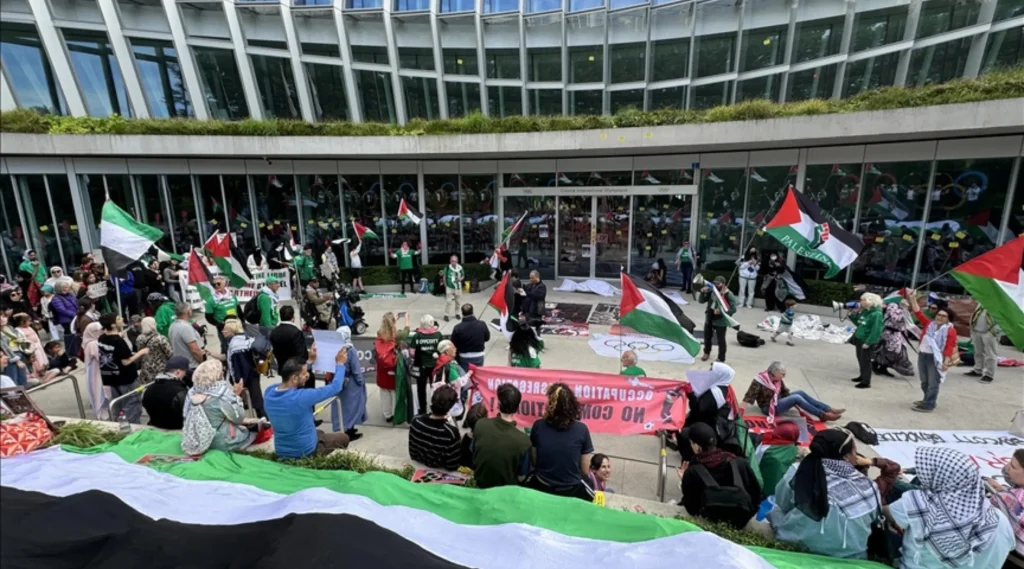
The Palestinian Olympic Committee (POC) has been pushing for action against Israel, comparing their request for Israel’s suspension to Russia’s suspension over its actions in Ukraine.
Jibril Rajoub, head of the POC and a former Israeli prisoner, criticized the International Olympic Committee (IOC) for not addressing his concerns and for ignoring its own rules. Rajoub also accused some Israeli athletes, including judoka Peter Paltchik, of promoting the conflict on social media. This situation shows how political conflicts can deeply affect the Olympics, distracting from the intended spirit of international unity and athletic competition.
Rajoub told the reporter, “ “Is he qualified in such a global, international, peaceful, humanitarian event to raise a flag?” “They should raise a red card to Israel.”
The Israeli embassy in Paris said Rajoub’s accusations were just a “smear campaign” meant to “hurt him with lies.”
But after some time, the Israeli officials announced that Rajoub is a convicted terrorist.