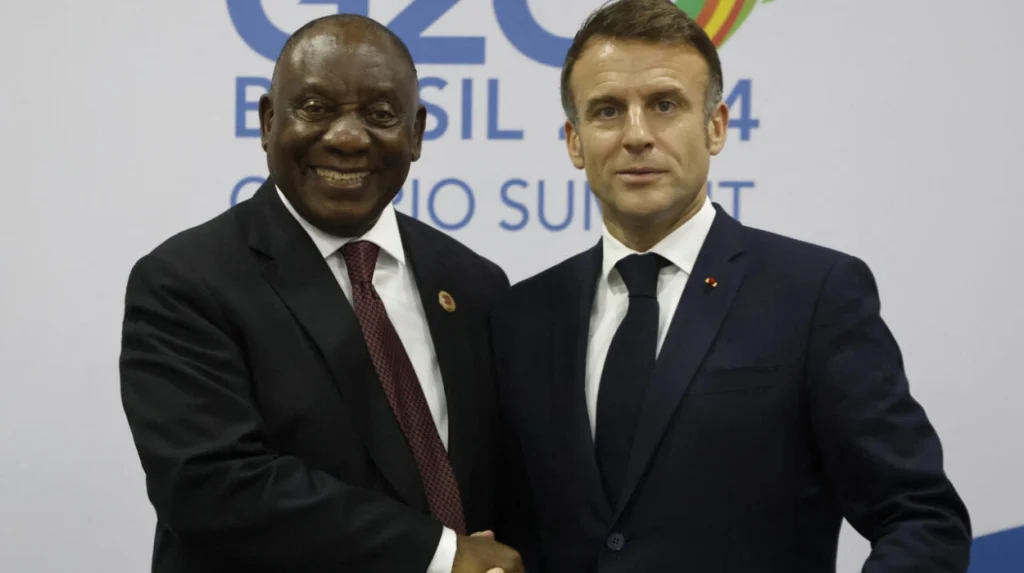
In August 2025 French President Emmanuel Macron and South African President Cyril Ramaphosa ramped up to an elevated diplomatic coordination due to the ongoing war in Ukraine. Their enhanced activity signifies the evolving system of conflict mediation which lies within their different but complementary international roles. France, as a permanent member of the UN Security Council, with historic powers in the West, is also a core institutionally and historically influential state. South Africa, in its turn, is not only a powerful voice of the Global South that possesses a moral authority in relation to international law and to post-colonial justice.
This bilateral cooperation will act on the renewed role of Ramaphosa as a liaison between both Ukraine and Russia; a role that has been facilitated by consultations with world leaders such as former President Donald Trump in the United States. Also, Macron and Ramaphosa joined multilateral talks between Zelenskyy and Stubb of Ukraine and Finland. These rounds of diplomacy signify a panicked effort to exert pressure on matters of ceasefire talks as the battlefield casualties and the devastation of the human beings reach to intolerable levels.
The Framework Of Complementary Diplomacy
Both leaders seem in agreement that long-term peace cannot be cobbled together by decree or in one-sided partnerships. In its stead, they have a structure based on not only coordinated channels of communication involving NATO members, neutral states and non-aligned states, but also, channels of communication with other target countries. This diplomatic approach hybrid aims at overcoming the international fatigue over Ukraine coupled with the establishment of a realistic road to negotiations.
Trilateral Diplomatic Convergence
In response, Vincent Magwenya, the spokesperson to President Ramaphosa, reinstated the importance of trilateral summits involving Russia, Ukraine and the United States. Ramaphosa considers these necessary in building trust with each other. The direct conversations with Putin that he has had with Trump following encounters with Trump underline how valuable South Africa can be as a confidant. This level of access offers unique opportunities to recalibrate dialogue, especially at moments when more conventional diplomatic backchannels stagnate.
Macron’s Proactive Diplomacy And Peace Initiatives
During the 2025 year, the diplomatic style of President Macron remains characterized by the readiness to personally enter the most complicated geopolitics. Ukraine also repeats this demand and urges direct negotiations between the rulers of Russia and Ukraine, Vladimir Putin and Volodymyr Zelenskyy, to resume. In some of his latest ideas, Macron proposed Geneva as a neutral venue where such negotiations can take place, an action that underlines the republic’s plan as being a mediator and would also act as a guarantor of peace structures.
Balancing Sovereignty With Realpolitik
Macron has repeatedly stated that:
“Ukraine will make the concessions it deems just and right.”
This is because at the end of the day, peace conditions can and must be generated at the sovereign agency of Kyiv. However, at the same time, he underlines the necessity of the deal not to legitimize aggression. The espousal of this position as far as the European community is concerned is a reflection of the general European consensus that territorial conquests made due to use of force cannot be entrenched into international treaties as such could be regarded to compromise the international post-World War II security regime.
France’s Military And Humanitarian Role
France has also continued to supply Ukraine with strong military support, particularly artillery and intelligence units. Macron has associated this material assistance to legitimacy of France in acting as a peace negotiator, as France helps to ensure that Ukraine acts out of a position of strength not desperation. At the same time France has increased its humanitarian activity in the western regions of Ukraine and control points along its border with Moldova, and that too to amplify its soft power strengths in the region.
Ramaphosa’s Unique Role As A Bridge-Builder
President Ramaphosa is injecting a certain finesse and patience in the Ukraine peacemaking process, one informed by the post-apartheid experience of reconciliation in South Africa and his experience in the international non-alignment field. He has become one of the important actors capable of introducing Global South interests in negotiations, which are traditionally dominated by Euro-Atlantic interest players. Such a view is critical to a war whose second-order effects, such as disruptions to grain supply or fuel inflation, are felt far outside of Europe.
Global South Advocacy And Balanced Messaging
Neutral positions by Ramaphosa have facilitated greater regional consensus support by Latin America, Southeast Asia and African Union, regions that have all been displaying a sense of discomfort at the unilateral view that the conflict is a problem of Western security. In his latest pronouncements, Ramaphosa has been careful not to put any blame on anyone and clearly urged the conflict to end as well as a respect to the sovereignty of Ukraine. He worded his statements in such a way that would retain diplomatic accessibility on all parts- a good attribute in such a divided international scenario.
Reception In Kyiv And Moscow
Ukrainian president Zelenskyy has publicly encouraged more mediation by the Global South, including South Africa. The Ukrainian government considers such intervention their opportunity to extend global pressure to Moscow, especially by those countries, which are not directly affiliated to NATO. At the same time, his previous connections with Russian officials are based on economic ties, BRICS cooperation, which makes him a likely combination of partners who might obtain the promises on the behalf of the Kremlin that might be hard to achieve with the support of NATO-aligned diplomacy.
Shared Challenges And Prospects In Peacebuilding
With all the diplomatic progress, the challenges that a peace agreement faces are formidable. As of 2025, Russian troops still hold control of extensive areas in the eastern parts of Ukraine and no side is showing signs of willingness to enter into a permanent ceasefire. Macron has said repeatedly that Putin feels the acute desire not to show weakness and Ramaphosa has admitted that timing is everything. In the absence of substantive changes in battlefield realities, each leader is restricted in the capacity to move on with negotiations.
Domestic Constraints And Strategic Calculations
Macron and Ramaphosa are working in the context of political environments that influence their freedom of diplomatic action. Macron has to deal with a split National Assembly and is under pressure, as well as, appeasement by European doubters. Ramaphosa, as South Africa prepares to have a general election in 2026, needs to strike the right balance between his global ambitions and the political move of the opposition party to criticize his overseas actions.
Macron And Ramaphosa Shaping A Multilateral Future For Peace
The joint engagement of Macron and Ramaphosa marks a significant step toward redefining global peacebuilding. Their efforts represent a convergence of old and new power structures: traditional Western influence and Global South moral leadership. This dual-track diplomacy may prove essential in avoiding diplomatic fatigue, particularly at a time when international consensus around Ukraine remains fragile.
Their actions in 2025—through bilateral summits, mediation proposals, and strategic alignment—illustrate a sophisticated blend of pragmatism and principle. Macron provides the institutional heft and European anchoring, while Ramaphosa offers access to alternative diplomatic arenas and regional legitimacy often lacking in traditional negotiations.
As the war in Ukraine persists, new peace efforts must evolve beyond historical patterns. Macron and Ramaphosa’s collaboration may serve as a blueprint for future multilateral crisis management, offering a more representative and effective path toward conflict resolution in an increasingly divided world.