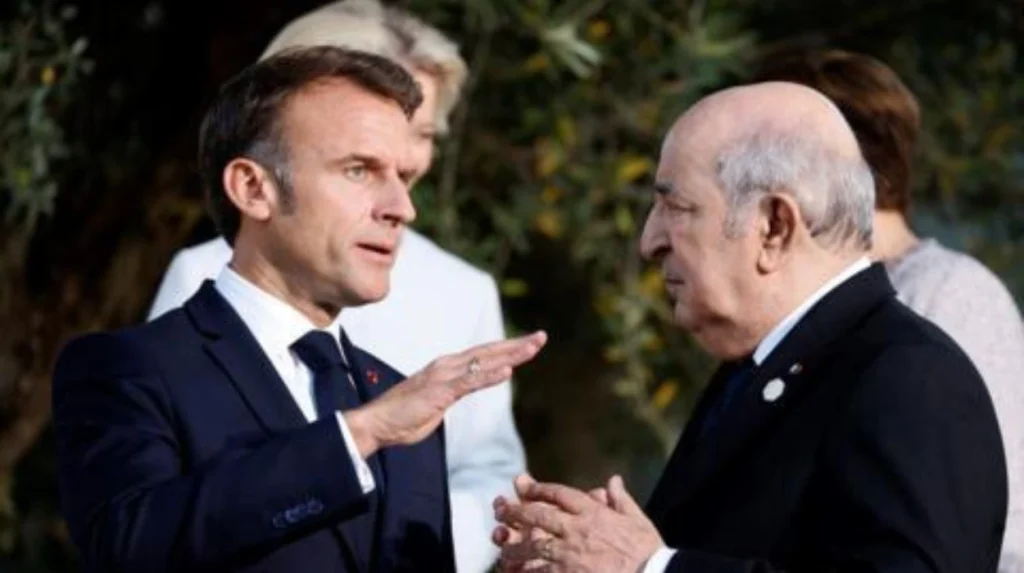
France’s Emmanuel Macron held his first phone call in months with Algerian leader Abdelmadjid Tebboune to resolve a diplomatic deadlock caused by Algeria’s reluctance to accept its expelled citizens back as nationals, the imprisonment of French-Algerian author Boualem Sansal, and suspended security relations.
The exchange marked a potential historic moment, with both leaders examining a reset of ties. Macron followed up by speaking with key ministers. Foreign Minister Jean-Noël Barrot will arrive in Algiers on April 6, and Justice Minister Gérald Darmanin is also expected to visit shortly afterward.
The Algerian leader had previously stated he wished to evade political turmoil in connection. Since January, Macron has dispatched envoys from the Élysée to Algiers on three occasions to discreetly reignite dialogue. According to a diplomatic source, it was the latest visit, which occurred just a few days ago, that prompted the recent call.
Renewed dialogue
According to experts, the phone call focused on rebuilding relations, with a mutual passion for outcomes, especially on migration. A first concrete action is a discussion between France’s regional administrators and Algeria’s 18 consuls based in France. The Macron government said this was planned to “quickly restore more fluid migration cooperation”.
Those discussions are expected to concentrate on implementing the 1994 bilateral accord, which notes that Algeria must assume the return of its nationals who are subject to deportation orders. Interior Minister Bruno Retailleau expressed optimism during a public meeting in Maisons-Alfort, near Paris. He stated that he had “for the first time good hope” that Algeria would implement the agreement “strictly”. He noted that the accord requires Algeria to accept the return of Algerian nationals whom France intends to deport. Furthermore, Retailleau suggested that Sansal might “return” to France.
A careful transition
The diplomatic situation had deteriorated steadily since late last year. Algeria’s unwillingness to receive its own nationals and the Sansal case contributed to strains, while French officials pushed for more stringent enforcement of migration deals. Macron’s determination to follow quiet diplomacy indicates a clear change in strategy. While Retailleau had preferred a public, pressure-driven system, Macron is now choosing to operate behind the scenes negotiation.
This shift in tone was positively received in Algiers. President Tebboune emphasized that his priority is “avoiding political turmoil, ” and both governments seem to be responding to this sentiment. Additionally, security cooperation is anticipated to resume. Paris aims to rekindle intelligence-sharing with Algerian services, especially concerning terrorism in West Africa.
In the meantime, Boualem Sansal’s situation continues to be unresolved. His detention stands as a symbol of the wider deterioration in relations. Analysts suggest that Macron is looking for a sign from Tebboune – perhaps a pardon – indicating Algeria’s readiness to progress.