In June 2025, the European Court of Human Rights (ECHR) passed a landmark decision to rebuke France over racial profiling between its police. This is the first instance that the ECHR has ever declined a case involving France and this has raised waves in the French society and the European community at large. Not only does the judgment lay bare the injustices to individuals but it also lays bare problems with the system of French policing overall and the urgency of such change. The ruling follows a fresh wave of questioning about how law enforcement agencies operate and demands by rights groups and the victims to have structural reform.
The Case That Changed the Conversation
The Story of Karim Touil
At the core of the ECHR decision is Karim Touil, a French-African national who was stopped by police on three occasions within a span of ten days in Besançon in 2011. The French government could not offer “objective and reasonable justification” for the repeated stops. The court concluded that Touil had suffered “presumed discriminatory treatment,” which the state could not dismiss.
Touil’s attorney is not alone in his experience. Touil was one of six men who took the case to Strasbourg, all reporting unjustified stop-and-searches and disrespectful treatment. Even though the ECHR was unable to establish discrimination in four of the five other plaintiffs’ cases, the court awarded Touil €3,000 in damages for violating Article 14 (prohibition of discrimination) and Article 8 (right to respect for private life) of the European Convention on Human Rights.
The Court’s Reasoning
The ECHR recognized the “dilemmas for police officers to determine, very rapidly and not necessarily having clear internal guidelines, whether they are confronted with a threat to public order or security.” Yet in Touil’s case, the lack of clear explanation and the practice of repeated stops meant that the court assumed discrimination.
The judgment did not identify a “structural failure” in France’s legal and administrative system for identity checks but identified the absence of clear internal instructions to officers. This subtlety matters because it puts the state under pressure to ensure police practice is not only legal but fair and non-discriminatory.
Statistics and the Scale of the Problem
Disproportionate Impact on Minorities
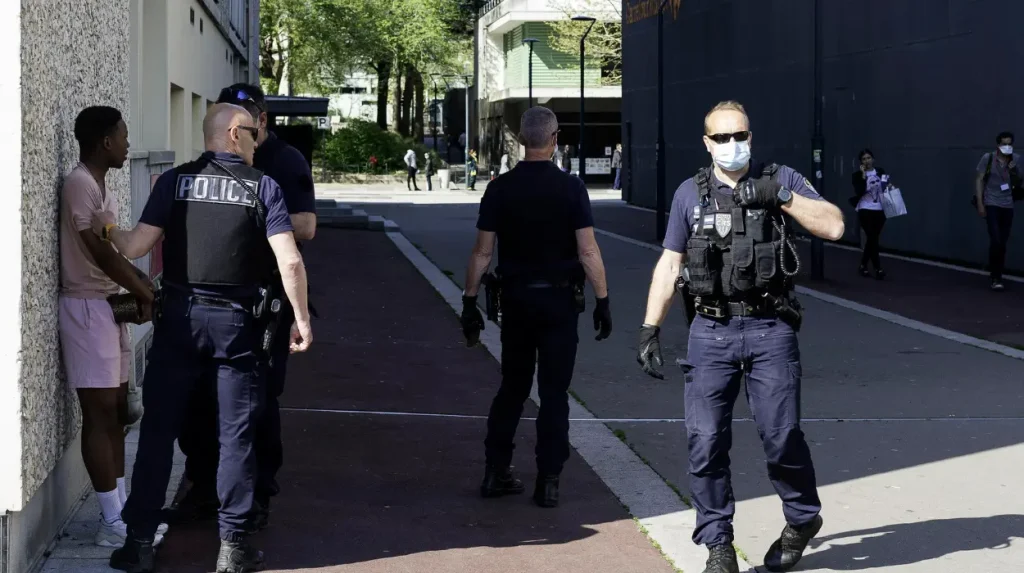
The problem is so deep that data working in France as the rights ombudsman and rights watchdogs can reveal. According to a 2017 report the perceived black and Arabs have been up to 20% more likely to face identity checks compared to ones in the general population because of young people. According to a June 2025 report, young Black men or those who were thought to be Arab or North African were twelve times more likely to undergo extensive checks, such as body searches or police station transfers, and four times more likely to be stopped.
These numbers are not statistics—they represent the lived reality of discrimination and the breakdown of relations between police and minority groups. Rights organizations like Human Rights Watch and Amnesty International have long painted racial profiling of French police as “widespread across the country and ingrained in police culture.” HRW has reported instances of boys as young as ten being subjected to “abusive and illegal identity checks.”.
Recent Developments in 2025
The ECHR decision coincides with a report released by France rights ombudswoman a few days ago that identity checks are on the rise between 2016 and 2024. The results of the watchdog only support their argument that the problem is not fading, but rather escalating especially in poorer neighbourhoods where there is high representation of the visible minorities.
Stakeholder Reactions
Voices from the Legal and Advocacy Community
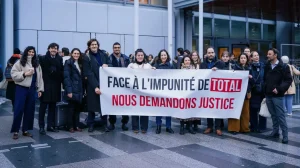
Slim Ben Achour, attorney for the six plaintiffs, described the decision as a “victory,” highlighting that “the French state must take responsibility and change the way it conducts identity checks.”. Lanna Hollo, a RECLAIM rights campaigner on the case for more than a decade, was pleased at the ruling but cautioned, “It does not adequately protect all individuals in all regions of the territory—particularly those residing in France’s lower-income neighborhoods with higher visible minority concentrations.” Hollo was worried that the court’s analysis threatens to re-entrench discrimination in some regions.
Human Rights Organizations
The ECHR decision coincides with a report released by France rights ombudswoman a few days ago that identity checks are on the rise between 2016 and 2024. The results of the watchdog only support their argument that the problem is not fading, but rather escalating especially in poorer neighbourhoods where there is high representation of the visible minorities.
Government and Police Response
The condemnation by the ECHR has been hailed by the human Rights watch and Amnesty International, who have since reiterated that racial profiling is rampant and systematic in France. They have even passed their grievance to the United Nations so have lodged their complaints at the Committee on the Elimination of Racial Discrimination.
When the French government defended the position, it was based on the fact that police struggle to come up with quick decisions without guidance especially when it comes to the issue of community safety. But the failure of the government to explain the series of stopovers in the case of Touil was decisional. The ruling by the court is likely to influence the way police operate, training their officers, however authorities have remained guarded in their remarks yet.
Political and Social Impact
National Debate on Sovereignty and Judicial Oversight
The ECHR decision has fueled controversy in France regarding national sovereignty and the authority of European courts to meddle in French internal affairs. Some analyze the ruling as “foreign judicial intervention in national policing matters,” while others view it as a necessary constraint on state power and stimulant for reform.
The ruling is expected to increase criticism of the ECHR’s control over the way European nations deal with public order and security. France is not the only country to have been so judged; in recent years, the court has made similar rulings against Germany and Switzerland in relation to discriminatory police stops.
Public Discourse and Political Voices
Manon Aubry, a leading French Member of the European Parliament, also criticized the situation in a live TV interview, saying, “This decision is a wake-up call for France. Systemic discrimination in police practice can no longer be denied. The government must take action to re-establish trust and equal treatment before the law.” Her words have struck a chord, generating public debate and demands for higher accountability.
La Cour européenne des droits de l'Homme condamne la France pour contrôle au faciès.
— Manon Aubry (@ManonAubryFr) June 26, 2025
Le racisme est systémique au sein de la police.
Retailleau en fait une politique publique en organisant des traques de sans-papiers plutôt que de refondre, du sol au plafond, l’institution. pic.twitter.com/OMsxisFWJR
The Path Forward: Reform and Accountability
Legal Precedent and International Influence
The decision of the ECHR should become a legal precedent, contributing to the struggle against the practice of discriminatory policing in France and throughout Europe. The decision makes it clear that states are required to be able to objectively and rationally justify the actions of the police, especially those actions which adversely affect the minority.
Calls for Structural Reform
Rights activists are compelled to force the French authorities to introduce structural changes such as issuing more directives on identity checks, enhancing training of the police officers and establishing firm control to check such maltreatments. The increased use of body cameras and detailed data collection on police stops in the quest to promote transparency and accountability has also been gaining backing.
The decision has also led to the debate concerning the necessity to create independent complaints bodies and more community policing. Several people feel that France will have to undergo systemic change to address the causes of racial profiling and restore the shaken trust in the marginalized people.
Broader European Context
The situation in France is one of the aspects of the European confrontation with police discrimination. The propensity of the ECHR in getting involved in cases of racial profiling also signifies the movement towards increased judicial control over law enforcement activities in the continent. It is also likely that the recent trend will not go away since more people and lobby groups hope to get justice in the international courts.
Societal Implications
Impact on Minority Communities
The decision of the ECHR gives some validation and hope of a new start to those living in the poorer parts of France and in the areas of high minority. There are however, numerous doubts on the speed and commitment of reform. Racial profiling has led to a strong sense of mistrust in the police leading in some cases to a social unrest.
What France has to do is to go past gesture politics and bring change that matters and appeals to both the law of small instances of injustice and the system which allows discrimination.
The Role of Data and Transparency
Recent researches and statements by authorities point at the role of information in unveiling and recognizing racial profiling. The arguments that young black men and those who are perceived as Arabs or North Africans are stopped or targeted by the police are now beyond doubt. Data collection and public reporting of the same shall be key towards holding the authorities to constant checks and accountability to the process.
France perseveres in its motion against discrimination facing new challenges and solutions in the fight against racial profiling by police that was frontally won under landmark ECHR ruling. Although the experience of Karim Touil is at the center of the verdict, its legal implications are much broader, involving the effects of justice, equality, and rule of law.
It is yet to be seen in the following months whether France is ready to listen to the call made by the court and put in place the hard task of reform. At this moment, the sentence itself is a strong message that the war on racial profiling is a legal and moral necessity and should be addressed not only by the government and police but also by the society.