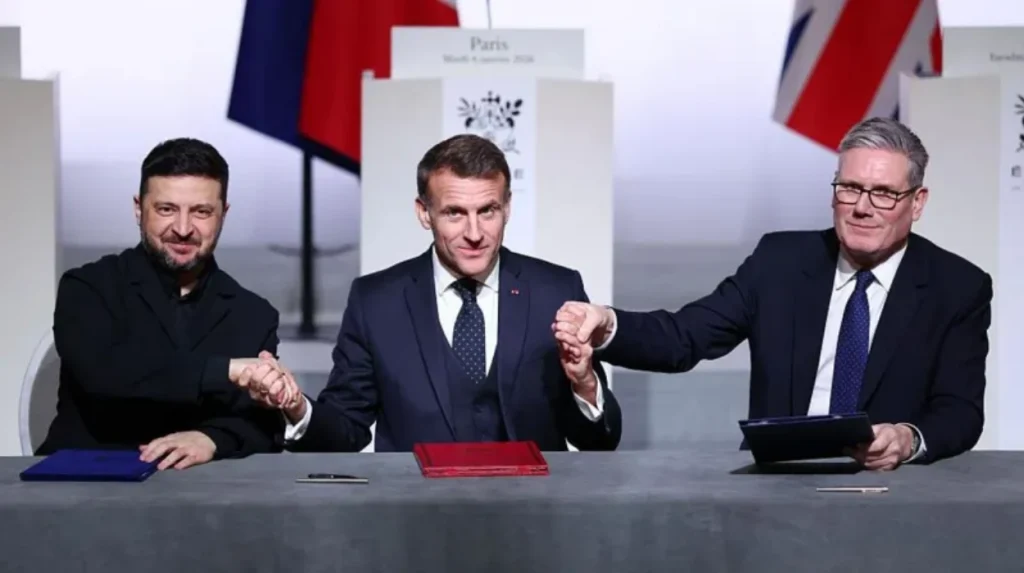
France, together with the UK, has signed an agreement on intent to send its troops to Ukraine if there is an opportunity for peace with Russia. The agreement was made known by French President Emmanuel Macron after his meeting with Ukraine’s allies. Thousands of troops from France might be included for deployment, as stated by President Emmanuel Macron, although there are no clear details yet.
La réunion de Paris acte une unité sans précédent entre la Coalition des volontaires, I'Ukraine et les États-Unis sur la dimension centrale des garanties de sécurité pour une paix juste et durable en Ukraine. pic.twitter.com/n1DxjGP0cU
— Emmanuel Macron (@EmmanuelMacron) January 6, 2026
Although the Paris summit has managed to attract a very impressive list of world leaders, including 27 heads of state, a very important question still looms: is France ready to turn rhetoric into reality?
How Concrete Are France’s Promises to Ukraine?
The declaration urges a UK-French military presence in ‘military hubs’ across Ukraine, with the stated aim of securing the country’s skies and seas, as well as reviving their military, but the French President quickly added that
“this international force would operate behind the front lines”
— suggesting the military role may lack deterrence. Moreover, by playing cautious in risky military ventures, perhaps France is counting more on promises rather than preparedness for action.
French cooperation is also contingent on a ceasefire verified by the U.S. leadership. Though it is credible to see U.S. involvement, it is a reflection of French reliance on American strategic guidance, contrary to French President Emmanuel Macron’s vision for European autonomy on the global stage.
Are France and Its Allies Ignoring the Territorial Elephant in the Room?
Territorial integrity in Ukraine has always been one of the points of controversy in the peace process. Russia already occupies about 20% of Ukrainian territory. Additionally, it has always rejected the placement of foreign soldiers on its soil. Macron and his European allies have been very vague about the terms of possible territorial adjustments in the peace agreement that Ukraine might be ready to accept.
The French delegation has been deferential to the American team on territorial issues and the enforcement of ceasefire commitments. It has been questioned whether Paris has its own weight in this process. It has been noted that the commitment of French troops could end up endorsing a framework that has been developed predominantly by Washington.
How Does France Balance Symbolism and Strategic Reality?
The rhetoric emphasizes “strong security assurances” and a commitment to Ukraine, though little detail is forthcoming. The French have not promised how many troops will be sent, either how these troops will be used. Lack of clarity, when President Vladimir Putin of Russia, a participant in this conflict, has already stated that any foreign military “is a legitimate target,” could weaken deterrence and public confidence.
One aspect of the declaration that observers point out as contradictory to France’s strategy in Ukraine is that France portrays itself as a security guarantor to Ukraine but does not want to embark on the risky course that could truly affect Russia.
Is France’s Role Overshadowed by U.S. Influence?
U.S. negotiators Steve Witkoff and Jared Kushner led the efforts in Paris in defining security strategies and providing “durable guarantees” to Ukraine. As “considerable progress” was noted by President Macron, the persistence of the U.S.-led peace framework in the proposed peace agreement indicates that the role of France is more of an aesthetic nature.
It is contended that the integrity of the Europeans is at stake since the vision for the future held by the Europeans of a strategy of “strategic autonomy” will be undermined if they fail to make a decisive stance without the leadership of the U.S. Additionally, the strategy of President Emmanuel Macron of relying on ambiguous military deployment may lead the Ukrainians into false hope since they are under attack every day by the Russians.
Can France Deliver on Its “Coalition of the Willing”?
For all the rhetorical declarations of common purpose, the summit exposed fault lines in European unity. Italy and Poland would not pledge troops for any Ukraine mission, while Germany suggested it would send forces only to neighbor states. France, along with the UK, might thereby be left bearing the biggest share of the European burden-an operational and political burden that could overstretch Paris’ resources and credibility.
Even Zelensky himself was not sanguine about the coalition and warned that in the absence of dramatic follow-through by Europe, this alliance will be a lot more symbolic than real.
What Are the Risks of France’s Calculated Caution?
Where France supplies troops behind the front line and emphasizes legal frameworks, immediate exposure to combat risk may be lessened-but so also is deterrence credibility. Russia has already made it clear that it would not tolerate foreign forces in Ukraine, while unclear rules of engagement would leave French troops with operational and political dilemmas.
In the longer run, it might please domestic constituencies wary of entanglement but give little assurance to Kyiv and less deterrence of Moscow. Analysts say that such symbolic gestures, without a more substantial underpinning, will embolden Russia, prolong the conflict, and weaken Europe’s strategic position.
Is Macron Prioritizing Diplomacy Over Deterrence?
A cautious approach is also consistent with the larger trend in the foreign policy strategy of French President Emmanuel Macron. By ensuring that the country signals commitment through diplomatic means but avoids operational risks, France can maintain a positive image on the world stage.
But the bigger question is: how can France position itself on defending Ukraine if the Kremlin presses on, and how would the European allies see the leadership provided by France if the influence of the United States still predominates on the world stage?
In the final analysis, the French intervention in the Ukraine conflict seems to walk the tightrope between the symbolism of its commitment and strategic ambivalence—anything but a recipe for success in the military realities on the ground.