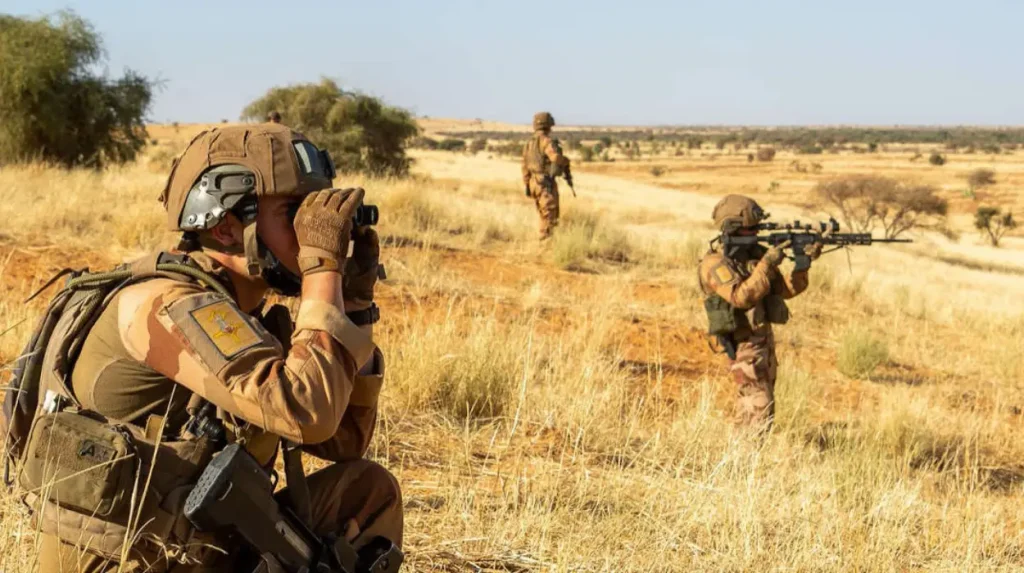
The ability of France to have military and diplomatic superiority in the Sahel region has been within the context of its post colonial approach to security aid. Serval in 2013, and Barkhane (20142022) have been ushered to counter the increase of Islamist uprisings involving thousands of French troops in Mali and adjoining countries. Both governments of these regions and parts of the population initially welcomed these missions as the responsive action to the worsening insecurity.
Nevertheless, by the year 2024, shortcomings of the French headed security framework were more pronounced. Despite tactical gains, groups like Jama’at Nasr al-Islam wal Muslimin (JNIM) and Islamic State in the Greater Sahara (ISGS) maintained or expanded influence in rural regions. The loss of life of civilians in the course of counter terrorism operations and minimal economic growth also contributed to bitterness. This undermined the legitimacy of France as the gratitude initially felt transformed into suspicion, and later on outright hostility in a great number of regions.
Military Coups And The Decline Of French Influence
In Mali, Burkina Faso, and Niger, a wave of military coups since 2020 transformed regional politics. The leadership of Mali under Colonel Assimi Goita sent away French forces indicating a distance move with the western security paradigm. Indications such as regime change were just the beginning of what should have been a more developed ideology of rejection of perceived neocolonial affiliations and conditional aid.
As French and European Union troops departed, transitional authorities courted alternative partners. The Wagner Group, operating as an informal arm of Russian foreign policy, became a prominent replacement, offering military support and political backing with fewer governance demands.
Regional Institutions Lose Ground
Another indication of strategic realignment was Mali quitting the G5 Sahel and widening separation with ECOWAS. In collaboration with Burkina Faso and Niger, Mali was part of the initiative to create Alliance of Sahelian States- a military and political group aiming to neutralize foreign impositions. All this served to highlight a more general way of disengagement with Western-centric modes of operation and toward bilateralism and multi-polar systems.
The Geopolitical Contest In The Sahel
Russia’s role in the Sahel, particularly through private military groups like Wagner and the newly surfaced Africa Corps, has grown considerably since 2022. Moscow is a seller of diplomatic aid and mining concessions as well as security and anti-colonial symbolism. This is a good mix because the military rulers will find a source of legitimacy and gain leverage without having outside pressure of reform.
Russian personnel are coming in to replace the French in providing intelligence and training services in Mali. Although these deployments have had mixed outcomes when it comes to the safety of a population, they have strengthened Russian control of both the political and security machinery.
Competing Interests From Emerging Global Actors
Outside Russia, other nations like China, the UAE, Iran and Turkey have expanded into the Sahel. These states usually want to seek interests behind the ideology, infrastructure, and natural resources so that they can give opportunities as alternatives to European models of the economy.
France and the EU are having strategic choices: how to be back into a region that now their ancient leverage has been lost, where their military presence is not necessarily greeted with automatic delight. Weakening multilateral security initiatives such as Takuba represent a bigger recoil to the partnered and rules based logistics that facilitated the role of the West in West Africa.
Domestic And Regional Implications
Non-state actors have occupied the vacuum created by withdrawal of French and UN troops in most regions. In just 2022, there were over 2,600 civilian deaths in the tri-border area of Liptako-Gourma and, according to UNHCR, displacement numbers have increased more than 200 percent compared to 2023.
The termination of the MINUSMA peacekeeping program in Mali, with the pressure of the government of Bamako, resulted in an even more weakened stance of the conflict mitigation process within institutions. Ethnic militias are even more bold and access to humanitarian corridors has been limited further exacerbating food insecurity and the lessening of medical outreach.
Reframing Sovereignty In African Political Discourse
This rhetoric of the Mali junta is getting more focused on the element of sovereign dignity, redefining any international cooperation as an intrusion. This is congruent with broader regional momentum of opposing to foreign imposed models and reasserting the national authority in the matters of security, economics, and diplomacy.
The former stable relationship between Algeria and Mali has developed a sour taste after a few months, as the two countries confront each other about securing trans-boundary security and mediation activities. With the changing alliances and priorities, this region in north Africa called the Sahel is experiencing a changing political geography affecting every aspect including migration paths and economic corridors.
Expert Insight On The Mali-France Rift
Rukiga FM, a respected analyst on West African politics, summarized the situation succinctly:
“The rift between Mali and France encapsulates broader trends of post-colonial assertion, geopolitical diversification, and the failure of Western-led security models in the Sahel.”
France says Mali’s arrest of embassy worker on coup charges ‘unfounded’.
— Rukiga F.M (@rukigafm) August 16, 2025
Arrest of Yann Vezilier, accused of trying to destabilise Mali, marks new low in relations between Paris and Bamako.
France’s Ministry for Europe and Foreign Affairs has said that a French man recently… pic.twitter.com/ozt5KkMXDw
This perspective highlights the symbolic and strategic weight of the Mali-France rupture. It’s not merely a bilateral dispute, but a representation of the Sahel’s changing identity within a fragmented global order.
Strategic Stability In A Fragmented Regional Order
The loss of French power in Mali and the arrival of non-western security interlocutors is not simply political change, but realignment on a global level as far as the Sahel is concerned. Multipolar interaction has now reshaped the region and the traditional western hegemony now has to contend with alternative new-comers offering security, investment and alignment diplomacy interests.
The process of stabilizing the region may now work with a much more complicated environment. Any practical plan must entail authoritative institutions within a country, inclusive certifications and regeneration of the economy as opposed to the external armed actions. Although foreign partnerships are still needed, their conditions are redefined by Sahelian governments with the priority being on sovereignty and self-determination.
The relative strength of state structures emanating out of such realignment will be determined by the ability of the African as well as internationally involved stakeholders to respond to emerging dynamics either in support or opposed to this realignment. The Sahel is between a cross and a future; this future is the one that will manage to transform geopolitical independence into sustainable governance and the goodwill of the global actors to assist the transition process without projecting the collectively expired frameworks.