For quite a long period, the French government and parliament have been trying to control young generations’ use of social media sites such as Instagram, Snapchat, and TikTok. The government claims that social media platforms expose children to dangerous content, lead them to addiction through their algorithms, and even contribute to mental health issues.
All these issues have now materialised into a new legislative movement as France heads towards one of the most restrictive social media environments for children within the European continent.
What does the new French bill propose?
The draft bill, which was unveiled on Wednesday, December 31, aims for a complete ban pertaining to social media usage among those under the age of 15. The bill, which is expected to be discussed at Parliament in the first part of 2026, has a scheduled opinion presentation from The Council of State, which is France’s highest consulting body on law, on January 8. The implementation of this ban is supposed to be implemented from the start of the academic year in 2026.
How would the ban be enforced?
There are only two articles in the draft bill. This will modify France’s Law on Confidence in the Digital Economy, which will make it illegal for online social networks to provide their services to people under 15 years old. This will come under the supervision of ARCOM, Regulatory Authority for Audiovisual and Digital Communication.
Has France attempted similar legislation before?
A “digital age of majority” of 15 years has been introduced by France by a law passed in 2023; however, this has never been implemented. The reason behind this is that France has been criticized for contradicting its Digital Services Act when it came into power because now the EU has primordial power over digital platforms regulation. This time around, the bill is going to be EU-friendly.
Why is France following Australia’s example?
This follows the move made by Australia to impose a ban on social media platforms among persons below the age of 16. According to a world-first move made by the Australian government, the ban came into effect in December. These platforms include Facebook, Snapchat, TikTok, and YouTube. Macron has continued to express his desire to see France move fast in the same direction.
Does the bill include other digital restrictions for students?
According to reports by Le Monde and France Info, the draft bill includes two major measures:
- a ban on social media for under-15s
- a ban on mobile phones in high schools, where students aged 15 to 18 study
Phones are already banned in French primary and middle schools. Education unions are expected to review the proposed extension of the phone ban to high schools.
What risks does the government cite to justify the ban?
The draft legislation identifies “the risks of excessive screen use by teenagers,” including exposure to inappropriate content, online bullying, sleep disruption and broader impacts on mental health. The bill says the aim is to “protect future generations” against dangers that undermine their ability to thrive and coexist in a society built on shared values.
What has Macron said about screen time and children’s health?
Earlier this month, Macron reiterated his support for a social media ban during a public debate in Saint-Malo, saying a “consensus is being shaped” internationally following Australia’s move.
“The more screen time there is, the more school achievement drops… the more screen time there is, the more mental health problems go up,”
he said.
He compared giving social media access to teenagers with putting a child in a Formula One car before they have learned to drive, saying his goal was not for them to “win the race,” but to “get out of the car” and learn safely first.
Are other countries considering similar bans?
Yes. Several countries are now exploring restrictions on social media for children following Australia’s decision.
Denmark hopes to introduce a ban in 2026, while Norway is also considering similar measures. Malaysia plans to ban social media for under-16s from 2026. In the UK, the Labour government has said “nothing is off the table,” although it insists any ban must be based on strong evidence.
How does the bill fit with EU digital regulations?
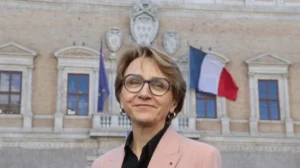
Anne Le Hénanff, France’s minister for digital development and artificial intelligence, has said the social media ban is a government priority. She told Le Parisien that the bill would be “short and compatible with European law,” particularly the Digital Services Act, which is designed to combat harmful content, misinformation and disinformation online.
Is this part of Macron’s political legacy?
This proposed ban is a part of a broader effort by Macron to define his legacy as he embarks on the most challenging year of his presidency, as he is currently faced with a divided parliament. In late December, emergency legislation was submitted and passed in order for the government to continue functioning in January as parliamentarians could not come to an agreement on a 2026 budget.
What did the parliamentary inquiry into TikTok conclude?
A French parliamentary investigation into the mental impact of using TikTok found the social media network had the equivalent impact of “slow poison” on children. Laure Miller, a centrist French politician leading the investigation, characterized TikTok as an “ocean of damaging content” fueled by algorithms ranking children’s content into damaging bubbles. This sparked rebuke by TikTok, claiming it was being blamed for societal problems.
Why are child safety concerns escalating in France?
The investigation was triggered by the fact that seven French families sued TikTok in 2024 because the social network was allegedly exposing their children to content encouraging self-harm and suicide. A report from the parliamentary inquiry suggested that social media should be banned completely for people under the age of 15, as well as the adoption of a “digital curfew” between 22.00 and 08.00 on platforms used by 15 to 18-year-old users.